$120.00
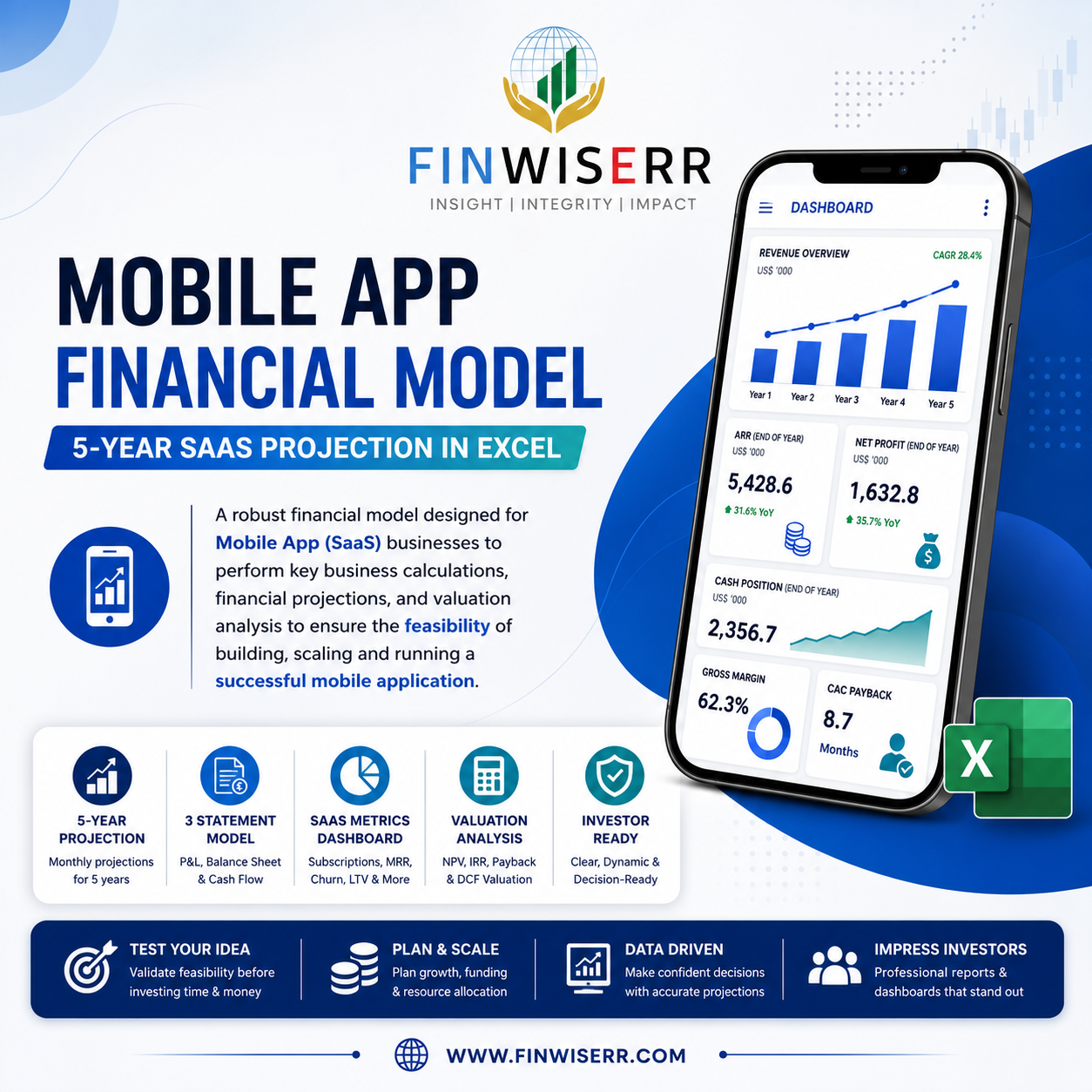
A detailed, investor-ready mobile app financial model for a subscription-and-advertising app business — with multi-store downloads, a user acquisition and retention funnel, and three parallel monetisation engines, plus an exit strategy, break-even analysis and valuation, in one integrated Excel model.
A mobile app is the purest form of a digital business, and one of the hardest to model credibly. There is no physical product and no inventory — just users you pay to acquire, a fraction you manage to retain, and the revenue you earn from those who stay. The whole enterprise turns on three ratios: what a download costs, how many users survive past the first month, and how much each active user is worth. Get those right and the model tells the truth; hand-wave them and it tells you whatever you want to hear.
This mobile app financial model puts those ratios at the centre. Downloads come from multiple app stores at a defined cost per download, a retention rate compounds them into an active base, and that base is monetised three ways at once — in-app purchases, subscriptions and advertising. App development is treated as the capitalised, amortised intangible it genuinely is, and the whole business flows through to a complete, investor-ready output set.
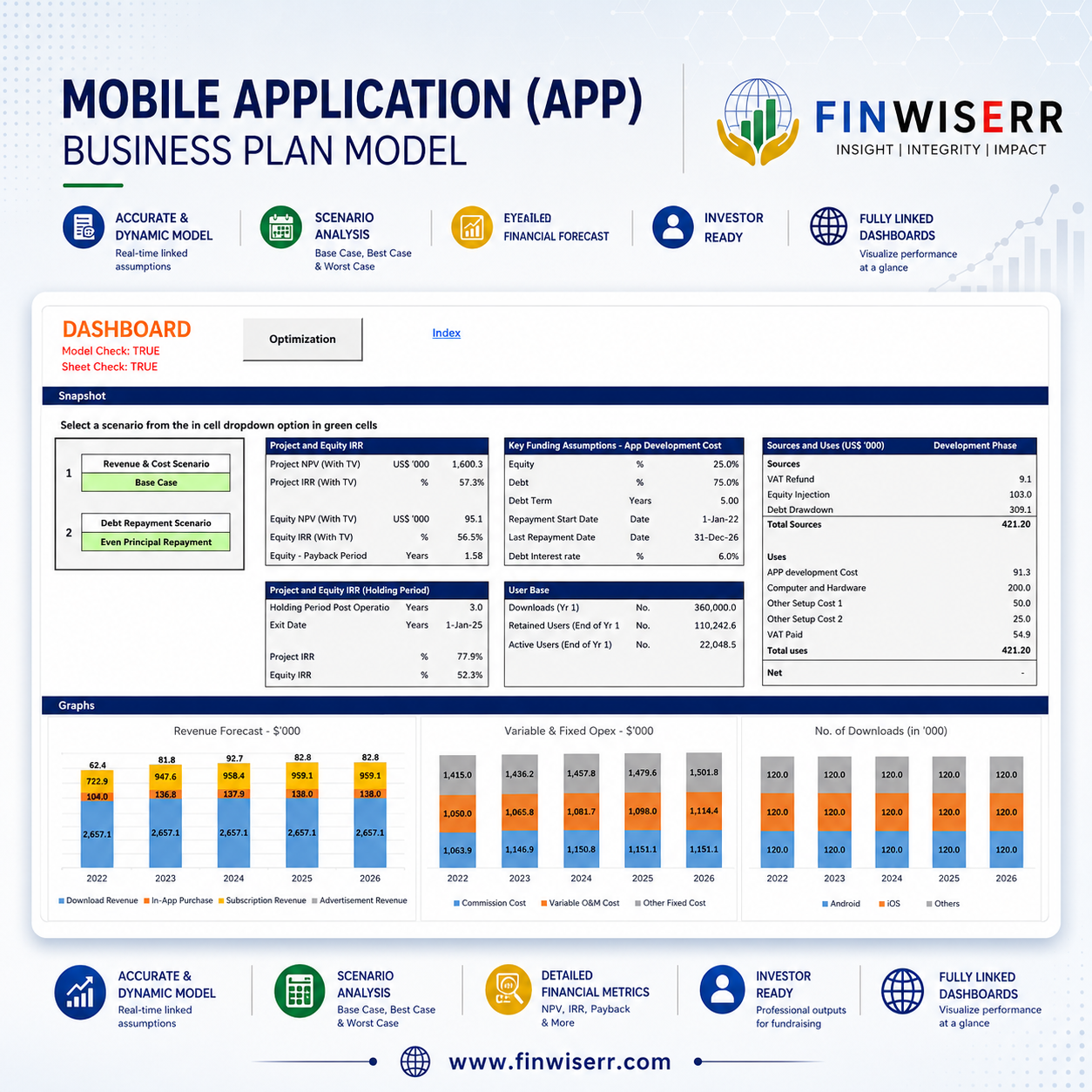
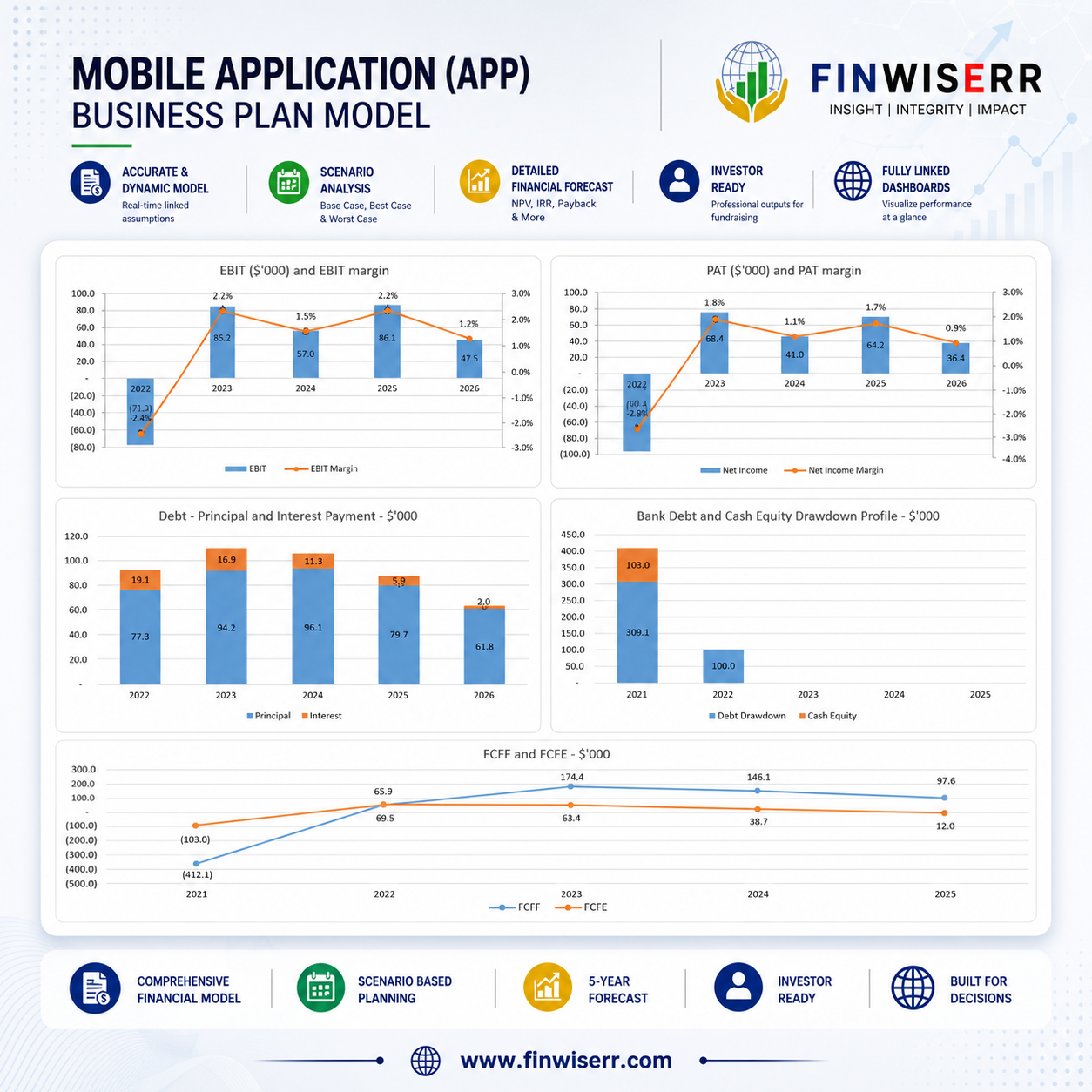
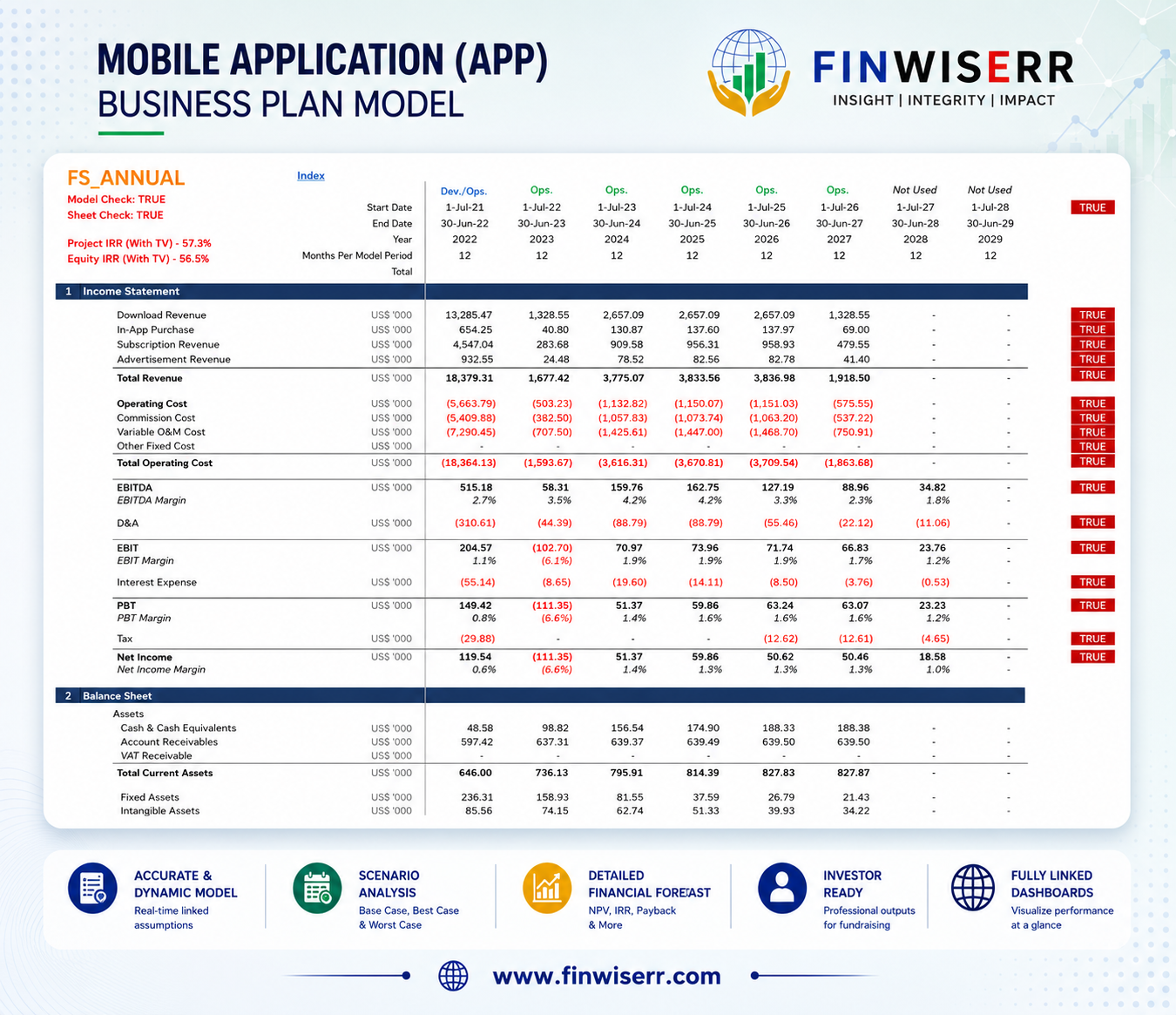
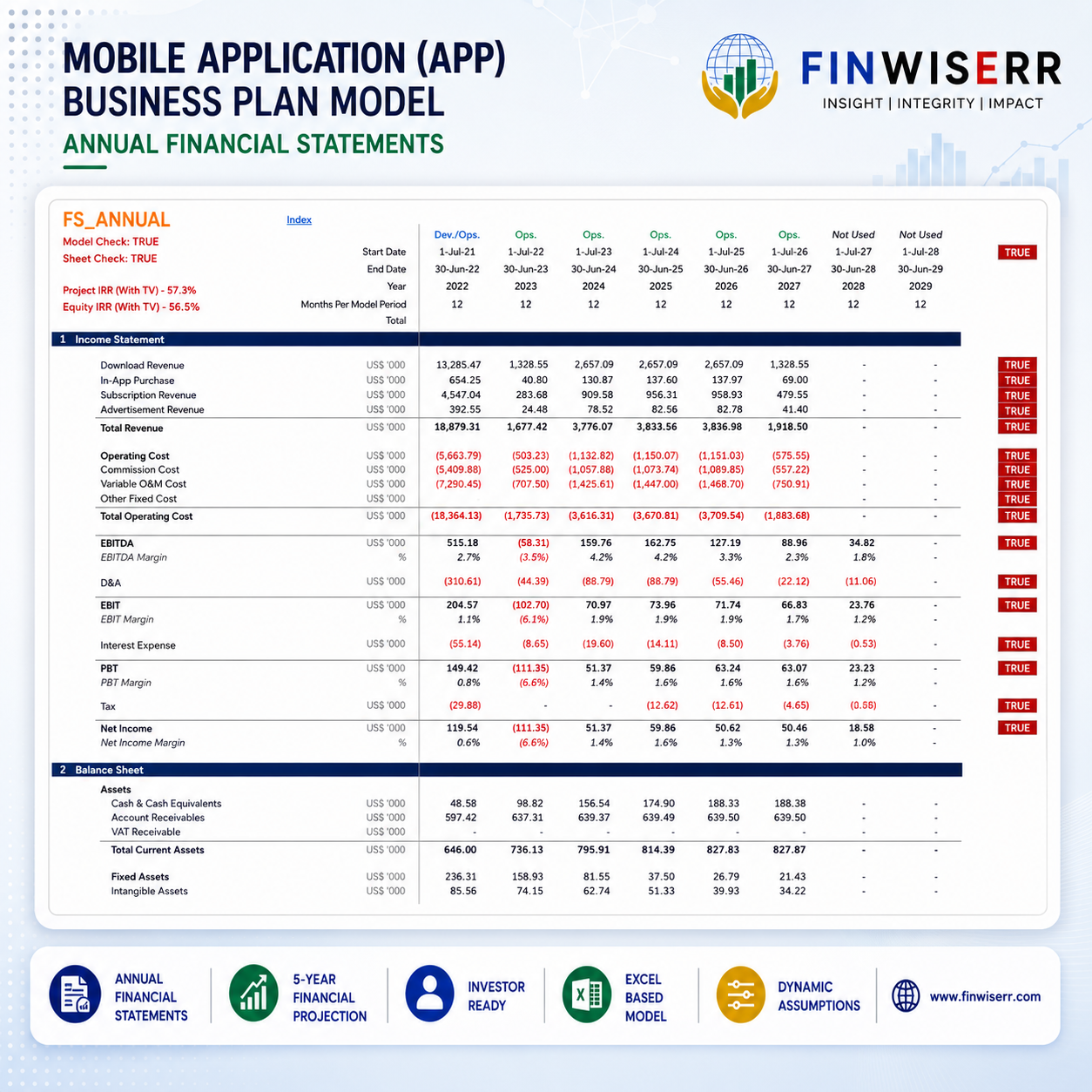
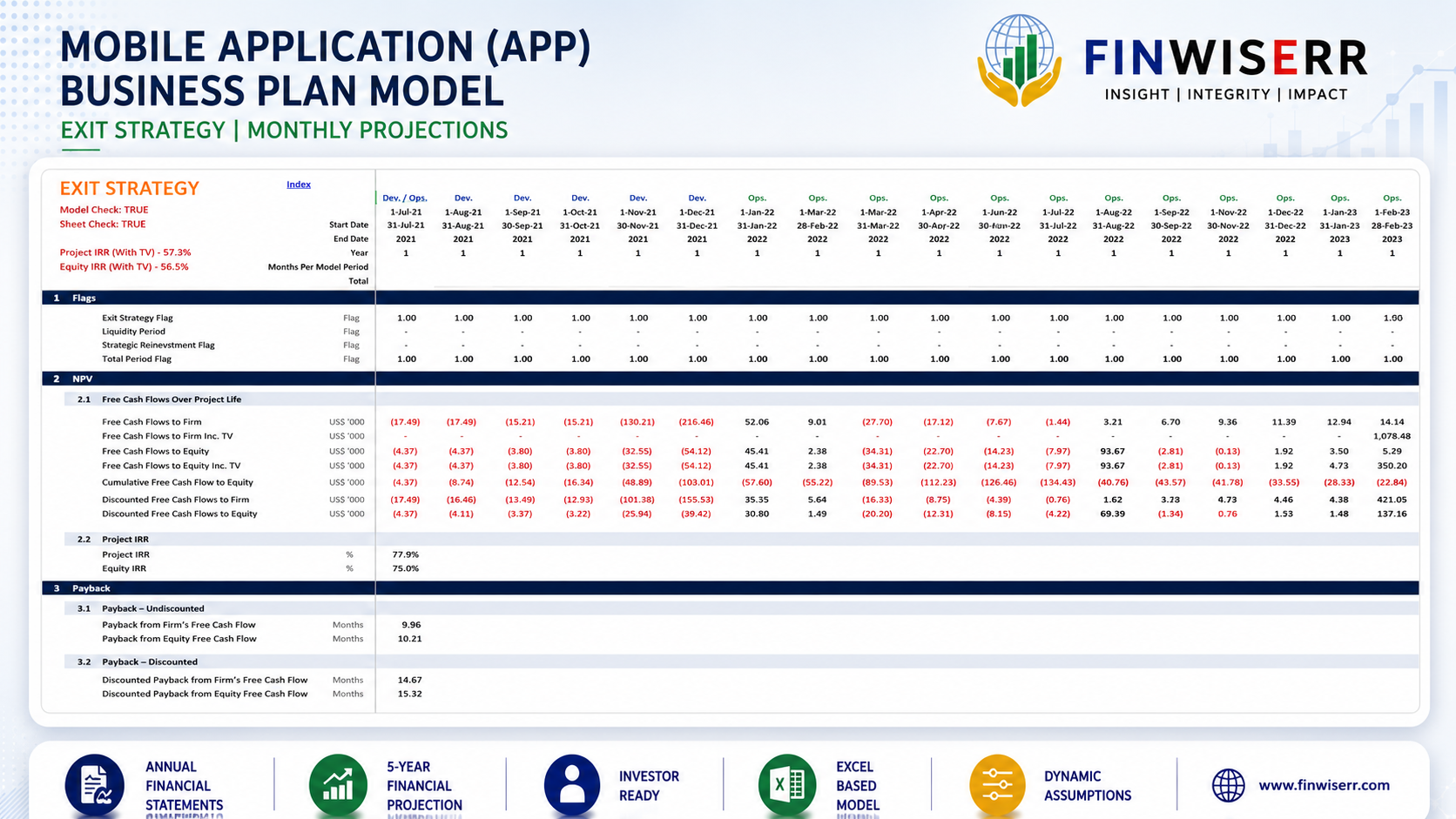
The output set is comprehensive: Project and Equity IRR and NPV (with and without terminal value), equity payback, break-even analysis, a DCF valuation, an exit strategy and a fully linked dashboard.
The model builds its user base from downloads across multiple app stores — Google Play, Apple and others — each acquired at a defined cost per download. That acquisition cost is a feature most templates omit and every real app founder obsesses over: an app that pays more to acquire a user than it earns from them is a machine for burning cash, however fast it grows.
Downloads then pass through a retention funnel — a monthly retention rate and an active-user percentage — to produce the base that actually generates revenue. Because both acquisition cost and retention are explicit, compounding inputs, you can model the single most important question in any app business: whether the lifetime value of a user exceeds what it costs to win them.
The model captures every way an app earns, running in parallel:
Modelling all three separately is what makes the model realistic. Few apps live on a single revenue type — the strongest blend a subscription base for predictability, in-app purchases for upside and advertising to monetise the free users who never pay. Being able to tune that blend, and see its effect on the valuation, is the core of app-business strategy.
Every driver of the business is an explicit, editable input. The assumptions cover:
| Downloads & Stores | Downloads per month across Google Play, Apple and other stores, at a cost per download |
| Retention | Monthly retention rate and active-user percentage |
| In-App Purchases | Share of active users making a purchase and average revenue per active user (ARPAU) per month |
| Subscriptions | Monthly, quarterly, semi-annual, annual and lifetime plans; take-up rate and split across tiers |
| Advertising | Sessions per month, minutes per session, ad impressions per minute and CPM |
| Fixed Costs | Management salary, technical and other staff, rental, office expenses, SPV cost, insurance and security |
| App Development Capex | UI/UX, native Android and iOS, backend, admin panel, DevOps and project management, amortised as an intangible |
| Financing & Exit | Debt-equity ratio, debt term, tax holiday, VAT, holding period and exit assumptions |
The primary capital outlay for an app business is the build itself, and the model treats it correctly. App development cost — across UI/UX, native Android and iOS, backend, admin panel and DevOps — is capitalised as an intangible and amortised over its useful life, with refresh capex to fund the periodic rebuild every app eventually needs. That treatment is what makes the early-year statements realistic and the valuation credible to an investor who understands how software businesses are reported.
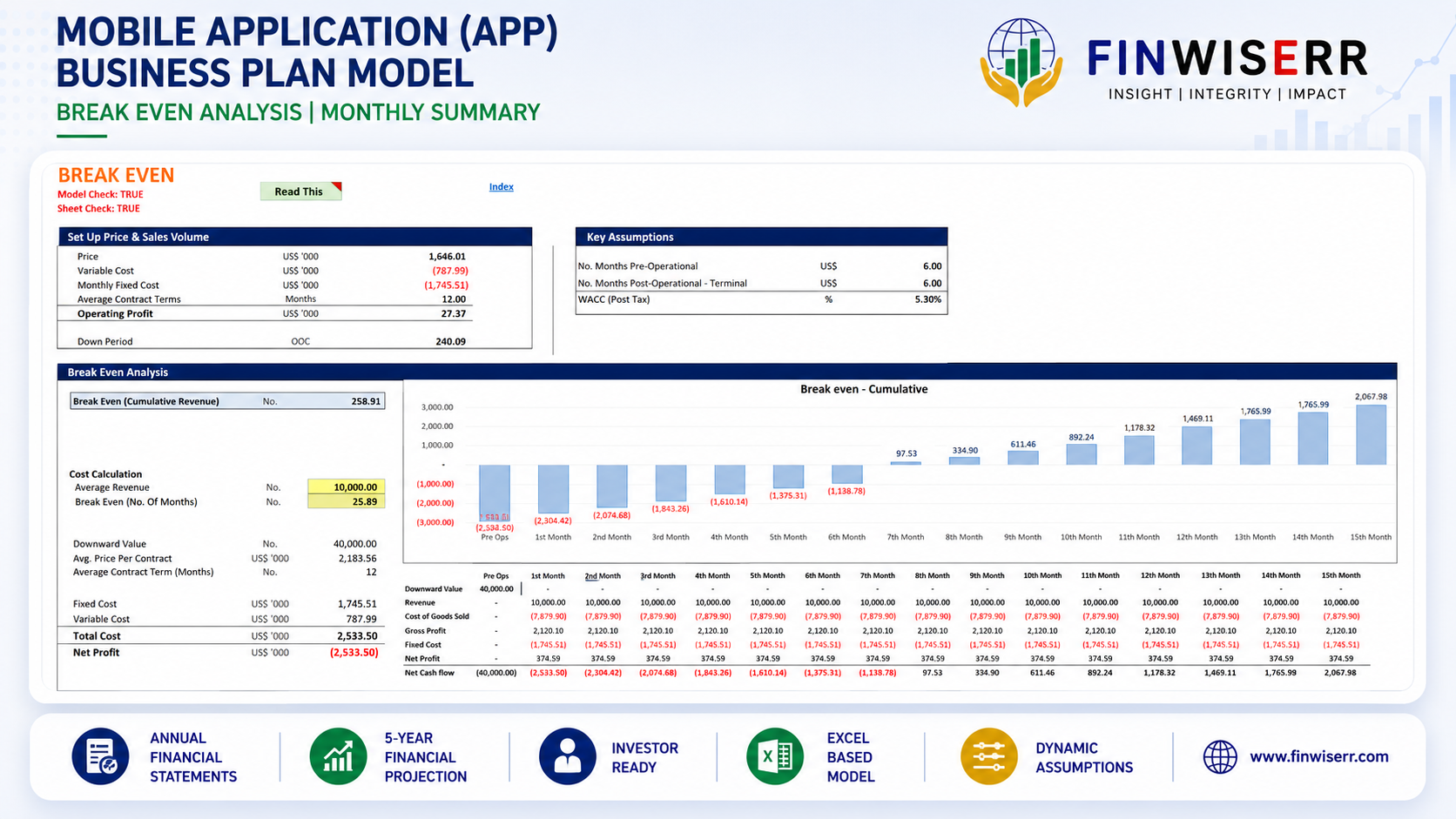
A dedicated break-even analysis shows when revenue overtakes cost — the moment an app business stops burning and starts earning. A full DCF valuation derives Project and Equity NPV and IRR both with and without terminal value, and a dedicated exit strategy lets you set a holding period and model a sale. For the many app ventures built to be acquired rather than held, that exit view is exactly the analysis that frames the investment case.
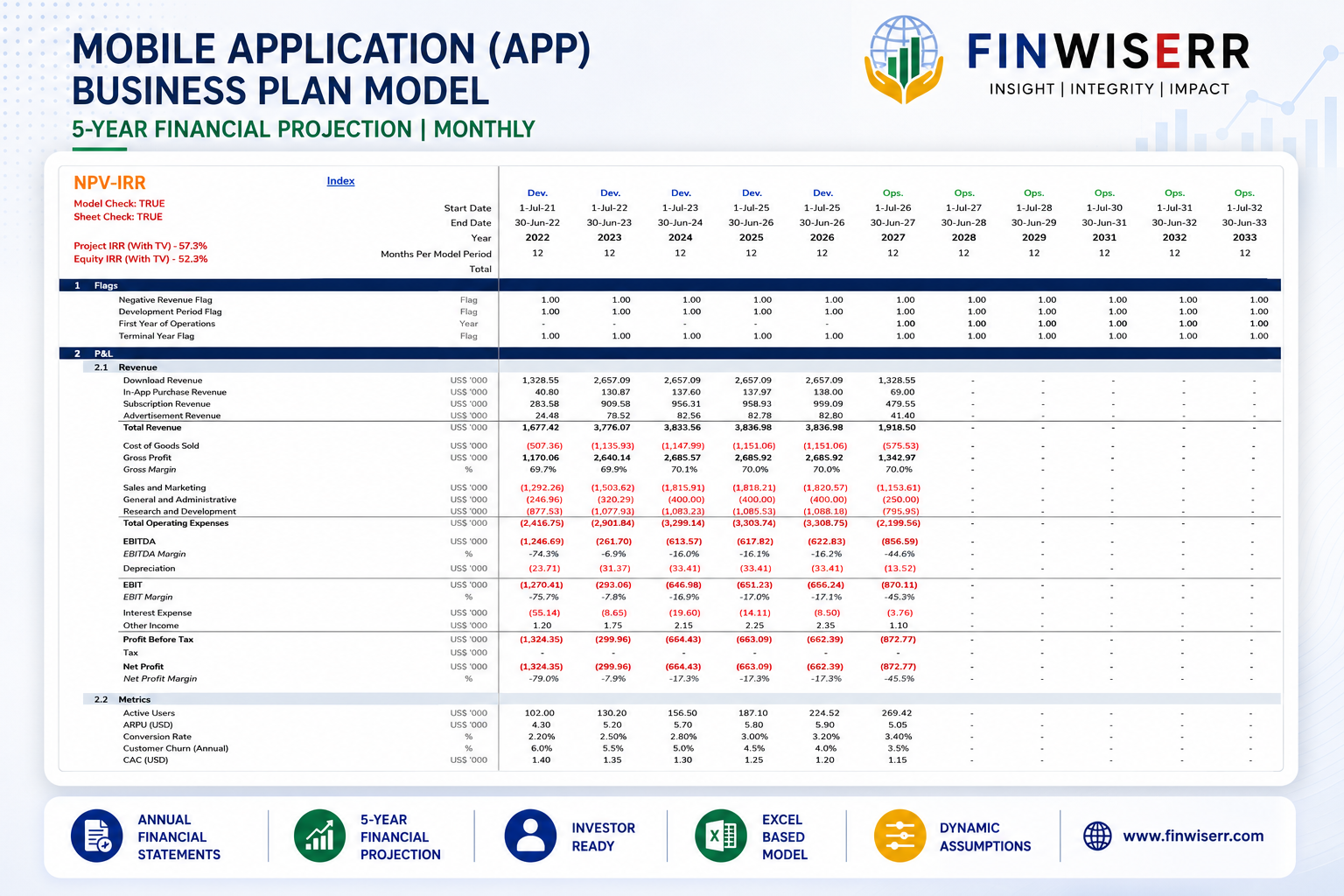
The model forecasts across development and operation on a monthly basis, with financial statements on both monthly and annual views. Every revenue and cost assumption can be entered across three scenarios and switched at the click of a button, so a conservative retention case sits beside an aggressive-growth one — and because the model uses no macros, every change flows through instantly.
Cost per download across multiple stores, so you can test lifetime value against what a user costs to win.
In-app purchases, a five-tier subscription ladder and advertising, tuned independently.
A holding-period exit plus a full DCF valuation with and without terminal value, for founders building to sell.
New to these metrics? Read an overview of internal rate of return. For a model built to your own specification, see our financial advisory services, or browse the full range of business plan Excel models.
Multi-store downloads, a retention funnel and three monetisation engines, with an exit and a full valuation — five years of monthly projections, ready in Excel.