The most important AI question isn’t “what should we buy?” — it’s “are we ready?”
Before committing budget to AI, AIRDIF™ gives you a structured, evidence-based way to assess whether your organization is actually prepared for it.
The Problem
Most AI initiatives don’t fail because of the technology. They fail because the organization wasn’t ready for it.
Artificial Intelligence has rapidly moved from experimentation to boardroom priority. Across industries, organizations are investing in AI platforms, machine learning solutions, automation tools, predictive analytics, AI agents, large language models, and generative AI technologies in pursuit of efficiency, innovation, and growth.
Yet despite billions being invested globally, a significant number of AI initiatives fail to achieve their intended outcomes. Organizations pursue AI because competitors are doing it. They invest because vendors are promoting it. They launch pilots because AI has become a board-level mandate. Very few pause to ask the fundamental question:
“Are we truly ready for AI?”
AIRDIF™ was created to answer that question.
What It Is
What is AIRDIF™?
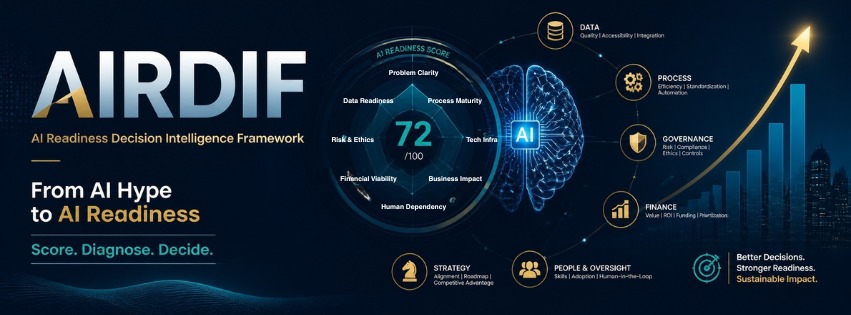
AIRDIF™ (AI Readiness & Decision Intelligence Framework) is a structured diagnostic framework designed to help organizations assess their readiness for AI adoption before committing significant investment in technology, people, consulting, infrastructure, or transformation programs.
Built as a practical decision-support tool, AIRDIF™ helps leaders determine:
- Whether AI investment makes sense today
- Whether organizational conditions support success
- Which readiness gaps need attention first
- Which business processes suit AI
- Which risks may threaten implementation
- Whether expected value justifies the spend
Rather than relying on assumptions, hype, or vendor narratives, AIRDIF™ provides an evidence-based methodology that turns a complex strategic question into a measurable, actionable, and defensible decision.
Why It Exists
The AI market is filled with excitement — and confusion
Organizations frequently invest in AI technologies without first evaluating data quality, process maturity, governance, or execution capability. McKinsey’s State of AI research has repeatedly found that most organizations deploying AI still aren’t seeing meaningful enterprise-wide results — a gap that traces back to readiness, not technology.
The result is often familiar:
- Failed AI pilots
- Budget overruns
- Low adoption rates
- Compliance concerns
- Poor return on investment
- Technology sitting unused
Most organizations discover these issues only after resources have already been committed. AIRDIF™ was designed to surface these risks before the investment decision is made.
The Philosophy
A business readiness challenge, not a technology one
Organizations that succeed with AI typically share the same foundations: clear business objectives, reliable data, mature operational processes, strong governance, capable leadership, and strategic alignment. Organizations lacking these often struggle regardless of how sophisticated their technology may be.
AIRDIF™ evaluates these foundations systematically. The goal isn’t simply to determine whether AI is possible — it’s to determine whether AI is likely to succeed.
The Framework
The eight dimensions of AI readiness
AIRDIF™ evaluates organizational readiness across eight critical dimensions — each addressing a key factor that influences AI outcomes.
Problem Clarity
Problem definition, strategic importance, success criteria, and stakeholder alignment. If the problem is unclear, AI is unlikely to create value.
Data Readiness
Data availability, quality, consistency, accessibility, governance, and integration readiness — the foundation every AI system depends on.
Process Maturity
Process standardization, workflow maturity, operational consistency, documentation, ownership, and visibility.
Human Dependency
Decision complexity, human intervention requirements, knowledge concentration, and automation suitability — not everything should be automated.
Technology Infrastructure
Existing systems, integration capability, infrastructure maturity, scalability, security, and architecture.
Financial Viability
Business case strength, investment requirements, expected returns, payback potential, and budget readiness.
Risk & Ethics
Regulatory compliance, data privacy, security, bias management, governance controls, and ethical implications.
Business Impact
Strategic value, productivity improvement, cost optimization, revenue opportunity, and scalability potential.
What Makes It Different
Not a checklist — a decision architecture
Many AI readiness tools function as simple checklists. AIRDIF™ is fundamentally different: it uses weighted scoring to reflect real-world business consequences. Critical dimensions like Problem Clarity and Data Readiness carry greater influence, because they’re among the most common causes of AI project failure — the framework mirrors practical business reality rather than treating every factor as equal.
Decision Intelligence Logic
Insight, not just a score
AIRDIF™ doesn’t merely generate a number. It helps users understand why a score was achieved, which dimensions need attention, where risk is concentrated, and what to prioritize next.
Universal Veto Gates
One strength can’t hide a critical gap
If a critical readiness dimension falls below an acceptable threshold, AIRDIF™ can override an otherwise favorable overall score — preventing organizations from overlooking significant implementation risk.
What’s Included
The AIRDIF™ package
Diagnostic Workbook
A structured Excel-based assessment tool containing:
- Comprehensive diagnostic questions
- Weighted scoring logic
- Automated calculations
- Readiness dashboards
- Industry-adjustable weightings
Results Interpretation Guide
A detailed reference document explaining:
- Score interpretation
- Readiness categories
- Risk indicators
- Decision outcomes
- Recommended next actions
Who It’s For
Built for leaders who need a disciplined AI decision
Key Benefits
Why organizations use AIRDIF™
Reduce AI investment risk
Identify weaknesses before major investments are made.
Improve decision quality
Replace assumptions with structured analysis.
Prioritize high-value opportunities
Focus resources on initiatives most likely to succeed.
Strengthen governance
Address compliance, ethics, and risk proactively.
Accelerate AI success
Build stronger foundations before implementation begins.
Increase organizational confidence
Ensure stakeholders understand both opportunity and risk.
The Bottom Line
AI is not a magic solution. It is a capability that requires preparation.
Organizations that invest in readiness before implementation consistently achieve better outcomes than those that rush into technology adoption without a clear foundation. AIRDIF™ helps you assess where you stand today, identify what needs attention tomorrow, and make smarter AI investment decisions for the future. Before investing in Artificial Intelligence, invest a few hours understanding your readiness for it.
AIRDIF™ · AI Readiness & Decision Intelligence Framework
Stage 1 of the AIDEX™ lifecycle — the first deliberate decision before you invest another dollar in AI.
Get Started
Find out where your organization really stands
Get the AIRDIF™ Diagnostic Workbook and Results Interpretation Guide, and turn your AI readiness into a measurable, defensible decision.