Business Feasibility Assessment: 2026 Guide for U.S. Businesses
How to test strategic, market, technical, operational and financial viability before committing capital
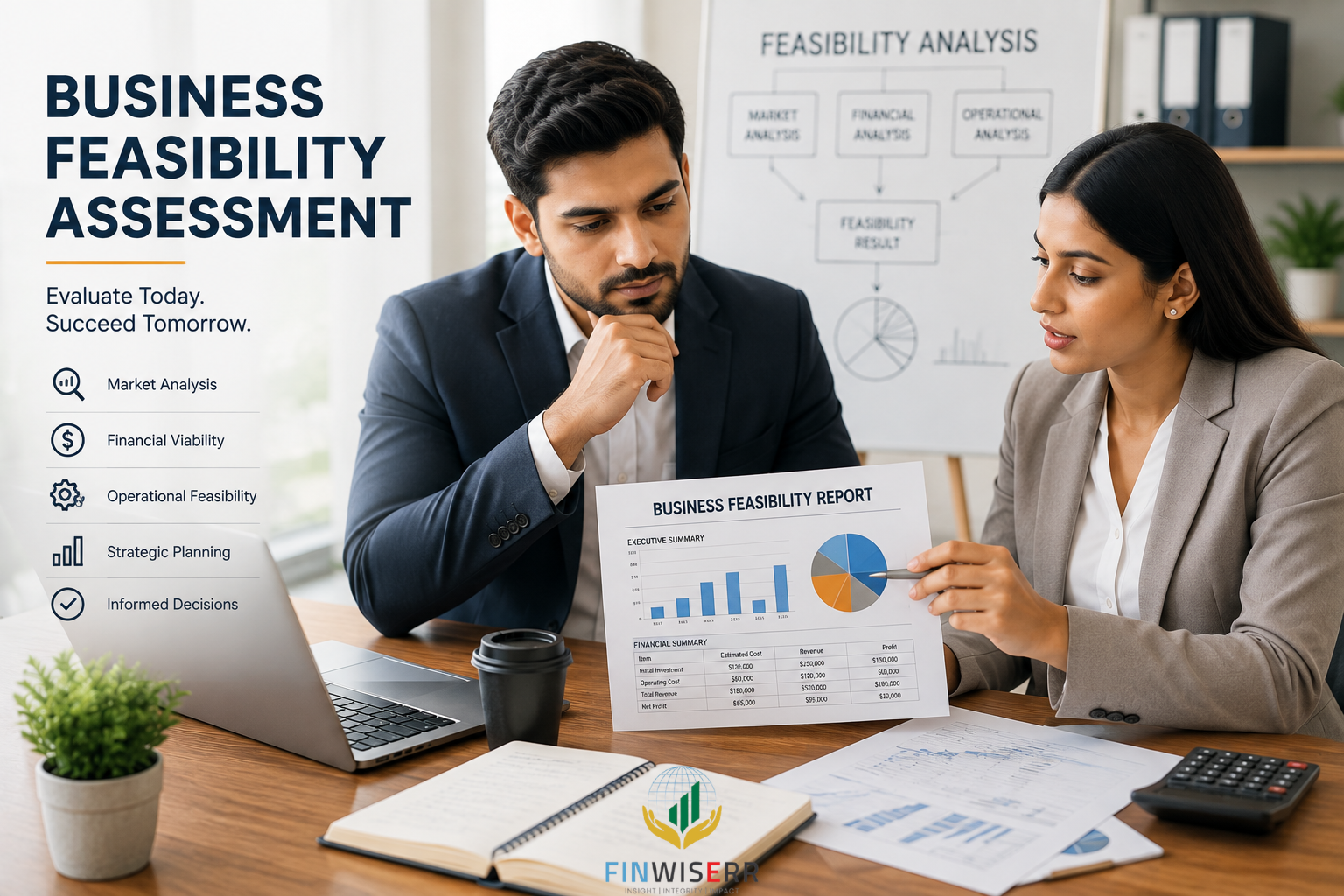
A business feasibility assessment is a structured, evidence-based evaluation of whether a proposed business, product, location, expansion or investment should proceed. It tests the opportunity across six practical dimensions and concludes with a proceed, modify, pilot, defer or stop recommendation.
Before launching a venture or approving an expansion, decision-makers need more than enthusiasm and a spreadsheet that works only under ideal assumptions. They need evidence that customers will buy, the business can be delivered, the necessary approvals and resources are obtainable, and the expected returns justify the risks.
This guide explains what a business feasibility assessment covers, how it differs from a business plan, the financial metrics that matter, the process for conducting the study and when professional feasibility and financial modelling support can improve the decision.
The Definition
What Is a Business Feasibility Assessment?
A business feasibility assessment—also called a feasibility study or business viability assessment—is a systematic evaluation of whether a proposed initiative is practical, commercially attractive, operationally achievable and financially worthwhile under defined assumptions.
Its purpose is not to justify a decision that has already been made. It should identify both the reasons to proceed and the conditions under which the proposal could fail. The assessment creates a documented basis for deciding whether to proceed, modify the concept, test it through a pilot, defer investment or stop.
Why It Matters
Why Feasibility Matters Before Investment
- Tests whether sufficient customer demand exists at a viable price
- Reveals the full capital, operating and working-capital requirement
- Identifies technical, operational, regulatory and execution constraints
- Shows which assumptions have the greatest effect on returns and cash flow
- Allows alternative configurations, locations, technologies or funding structures to be compared
- Creates a clearer evidence base for boards, investors, lenders and project sponsors
- Establishes measurable conditions that must be met before capital is committed
The Distinction
Feasibility Assessment vs. Business Plan
The two documents are related but serve different decision stages. A feasibility assessment decides whether and under what conditions the opportunity should proceed. A business plan explains how an approved opportunity will be implemented, financed and managed.
| Aspect | Feasibility Assessment | Business Plan |
|---|---|---|
| Primary question | Should this initiative proceed, and under what conditions? | How will the approved initiative be executed and managed? |
| Timing | Before major commitment or at an investment decision gate | After initial validation and during implementation or fundraising |
| Orientation | Investigative, comparative and decision-focused | Execution, communication and funding-focused |
| Core output | Proceed, modify, pilot, defer or stop recommendation | Operating, marketing, organisational and financing roadmap |
| Primary users | Sponsors, boards, investors, lenders and internal decision-makers | Management, employees, investors, lenders and partners |
The Framework
Six Dimensions of a Complete Feasibility Assessment
The scope should match the proposed investment, but most robust assessments consider six interconnected dimensions. A conclusion is only as strong as the weakest untested dimension.
Strategic Feasibility
Strategic feasibility examines whether the proposal supports the organisation’s objectives and whether it is the best use of scarce capital, management attention and capabilities.
- Stakeholder objectives and success criteria
- Strategic fit and investment rationale
- Alignment with core capabilities and portfolio priorities
- Alternative options and opportunity cost
Market and Commercial Feasibility
Market and commercial analysis tests whether a reachable customer segment has a problem worth solving and is willing to buy the proposed offering at a commercially viable price.
- Target customers, market size and realistic addressable demand
- Competitors, substitutes and barriers to entry
- Customer needs, willingness to pay and purchasing behaviour
- Pricing, routes to market and sales-cycle assumptions
- Market growth, seasonality and demand risks
Technical Feasibility
Technical feasibility determines whether the required product, asset, system or service can be designed, built and operated with available or obtainable technology and expertise.
- Technology, equipment, infrastructure and capacity requirements
- Site, location and utility requirements
- Technical performance, reliability and scalability
- Supplier capability and critical dependencies
- Construction, integration, testing and commissioning requirements
Operational Feasibility
Operational feasibility assesses whether the proposed model can function reliably after launch and whether the organisation can deliver the expected customer, service and financial outcomes.
- Operating model, processes and responsibilities
- Workforce, skills, training and management capacity
- Procurement, logistics, supply chain and vendor availability
- Service delivery or production capacity
- Implementation schedule, milestones and readiness dependencies
Legal, Regulatory and Environmental Feasibility
This dimension identifies the approvals, licences, contractual conditions and environmental requirements that may determine whether the initiative can proceed and on what timetable.
- Corporate, sector and location-specific legal requirements
- Permits, licences and regulatory approvals
- Employment, data, consumer and contractual obligations
- Environmental and sustainability requirements
- Matters requiring review by appropriately qualified legal, tax or regulatory professionals
Financial and Economic Feasibility
Financial feasibility translates the business concept into cash flows, funding needs, returns and decision thresholds. It should show not only whether the base case works, but also how quickly the conclusion changes when key assumptions are weaker than expected.
- Capital expenditure, startup costs and contingency allowances
- Operating costs, fixed and variable cost drivers and inflation
- Revenue, pricing, volume, utilisation and ramp-up assumptions
- Working-capital requirements and minimum cash needs
- Funding requirement, capital structure and debt-service capacity
- Profitability, free cash flow, break-even point and payback period
- Net present value (NPV), internal rate of return (IRR) and return on investment (ROI)
- Base, upside and downside scenarios with sensitivity and stress testing
The Process
How to Conduct a Business Feasibility Assessment
Define the decision and scope. Specify the proposal, investment boundary, decision date, alternatives, intended users and required level of analysis.
Set evaluation criteria. Agree the commercial, technical, operational, regulatory and financial conditions that would justify proceeding.
Collect evidence. Combine primary research, management interviews, supplier information, customer testing, official data and relevant industry sources.
Evaluate market and commercial demand. Test customer need, competitive position, pricing and attainable market share rather than relying only on broad market size.
Assess technical and operational requirements. Confirm that the technology, site, people, suppliers, processes and schedule are realistic and obtainable.
Build the financial feasibility model. Link operational assumptions to revenue, costs, working capital, funding, cash flow and investment returns.
Analyse risks and scenarios. Rate key risks, define mitigations and test downside conditions, delays, cost overruns and weaker demand.
Make a decision and document conditions. Present the evidence, limitations, assumptions and recommendation with clear actions, owners and decision gates.
The Result
Possible Feasibility Outcomes
A credible study should not force every proposal into a simple yes-or-no answer. Its recommendation may be:
- Proceed — the proposal meets the agreed decision criteria
- Proceed subject to conditions — specific approvals, contracts, funding or performance thresholds must be achieved
- Pilot first — additional evidence is required before full-scale investment
- Modify — change the scope, capacity, pricing, technology, location or funding structure
- Defer — the concept may be attractive, but market, capability or timing conditions are not ready
- Stop — expected benefits do not justify the risks, cost or opportunity cost
Feasibility Study Checklist
- Implementation schedule and decision gates established
- Capital, operating and working-capital requirements modelled
- Funding sources and debt-service capacity assessed
- NPV, IRR, payback, break-even and cash flow calculated where relevant
- Base, upside and downside scenarios tested
- Key risks, mitigations and residual exposures documented
- Recommendation and conditions for proceeding approved by decision-makers
Who It’s For
Who Benefits From a Feasibility Assessment?
- Existing businesses evaluating a product, location, capacity expansion or new market
- Boards and investment committees assessing a significant capital commitment
- Project sponsors evaluating infrastructure, energy, real-estate or industrial investments
- Franchise buyers assessing a specific territory and operating model
- Investors and lenders evaluating the assumptions behind a proposal
- Nonprofits and public-sector organisations testing programme sustainability and affordability
The Pitfalls
Common Mistakes That Undermine Feasibility Studies
- Starting with the desired answer instead of neutral decision criteria
- Confusing total market size with realistically attainable demand
- Using optimistic revenue growth without a credible sales ramp-up
- Underestimating working capital, contingencies and implementation delays
- Treating permits, suppliers, staffing or technology as automatically available
- Testing only the base case and ignoring downside scenarios
- Using a model whose assumptions cannot be traced to operational evidence
- Presenting a recommendation without clear conditions, risks and decision gates
Regulatory Context
U.S. Lender and Regulatory Considerations
Lenders may request detailed financial projections, market evidence or other feasibility information for startups, expansions and higher-risk proposals. Requirements vary by lender, programme, transaction and applicant. The U.S. Small Business Administration’s SOP 50 10 governs the 7(a) and 504 loan programmes, but it should not be interpreted as a universal requirement for every applicant to submit a standalone feasibility study.
Where the proposal involves state-specific tax, legal, environmental, licensing or regulatory matters, the feasibility team should coordinate with appropriately qualified U.S. professionals. Financial modelling and commercial analysis can support the decision, but they do not replace legal, tax or regulatory advice.
Advisory Support
Why Work With a Feasibility and Financial Modelling Adviser?
Management can complete an initial screening internally. Independent advisory support becomes particularly valuable when the proposal is capital-intensive, strategically important, technically complex, dependent on external funding or likely to be reviewed by a board, investor or lender.
A professional team can help define the decision framework, challenge assumptions, integrate market and operating evidence into a financial model, compare alternatives and identify the thresholds at which the recommendation changes.
Our Approach
How Finwiserr Supports Feasibility Decisions
Finwiserr supports businesses, investors and project sponsors with feasibility analysis, financial modelling, project finance and investment advisory. Its work is designed to translate commercial and operational assumptions into decision-ready financial outcomes.
Depending on the engagement, Finwiserr’s support may include:
- Market, commercial and financial feasibility analysis
- Integrated business and project financial models
- Capital expenditure, operating cost and working-capital modelling
- Funding, capital-structure and debt-capacity analysis
- NPV, IRR, payback and break-even assessment
- Scenario, sensitivity and stress testing
- Investment comparisons and decision recommendations
- Coordination with technical, legal, tax and other specialist advisers where required
Frequently Asked Questions
Common Questions
What is the main purpose of a business feasibility assessment?
Its purpose is to determine whether a proposed business or investment should proceed, under what conditions and with which risks. It replaces intuition-only decisions with a documented evaluation of demand, deliverability, funding and returns.
Is a feasibility assessment the same as a business plan?
No. A feasibility assessment determines whether and how the proposal should proceed. A business plan explains how an approved concept will be implemented, operated, financed and managed.
How long does a feasibility study take?
Timing depends on scope, data availability, market research, technical complexity and the required financial model. A focused assessment may take several weeks, while complex or capital-intensive projects can require substantially longer.
Can a business conduct the assessment internally?
Yes, particularly for preliminary screening. Independent support can improve objectivity and modelling quality when the decision is high-value, complex, externally funded or subject to third-party review.
Is a feasibility study required for an SBA loan?
Not universally. SBA-backed financing is governed by programme and lender requirements. Applicants may need detailed projections and supporting analysis, but the required documentation depends on the loan, lender and transaction.
What financial metrics should a feasibility study include?
The appropriate metrics depend on the proposal. Common measures include cash flow, break-even point, funding requirement, payback period, NPV, IRR, ROI and debt-service capacity, supported by scenario and sensitivity analysis.
What is the difference between feasibility and viability?
Feasibility asks whether the proposal can be implemented with the available or obtainable resources. Viability asks whether it can remain commercially and financially sustainable. A complete assessment normally considers both.
Planning a new venture, expansion or capital project? Speak with Finwiserr about a feasibility assessment and financial model tailored to your decision, industry and investment requirements.