Great AI ideas deserve a strong business case.
AIBCF™ turns “AI sounds promising” into “this AI investment is financially justified” — with ROI, NPV, payback, and risk analysis leadership can actually approve.
The Problem
The challenge is rarely a lack of AI ideas. The real challenge is determining whether those ideas are financially justified.
Organisations are identifying opportunities to automate operations, improve customer experiences, increase productivity, reduce costs, and create new business models. But leadership teams still have to answer the hard questions: how much investment is required, what measurable value could it generate, what’s the expected return, how long until it pays back, and what financial and execution risks exist?
These aren’t only technology questions — they’re business and investment questions. That’s why Finwiserr developed AIBCF™, the AI Business Case Framework.
What It Is
What is AIBCF™?
AIBCF™ is a structured methodology used to assess whether a proposed AI initiative can create measurable, defensible, and financially sustainable business value. It enables organisations to move beyond broad assumptions and develop investment-grade AI proposals backed by structured financial and strategic analysis.
Each of the 10 dimensions is worked through with 10 evidence-based questions — 100 in total — feeding directly into a live 5-year financial model. In practice, this takes roughly 60–90 minutes per use case, and only the use cases already validated by AIPIF™ should go through it: AIBCF™ is reserved for Tier 1 and Tier 2 use cases coming out of the prioritisation stage — not the full opportunity list.
AIBCF™ helps organisations define the strategic rationale, establish the cost baseline, estimate implementation and operating costs, quantify benefits, calculate ROI/NPV/payback, compare scenarios, assess feasibility, and strengthen investment governance.
“AI sounds promising.”
↓ becomes ↓“This AI investment is financially justified.”
Why It’s Needed
Ambition isn’t a business case
Many AI programmes begin with enthusiasm. Far fewer begin with disciplined financial justification. Gartner’s research on rethinking AI ROI makes a related point: AI doesn’t follow a single cost curve or produce one uniform type of value, which is exactly why a structured, multi-dimensional business case beats a single ROI formula.
Skipping straight from idea to pilot without a business case often results in:
- Expensive, poorly defined experiments
- Unclear investment requirements
- Overstated benefits
- Underestimated implementation costs
- Weak executive confidence
- Misallocated capital and resources
Part of the AIDEX™ Suite
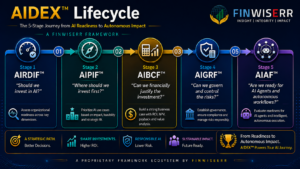
AIBCF™ is Stage 3 of AIDEX™
It follows AIRDIF™ and AIPIF™, ensuring detailed financial modelling is performed only for AI opportunities that have already demonstrated organisational readiness and strategic priority.
The Framework
The 10 dimensions of AIBCF™
AIBCF™ evaluates each shortlisted AI initiative across ten structured dimensions — from strategic rationale through to governance readiness.
Strategic Business Case
Why the organisation should invest — strategic alignment, business problem definition, and expected organisational impact.
Current-State Cost Baseline
The existing cost of performing the relevant process — the reference point future AI benefits are measured against.
Investment Cost Assessment
The full cost to design, implement, and operate the initiative — beyond just the initial technology spend.
Financial Benefits
The measurable value expected — cost savings, productivity gains, revenue growth, error reduction, and more.
ROI Analysis
Compares expected financial benefits with the investment required, enabling consistent comparison across initiatives.
NPV & Value Creation
Evaluates the current value of future cash flows. A positive NPV means value is created after the time value of money.
Payback Analysis
Estimates how long it takes for financial benefits to recover the initial investment — and how long capital stays at risk.
Scenario & Sensitivity Analysis
Tests the business case across five modelled scenarios — Base, Upside, Downside, Stress, and Delayed — so leadership sees a range of outcomes, not a single forecast.
Execution Feasibility
Connects financial attractiveness with practical deliverability — capabilities, resources, and readiness available.
Investment Governance
Whether suitable controls and decision-making structures exist — sponsorship, accountability, and benefit tracking.
Financial Discipline
AIBCF™ Universal Veto Gates
A high overall score can’t compensate for a critical weakness that would undermine the investment. If any single gate below triggers, the framework automatically overrides the recommendation to NO-GO — regardless of how strong the rest of the score looks:
Any of these trigger an automatic NO-GO
- ROI below the minimum required threshold (10%)
- NPV is negative
- Payback period exceeds 36 months
- Execution feasibility score below 50% (<3/5)
- Key financial assumptions aren’t defensible
- Investment governance readiness is insufficient (<3/5)
The Decision Reference
Once veto gates clear, ROI sets the recommendation
Assuming no veto gate is triggered, AIBCF™ maps the 5-year ROI to one of four decision bands:
Proceed to board approval immediately.
Address flagged risks before committing.
Strengthen assumptions or revise scope.
Do not invest under current assumptions.
Default global parameters behind these calculations: a 12% discount rate (WACC), a 5-year NPV evaluation window, 15% cost contingency, and benefits risk-adjusted downward before they count toward ROI — all editable per organisation.
The Process
From opportunity to investment recommendation
Define the Strategic Case
Clarify the business problem, strategic rationale, and expected organisational impact.
Establish the Current-State Baseline
Measure existing costs, performance levels, and operational challenges.
Estimate the Required Investment
Identify implementation, technology, data, people, governance, and operating costs.
Quantify Financial Benefits
Estimate cost savings, productivity gains, revenue improvements, and other measurable benefits.
Calculate ROI, NPV & Payback
Assess whether expected financial returns justify the investment.
Test Scenarios & Sensitivities
Evaluate how the business case performs under alternative assumptions.
Assess Execution Feasibility
Confirm the organisation has the resources, capabilities, and readiness required.
Apply Governance & Veto Gates
Review the investment against defined financial, execution, and governance requirements.
Prepare the Executive Recommendation
Present a clear Go, Modify, Defer, or No-Go investment recommendation.
Key Outputs
What AIBCF™ produces
- Executive AI Business Case Report
- AI ROI Dashboard
- Net Present Value Analysis
- Cash Flow Forecast
- Payback Period Model
- Scenario & Sensitivity Engine
- Investment Decision Matrix
- Go / No-Go Recommendation
Who It’s For
Built for leaders evaluating AI investments
In practice, it’s typically completed by a finance lead and strategy lead working together, with input from technology and operations — not a solo exercise.
Frequently Asked Questions
Common questions about AIBCF™
What is an AI business case?
A structured assessment of the strategic rationale, investment cost, expected benefits, financial return, risks, and execution requirements associated with an AI initiative.
Why is an AI business case important?
It helps leadership determine whether a proposed initiative creates sufficient value to justify the required investment and risk.
How do you calculate ROI for an AI project?
By comparing the net financial benefits generated by the initiative with the total investment required — including implementation costs, operating costs, and the timing of expected benefits.
What financial metrics should be included in an AI business case?
Common metrics include ROI, NPV, payback period, cash flow, cost savings, revenue benefits, and scenario-based financial outcomes.
What is the difference between AIPIF™ and AIBCF™?
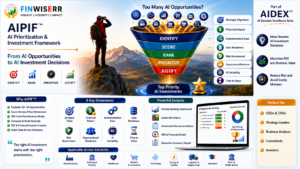
AIPIF™ prioritises AI opportunities and identifies where an organisation should invest first. AIBCF™ develops the detailed financial business case for the highest-priority opportunities.
What is a veto gate in AIBCF™?
A mandatory investment condition. An initiative may not proceed if it fails a critical requirement relating to ROI, payback, value creation, execution capability, or governance readiness.
Who approves an AI business case?
Approval may involve executive leadership, finance teams, technology leaders, investment committees, or boards, depending on the size and importance of the proposed investment.
AIBCF™ · Build. Quantify. Justify. Approve.
Stage 3 of the AIDEX™ lifecycle. A GO recommendation advances to AIGRF™ (Stage 4) for AI Governance & Risk assessment.
Get Started
Build an investment-grade AI business case
Contact Finwiserr to explore how AIBCF™ can help your organisation evaluate AI investments and develop executive-ready business cases.