| Quick answer: Bid advisory services UAE help a bidder convert an RFP into a controlled submission process. For UAE infrastructure and PPP tenders, that normally means building a clause-by-clause compliance matrix, coordinating technical and commercial inputs, testing risk allocation, preparing a robust bid financial model, assessing financing conditions and completing independent submission quality assurance. The objective is a bid that meets the procuring entity’s requirements and remains economically executable if awarded—not a promise of award or financing. |
A competitive price is only one part of an infrastructure tender. The submission must also be complete, internally consistent and supported by assumptions that the bidder can deliver. In project-financed and PPP structures, the commercial offer must remain viable under the proposed contracts and funding plan.
This is difficult when engineering, legal, tax, insurance, financing, operations and consortium teams are developing inputs in parallel against a fixed deadline. A late change to construction cost, programme, performance assumptions or risk allocation can affect the model, pricing, financing plan and written proposal at the same time.
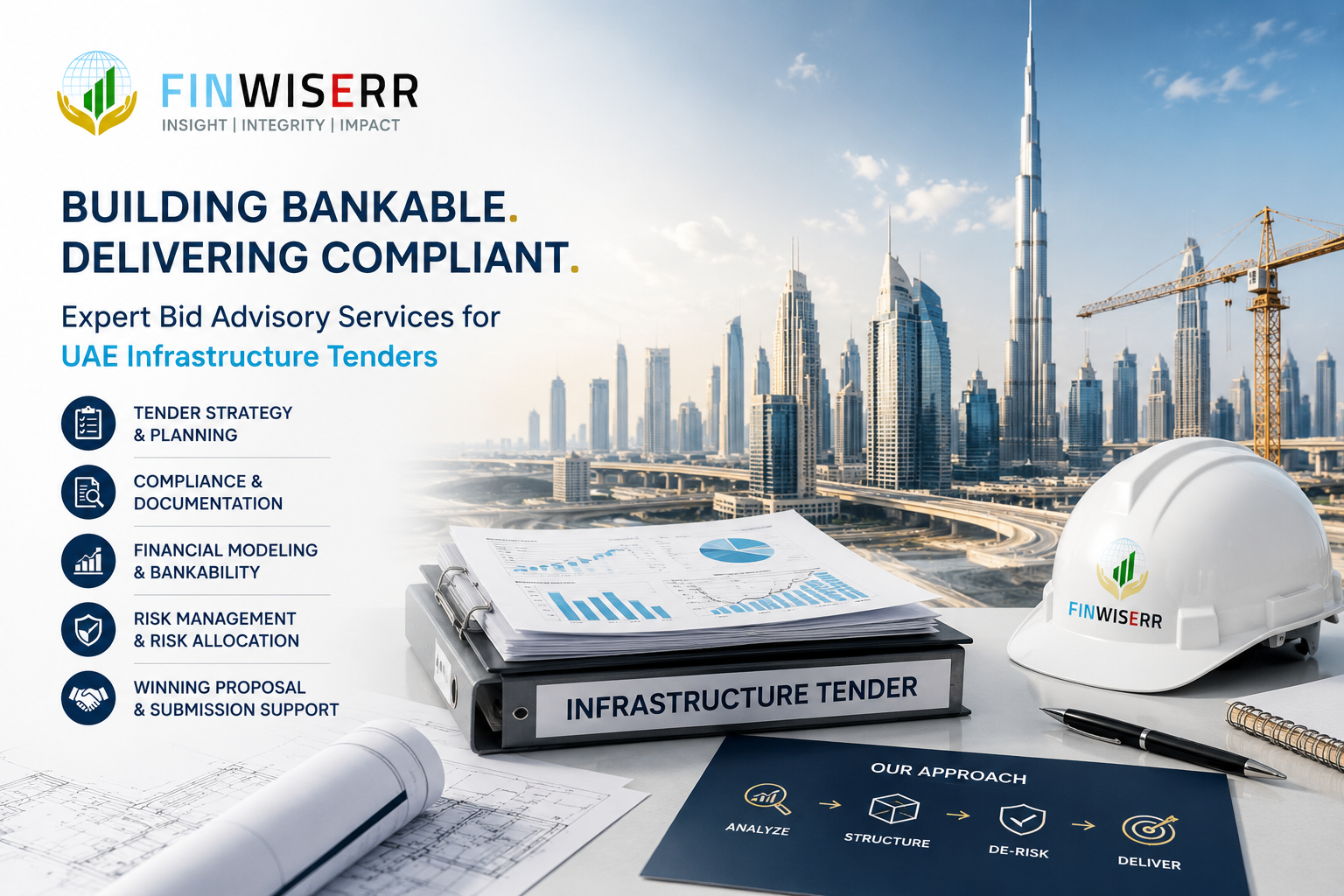
Bid advisory creates the governance and analytical discipline needed to manage those dependencies. This guide explains the main workstreams, the role of the bid financial model and the practical checks that support compliant and bankable UAE infrastructure tenders.
What are bid advisory services UAE?
Bid advisory services UAE provide structured commercial, financial and process support to contractors, developers, operators, investors and consortiums preparing a tender response. The scope is determined by the project, the RFP and the bidder’s internal capabilities.
A comprehensive engagement may include:
- Bid/no-bid analysis and tender mobilisation.
- RFP review and compliance-matrix management.
- Bid programme, governance, document control and review gates.
- Commercial strategy, pricing logic and bid financial modelling.
- Risk allocation, assumptions and departures tracking.
- Funding-plan, covenant and bankability analysis.
- Scenario, sensitivity and downside testing.
- Independent red-team review and final submission assurance.
- Clarification, negotiation and best-and-final-offer support within the agreed scope.
| Scope matters : Bid advisory services UAE does not replace the bidder’s legal, tax, technical, insurance or regulatory advisers. It connects their inputs, quantifies the financial consequences and helps ensure that the submission tells one consistent commercial story. |
What do ‘compliant’ and ‘bankable’ mean?
| Compliant tender | Bankable tender |
| Addresses the RFP requirements, forms, schedules and submission instructions. | Produces cash flows that can support the proposed funding structure under credible assumptions. |
| Maps responses and evidence to evaluation criteria. | Allocates construction, operating, revenue and interface risks to parties able to manage them. |
| Identifies qualifications, assumptions and departures transparently. | Includes financeable project documents, security, reserves and conditions precedent. |
| Maintains consistency across technical, commercial, legal and financial volumes. | Remains resilient under lender sensitivities and downside cases. |
| Meets the procuring entity’s stated deadlines and portal or delivery requirements. | Provides a credible path to financing; it does not guarantee lender approval or financial close. |
A bid can be compliant but commercially unattractive, or competitively priced but difficult to finance. Strong bid governance tests both dimensions together before submission.
UAE procurement requirements are project-specific
UAE tenders do not all operate under one identical rulebook. Federal procurement, emirate-level procurement, sector regulation, government-related entities and individual project documents may impose different procedures and approval requirements. PPP projects may also be governed by federal or emirate-specific frameworks and project agreements.
Federal Law No. 11 of 2023 and its executive regulation establish a federal procurement framework. Federal Law No. 12 of 2023 addresses federal public-private partnerships, while Dubai has its own PPP framework and dedicated PPP Unit. These sources are relevant context, but the specific RFP, applicable law and procuring-entity instructions remain decisive for each bid.
| Practical rule : Do not assume that a requirement used on one UAE authority’s tender applies to another. Build the compliance matrix from the current tender documents and record the owner, evidence, status and approval route for every obligation. |
The 10 core workstreams of an infrastructure bid
- Opportunity assessment. Test strategic fit, resource capacity, consortium readiness, estimated bid cost, key risks and the conditions required to proceed.
- RFP decomposition. Break the tender into instructions, evaluation criteria, contractual obligations, data requirements, forms, deliverables and deadlines.
- Compliance management. Create a live matrix showing each requirement, response location, responsible owner, supporting evidence, status and open clarification.
- Bid governance. Set decision rights, document control, review gates, approval thresholds, change control and escalation routes across all workstreams.
- Risk allocation. Maintain an integrated risk register covering design, construction, interfaces, commissioning, operations, demand or offtake, regulation, force majeure and termination.
- Commercial strategy. Translate the delivery solution into pricing, indexation, payment, performance, compensation and contractual assumptions.
- Financial modelling. Integrate construction, operations, revenue, tax, working capital, financing and return assumptions into a controlled decision model.
- Financing readiness. Test debt capacity, covenants, reserves, security, funding timing, lender conditions and any support required from sponsors or consortium members.
- Scenario and sensitivity testing. Evaluate how the bid performs under changes in cost, schedule, revenue, interest rates, inflation, utilisation and operating performance.
- Submission assurance. Complete red-team review, model checks, cross-document reconciliation, approvals and a final compliance sweep before upload or delivery.
What should a bid financial model contain?
The bid model connects the proposed technical solution to the commercial offer. Its structure should reflect the RFP and transaction, but an infrastructure or PPP model commonly covers:
- Construction programme, capital expenditure, contingencies and drawdown profile.
- Operating costs, lifecycle expenditure, working capital and major maintenance.
- Revenue, tariff or availability-payment mechanics, deductions and indexation.
- Tax and accounting assumptions supplied or reviewed by qualified advisers.
- Debt drawdown, fees, interest, repayment, coverage ratios, reserves and covenants.
- Equity funding, distributions and sponsor return metrics.
- Cash waterfall, lock-up and default mechanics where relevant.
- Base, upside, downside and break-even cases.
- Checks, controls, audit trail, input sources and version history.
| Model control The commercial schedules, financing plan and written proposal should reconcile to the same approved model version. A technically correct model can still create bid risk if another volume contains different dates, costs, capacity, escalation or performance assumptions. |
Pricing: competitive, credible and executable
The lowest apparent price is not automatically the strongest bid. The commercial offer must reflect the bid solution, contract terms, risk allocation, funding costs and return thresholds while remaining aligned with the evaluation methodology.
- Establish the cost base. Reconcile supplier quotations, design quantities, programme, contingencies, operating plan and financing assumptions.
- Price contractual risk. Quantify material obligations such as delay exposure, performance deductions, guarantees, change risk and lifecycle requirements.
- Test the payment mechanism. Model timing, indexation, deductions, availability or volume risk and any caps or floors.
- Set decision thresholds. Define minimum acceptable returns, coverage ratios, headroom and negotiation limits before final pricing pressure begins.
- Reconcile the submission. Confirm that every commercial schedule and narrative statement agrees with the approved pricing case.
How is bankability tested before submission?
Bankability is a structured assessment of whether the proposed contracts, cash flows and risk allocation could support the intended financing. Lender appetite and final credit approval remain separate decisions.
| Question | What the bid team should test |
| Are cash flows predictable? | Contracted revenue, payment security, deductions, termination compensation and market exposure. |
| Can construction risk be managed? | Fixed-price or otherwise supportable costs, schedule, contingencies, completion tests and contractor capability. |
| Can debt be serviced? | Debt-service coverage, repayment profile, reserves, lock-up triggers and downside headroom. |
| Are key risks allocated clearly? | Interfaces, permits, land, utilities, change in law, force majeure, operations and handback. |
| Is the funding plan credible? | Debt and equity timing, commitment conditions, guarantees, hedging and sponsor support. |
| Can lenders complete diligence? | Traceable assumptions, consistent documents, data room, technical reports and legal analysis. |
Sensitivity cases that can change a bid decision
Sensitivity analysis should support decisions, not simply populate a standard model tab. The cases should reflect the project’s material risks and show the effect on pricing, liquidity, debt service and investor returns.
- Capital-cost increase and contingency utilisation.
- Construction delay and later operating commencement.
- Lower performance, availability, demand or throughput.
- Operating-cost and lifecycle-cost escalation.
- Interest-rate, refinancing and hedging changes.
- Foreign-exchange exposure where revenues and costs are mismatched.
- Payment deductions, penalties or delayed receivables.
- Combined downside and break-even scenarios.
The bid committee should know which variable creates the greatest loss of headroom and what mitigation is available. If the base case works only under optimistic assumptions, the proposal may require redesign, repricing or a no-bid decision.
A practical bid advisory process
- Mobilise. Confirm scope, tender calendar, workstream leads, governance, communication protocol and decision makers.
- Diagnose. Review the RFP, identify critical compliance and bankability issues, and agree the clarification strategy.
- Structure. Establish the compliance matrix, risk register, assumptions book, bid model architecture and document plan.
- Develop. Build the technical-commercial-financial response in parallel with controlled updates and regular challenge sessions.
- Optimise. Evaluate pricing, funding, risk and return trade-offs under base and downside cases.
- Assure. Perform red-team, model and reconciliation reviews; resolve open items and obtain formal approvals.
- Submit and respond. Control the final submission and support clarifications, negotiations or a best-and-final-offer stage within scope.
Common reasons strong bids become avoidably weak
- Late mobilisation: critical workstreams begin before ownership, assumptions and approval routes are clear.
- Compliance without evidence: the response says a requirement is met but does not show where or how.
- Uncontrolled assumptions: engineering, commercial and finance teams use different dates, quantities or escalation rates.
- Pricing before risk review: the commercial offer is fixed before contractual exposures are quantified.
- Model-document mismatch: the tariff, funding plan or programme in the model differs from the written submission.
- Optimistic base case: contingency, delays, working capital or performance deductions are understated.
- Weak version control: reviewers and decision makers approve different files or cannot trace the final changes.
- No independent challenge: the team closest to the content is also responsible for the only final review.
How to choose a bid advisory consultant in the UAE
- Relevant transaction experience: Ask for work involving a comparable procurement model, sector and level of financial complexity.
- Financial modelling depth: The team should be able to build, review and explain the bid model rather than treat it as a separate black box.
- Clear workstream boundaries: Understand who covers legal, tax, technical, insurance, financing and proposal-management responsibilities.
- Governance discipline: Look for a practical approach to compliance, document control, changes, review gates and approvals.
- Commercial independence: Fees and incentives should not encourage an uneconomic bid or obscure conflicts of interest.
- Confidentiality and security: Confirm access controls, information handling, data-room protocols and team permissions.
- Post-submission capability: Clarification and negotiation support should be defined in advance, including any exclusions.
| Selection test Ask the adviser to explain how a single change to construction completion would flow through costs, revenue, debt drawdown, coverage ratios, pricing schedules, risk allocation and the written proposal. The answer reveals whether the team can manage the bid as an integrated transaction. |
How Finwiserr can support UAE infrastructure bids
Finwiserr supports bidders, developers and project teams with the financial and commercial workstreams needed to prepare decision-ready infrastructure submissions. Depending on the engagement, support may include:
- Bid strategy, mobilisation and governance support.
- RFP financial and commercial requirement analysis.
- Bid financial model development, review and scenario analysis.
- Pricing, tariff, capital-structure and return analysis.
- Risk-register quantification and assumptions management.
- Financing-readiness and lender-case analysis.
- Commercial-volume and model reconciliation.
- Independent bid review and clarification support.
The engagement should define the relevant procuring entity, applicable framework, deliverables and interfaces with the bidder’s legal, tax, technical and financing advisers. Finwiserr does not guarantee tender award, lender approval or financial close.
Frequently asked questions
What is the difference between bid advisory and proposal writing?
Proposal writing focuses on drafting and presenting the response. Bid advisory is broader: it links compliance, commercial strategy, risk, financial modelling, governance and submission assurance.
When should a bid adviser be appointed?
Ideally at opportunity assessment or RFP release. Early appointment allows the team to shape the compliance plan, model architecture, risk process and decision calendar before the deadline becomes restrictive.
Can bid advisory guarantee that a tender will be awarded?
No. Award depends on the procuring entity’s evaluation, competition, approvals and other factors. Advisory support is intended to improve submission quality, compliance control and decision discipline.
Does a bankable bid guarantee financing?
No. Bankability analysis can identify financing constraints and improve readiness, but lenders still complete their own diligence, credit assessment, approvals and documentation.
What information is needed to start?
The RFP and addenda, bidder and consortium structure, proposed technical solution, programme, cost estimates, operating assumptions, financial information, funding strategy and known legal or commercial concerns.
How long does a bid advisory engagement take?
It follows the tender timetable and can range from a focused review to a multi-month work programme. Scope depends on project complexity, data readiness, consortium interfaces and the number of review or negotiation rounds.
How are fees structured?
Fees may be fixed, time-based or milestone-linked depending on scope and timetable. Any success-linked element should be assessed for commercial, legal and conflict implications before appointment.
Build the bid around the decision, not only the deadline
A well-managed tender gives decision makers a clear view of compliance, price, risk, financing and execution before the offer becomes binding. The strongest submissions are not merely complete; their technical solution, contracts, commercial schedules and financial model all support the same deliverable project.
Preparing an infrastructure or PPP tender in the UAE?
Speak with Finwiserr about bid financial modelling, commercial analysis, bankability review and independent submission assurance tailored to the RFP and your project team.