$120.00
A detailed, investor-ready online coaching financial model for an edtech coaching and counseling platform — with a freemium-to-premium user funnel and five distinct revenue streams, plus platform-development and operation phases, an exit strategy and valuation, in one integrated Excel model.
An online coaching platform is a freemium business at heart. Most users arrive on a free tier and cost you money to serve; the business succeeds by converting a fraction of them into paying customers and monetising the rest through other means. Layer on live counseling and coaching sessions, merchandise and advertising, and you have a platform with five ways to earn — but only if the model separates the free users who cost from the premium users who pay, and tracks the conversion between them.
This online coaching financial model is built for exactly that structure. Downloads split into freemium and premium at the top of the funnel, retention compounds each cohort, and five revenue streams monetise the active base. Platform development is treated as the capitalised, amortised intangible it genuinely is, and the whole business flows through to a complete, investor-ready output set.
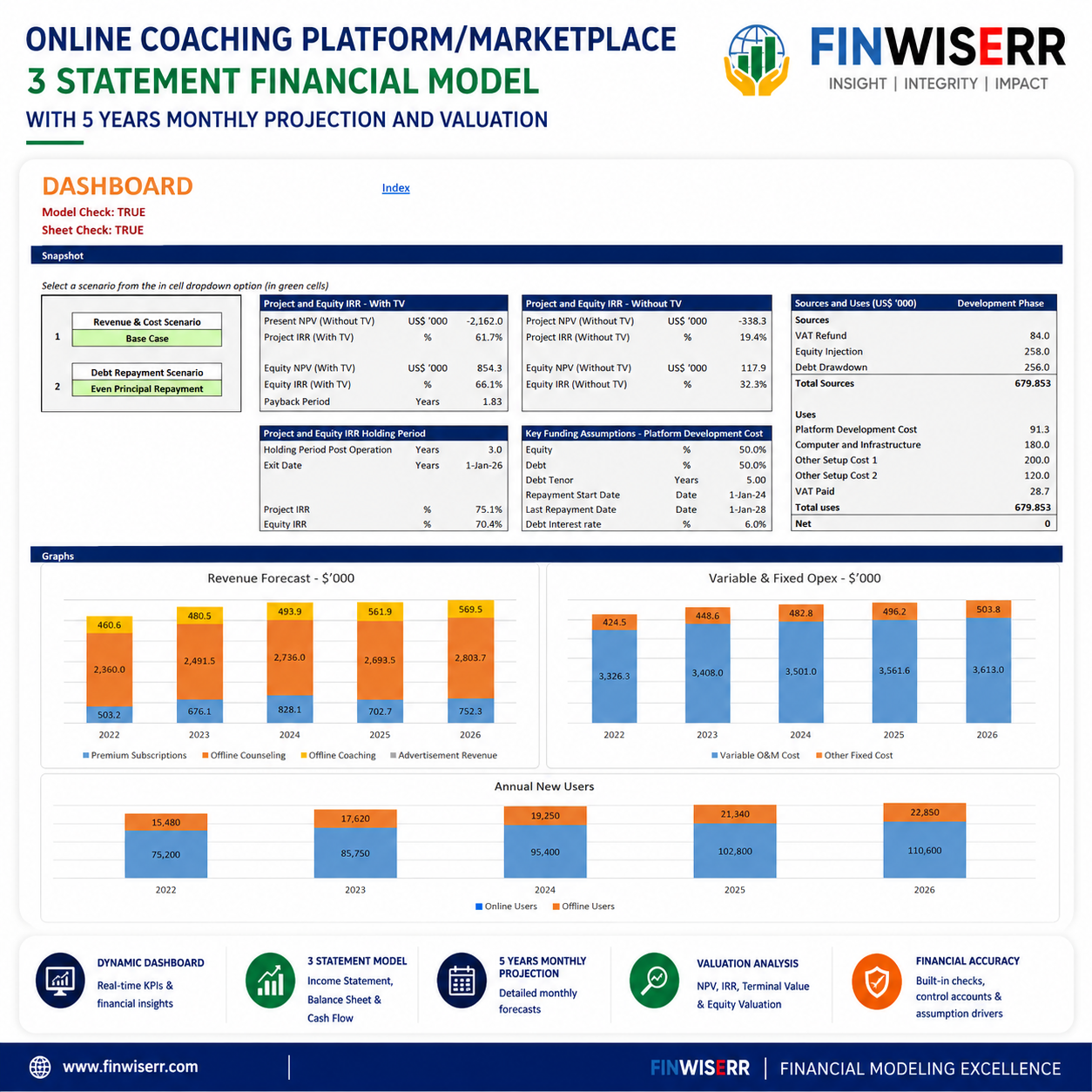
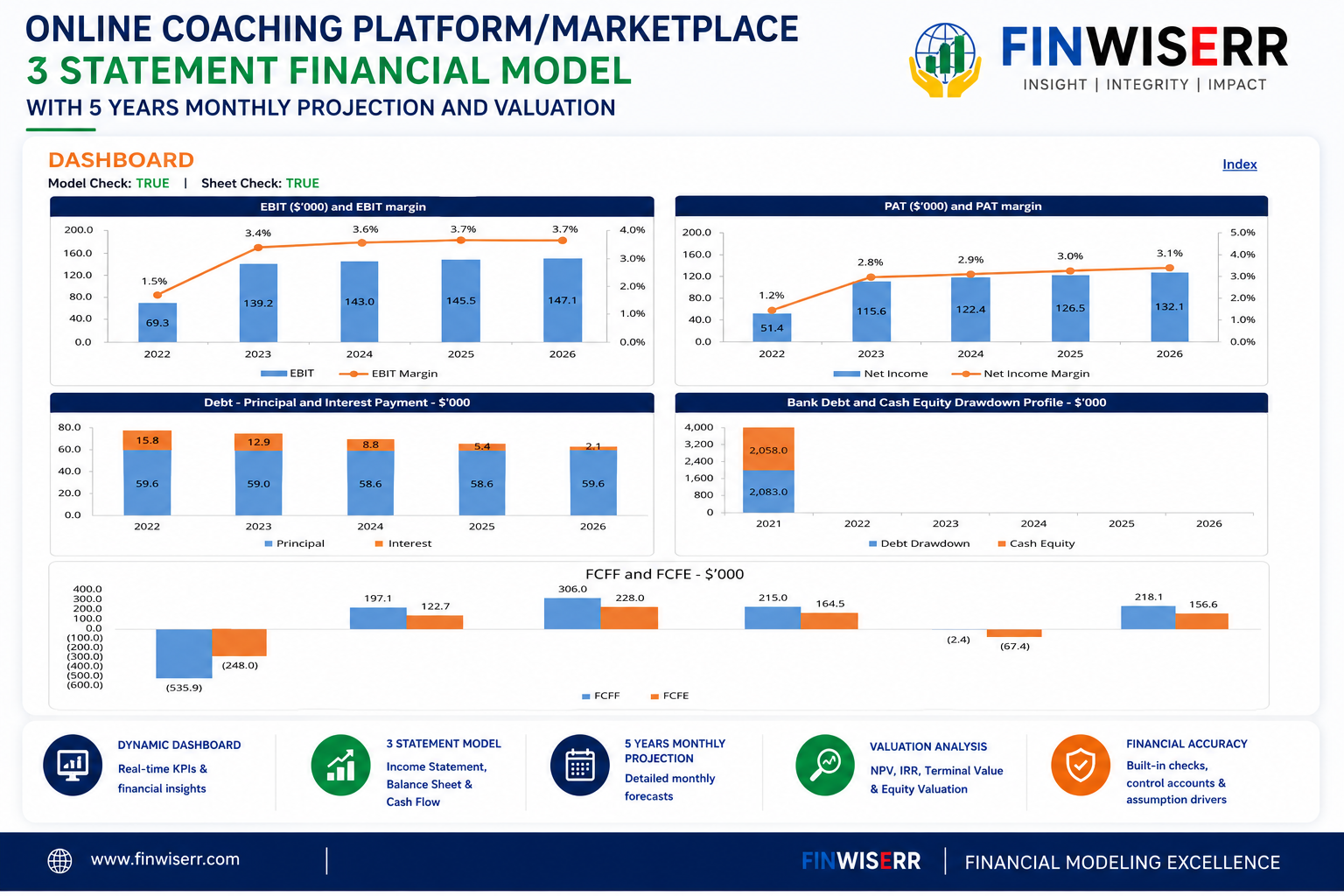
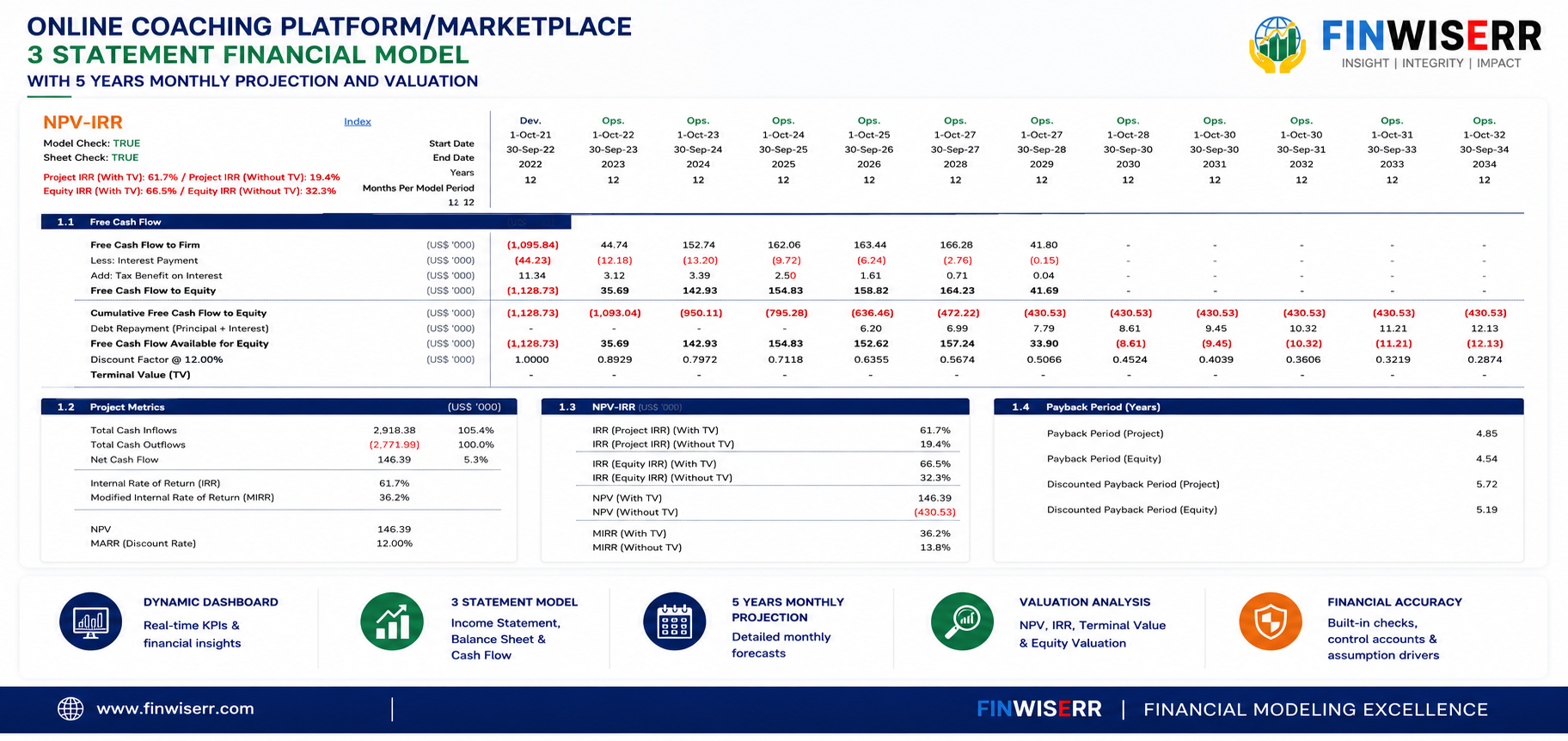
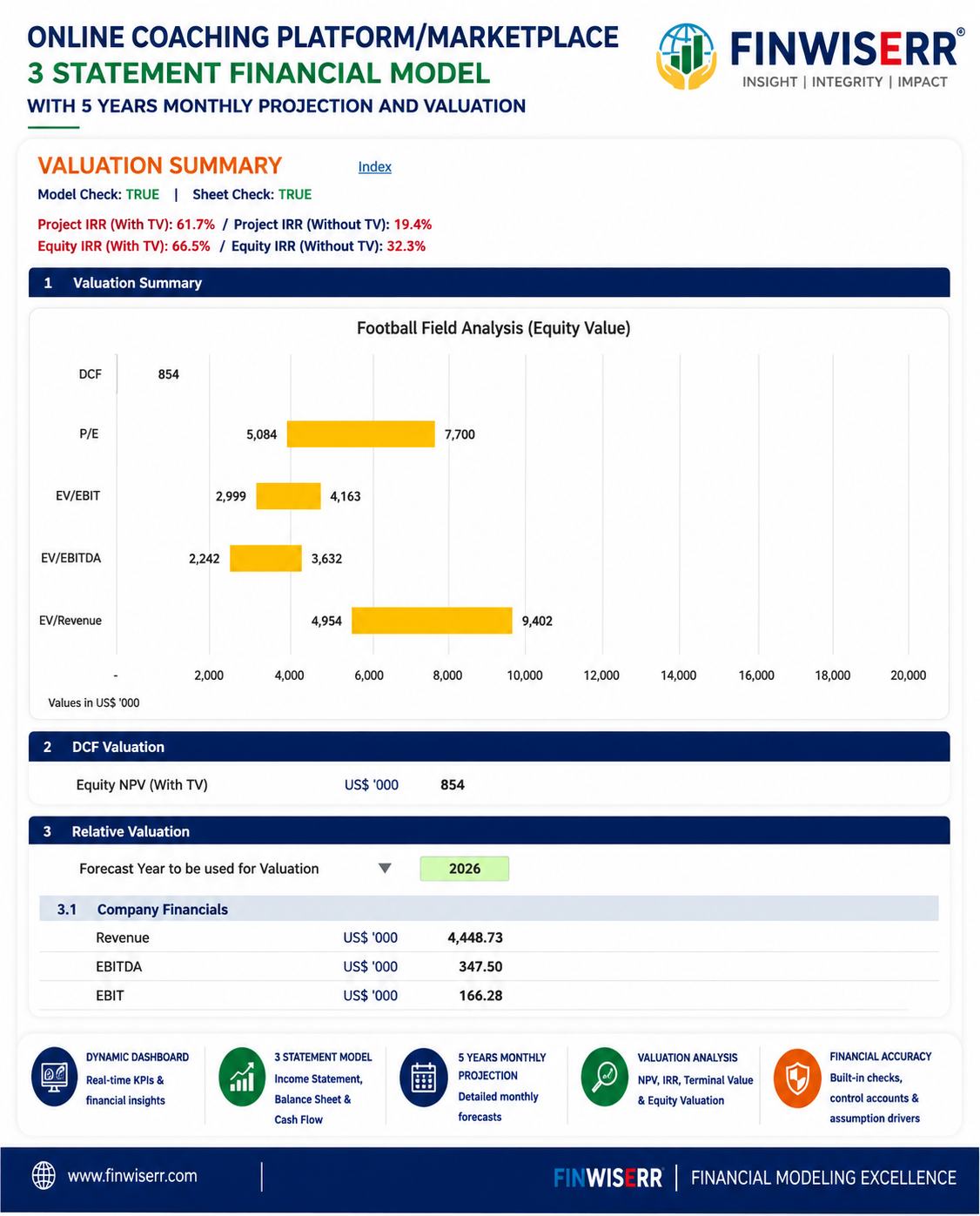
The output set is comprehensive: Project and Equity IRR and NPV (with and without terminal value), equity payback, a DCF valuation, an exit strategy and a fully linked dashboard.
The model builds its user base from monthly downloads split between freemium and premium users, each with its own retention rate and active-user percentage. That split is the strategic core of any freemium business: freemium users are a cost to serve and a marketing funnel at the same time, while premium users are where the subscription revenue comes from. Modelling them separately is what lets you see the true economics — the cost of carrying free users against the revenue converted premium users generate.
Because the freemium-to-premium mix is an explicit input, you can test the lever every edtech founder pulls: a generous free tier that grows the top of the funnel but costs more to serve, versus a tighter one that converts harder but carries less dead weight.
The model captures every way the platform earns, separately:
The counseling and coaching streams are modelled as a two-sided service — supply is the number of counselors and teachers available, throughput is sessions per professional, and revenue is a fixed fee per session. That structure lets you scale the marketplace realistically: revenue grows as you onboard more professionals, not as a single abstract number.
Every driver of the platform is an explicit, editable input. The assumptions cover:
| User Base | Downloads per month, split between freemium and premium, with retention and active-user rates for each |
| Subscriptions | Monthly subscription charge and number of premium subscribers |
| Counseling & Coaching | Counselors and teachers available, sessions per professional per month, and fixed fee per session |
| Products & Ads | Share of active users buying, average merchandise price; sessions, minutes, impressions and CPM |
| Variable O&M | Operating cost as a percentage of revenue, set separately for each of the five revenue streams |
| Fixed Costs | Management salary, technical and other staff, rental, office expenses, SPV cost, insurance and security |
| Platform Capex | UI/UX, native platform and app, backend, admin panel, DevOps and project management, amortised as an intangible |
| Financing & Exit | Debt-equity ratio, development and operations debt, holding period and exit assumptions |
The primary capital outlay for an edtech platform is software, and the model treats it correctly. Platform development cost — across UI/UX, native platform and app, backend, admin panel and DevOps — is capitalised as an intangible and amortised over its useful life, with refresh capex to fund the periodic rebuild. That treatment is what makes the early-year statements realistic and the valuation credible to an investor who understands how technology businesses are reported.
The model derives a full DCF valuation — Project and Equity NPV and IRR, both with and without terminal value — and a dedicated exit strategy lets you set a holding period and model a sale of the platform. For an edtech venture built to scale and exit to a larger education or technology acquirer, that exit view is exactly the analysis that frames the investment case.
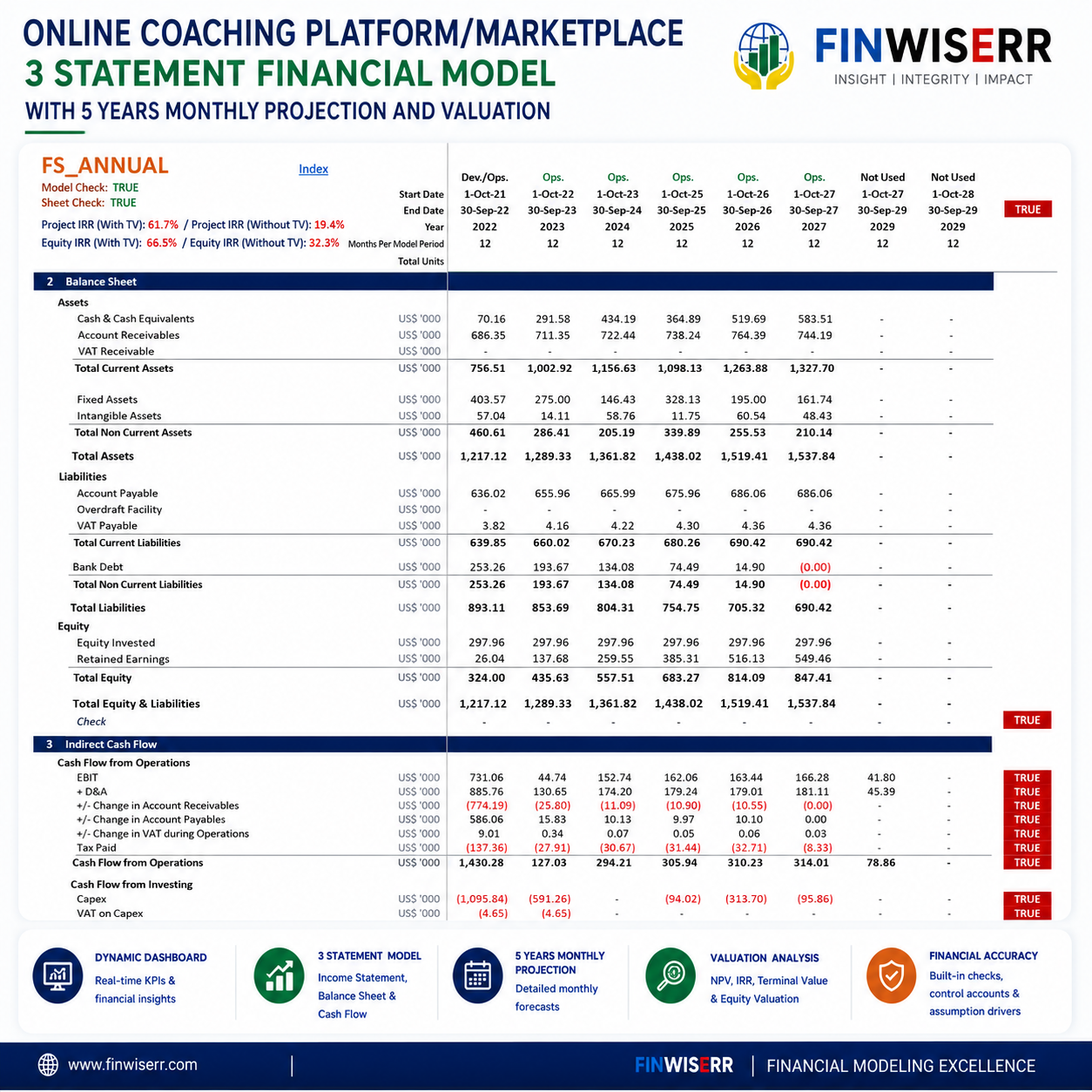
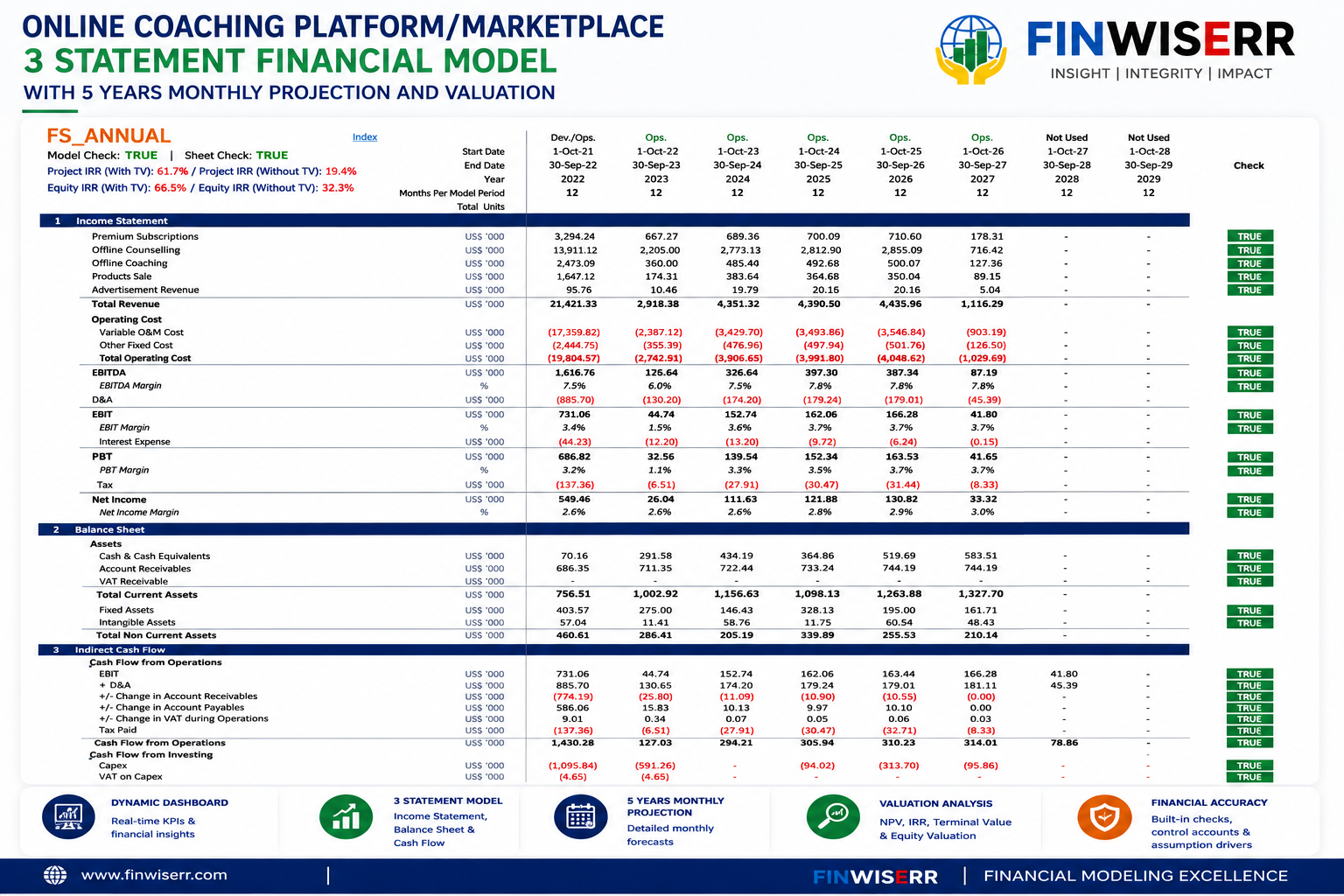
The model forecasts across development and operation on a monthly basis, with financial statements on both monthly and annual views. Every revenue and cost assumption can be entered across three scenarios and switched at the click of a button, so a conservative conversion case sits beside an optimistic one — and because the model uses no macros, every change flows through instantly.
Free and premium users tracked separately, so the cost of the free tier and the value of conversion are both visible.
Subscriptions, counseling, coaching, product sales and advertising, each on its own drivers.
A holding-period exit plus a full DCF valuation with and without terminal value.
New to these metrics? Read an overview of internal rate of return. For a model built to your own specification, see our financial advisory services, or browse the full range of business plan Excel models.
A freemium funnel and five revenue streams, with software amortised and a full exit — five years of monthly projections, ready in Excel.