$249.00
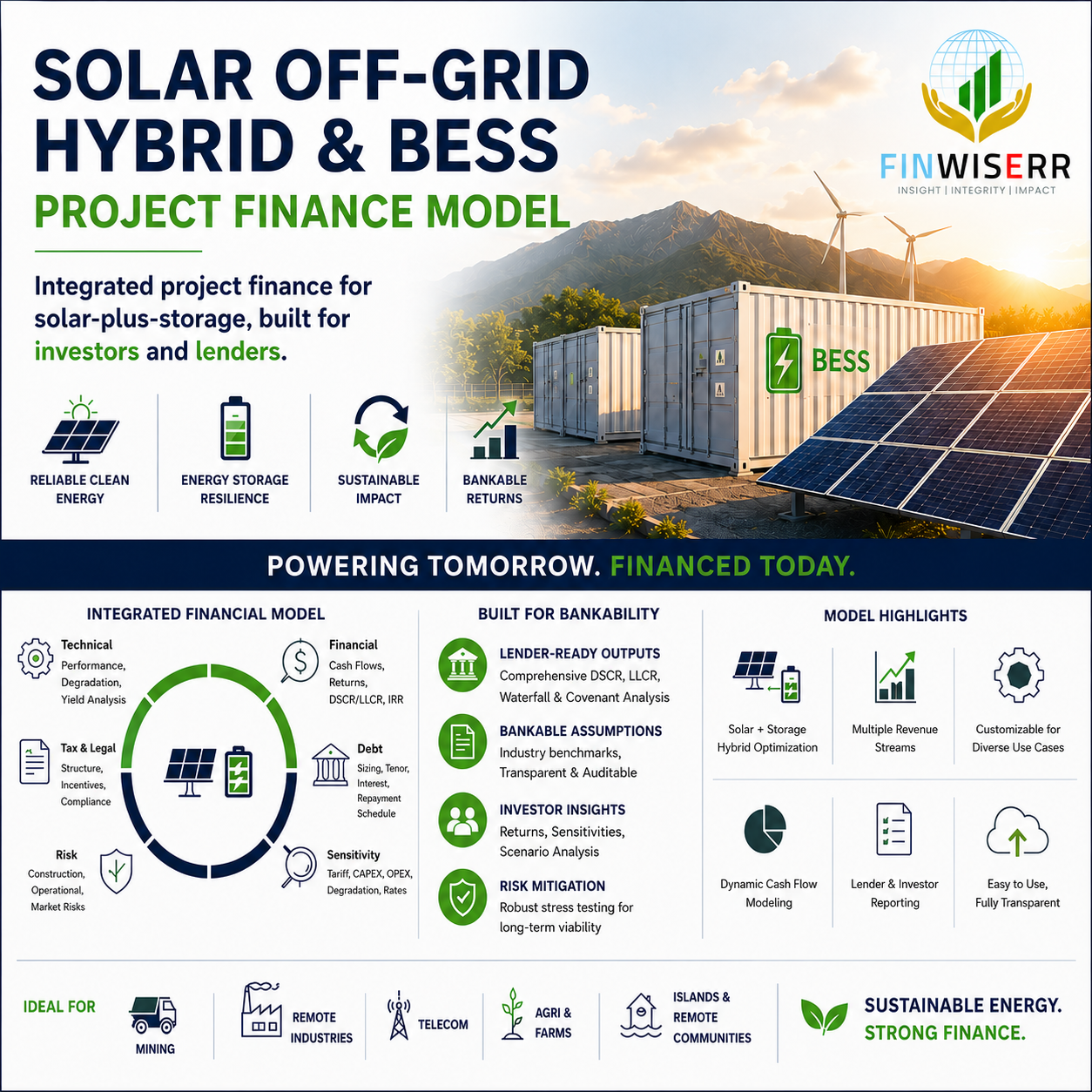
A detailed, institutional-grade solar BESS financial model for an off-grid solar project paired with a Battery Energy Storage System — covering construction, operations and decommissioning across thirteen linked sheets, with battery dispatch mechanics, a full senior and subordinate debt structure, LCOE and complete lender covenants.
Adding storage to a solar project changes the financial model fundamentally, and most templates simply do not account for it. A battery is not a solar panel with a different name. Energy goes in and less comes out, because round-trip efficiency takes a cut on every cycle. Capacity is bounded by cycles per day and an availability factor. The asset degrades on its own curve and must be replaced as a substantial capital outflow — often while the debt is still outstanding.
This solar BESS financial model handles all of it explicitly. Generation splits between direct consumption and energy sent to storage. Round-trip efficiency is applied after transmission and distribution losses. Maximum storage per period is derived from battery capacity, availability factor, degradation and daily cycles — and only then is energy recovered from the batteries added to direct supply to establish what you can actually bill.
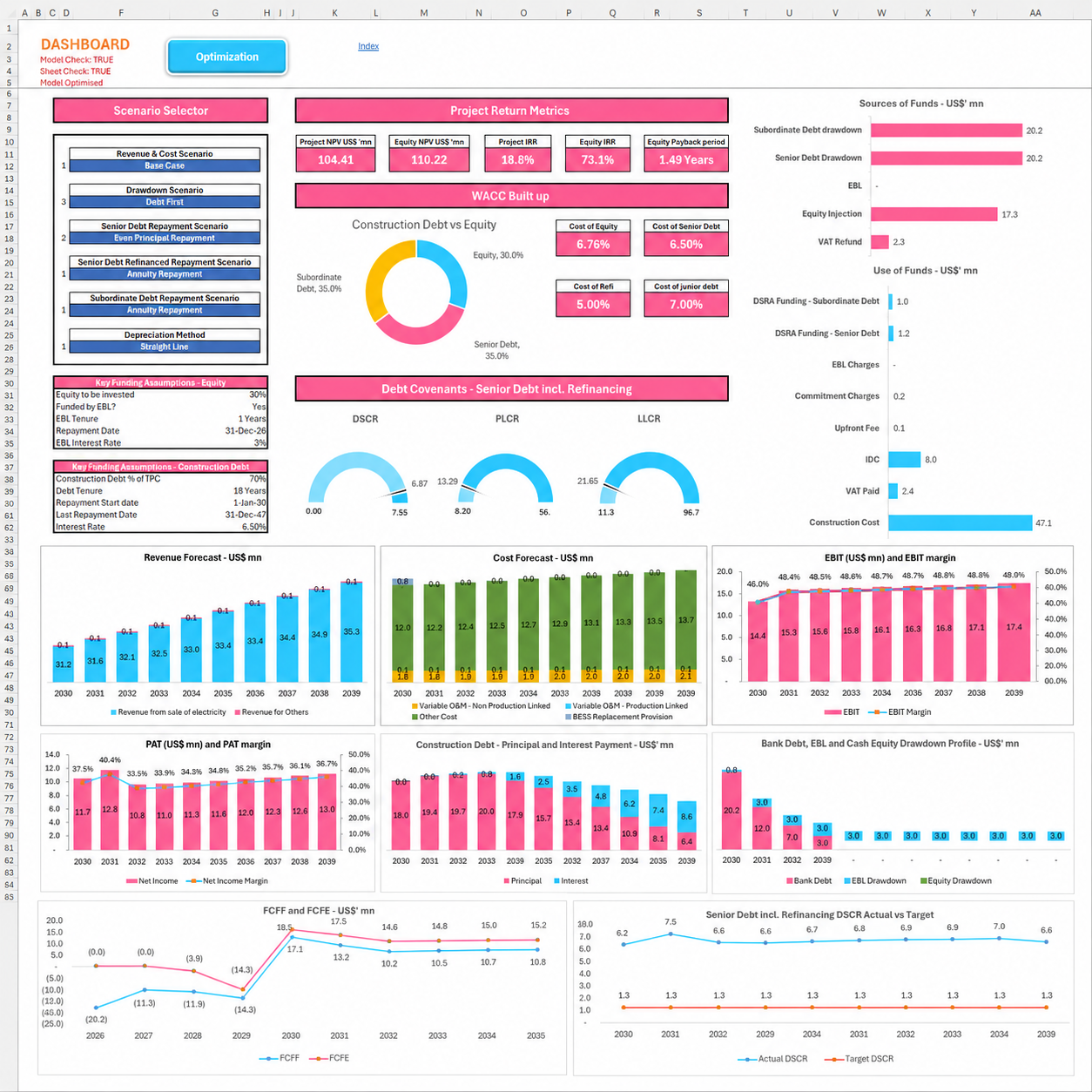
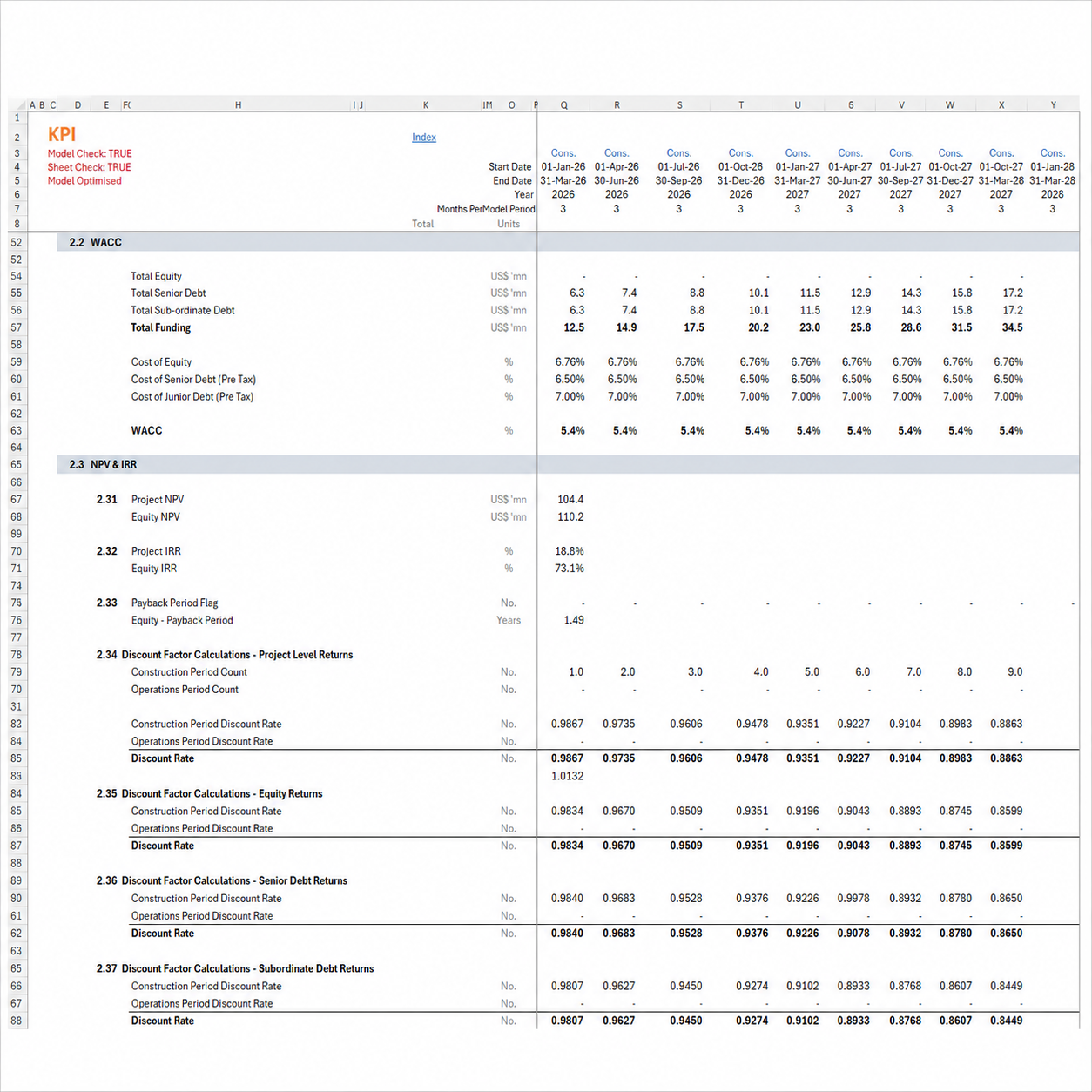
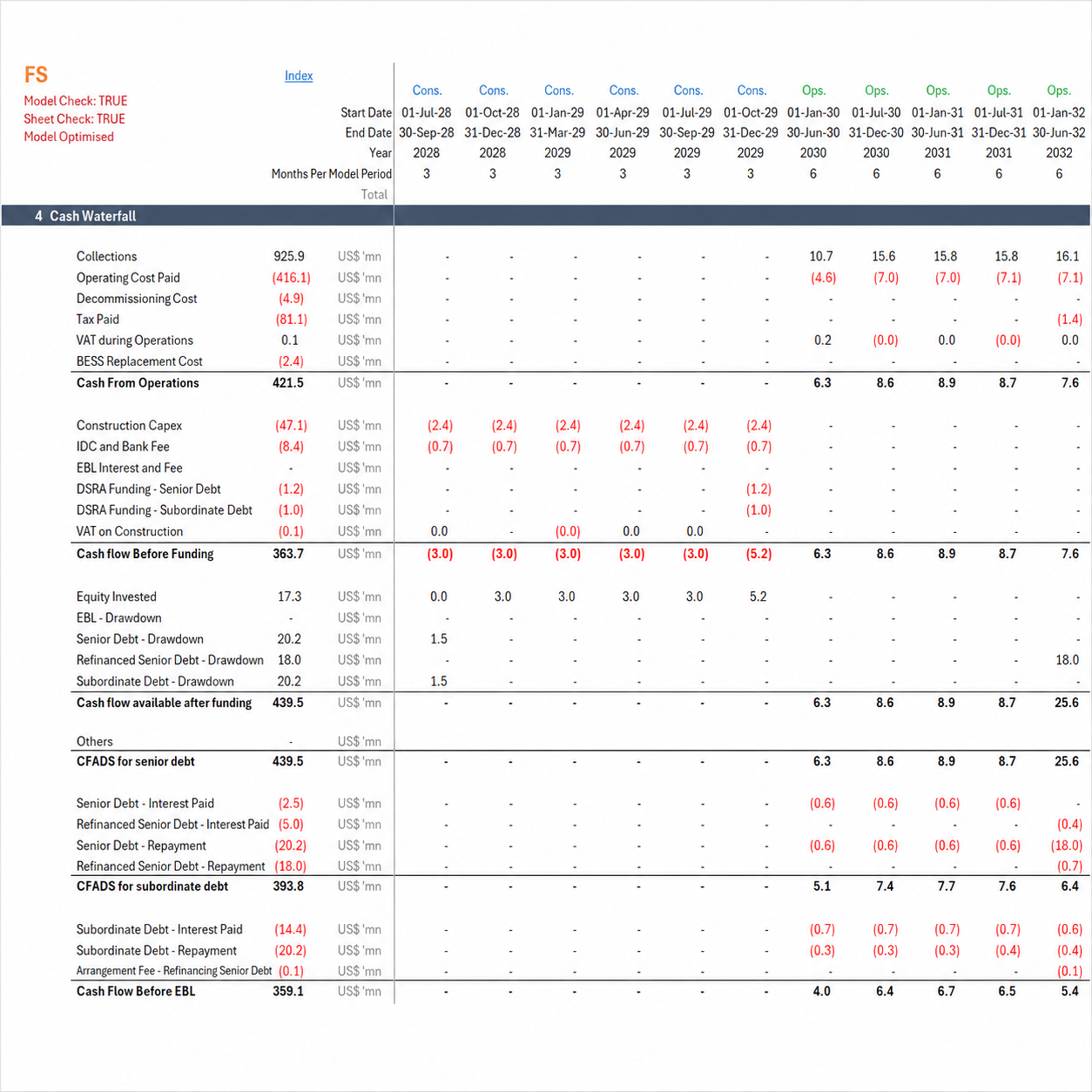
Around that engine sits a genuinely complete project finance structure — Project and Equity IRR and NPV, DSCR, LLCR and PLCR for both senior and subordinate debt, gearing ratios, equity payback, LCOE, a full cash waterfall and integrated financial statements on both periodic and annual bases.
Most renewable models assume everything generated is sold. Off-grid does not work that way, and neither does this one. The model calculates the off-taker’s actual energy demand from contracted capacity and load factor, calculates net available supply from solar plus recovered battery energy, and bills the lesser of the two.
That single piece of logic is what makes the model honest. Oversize the plant and you generate energy nobody pays for. Undersize it and you incur an unserved energy penalty — priced per kWh with a cap set as a percentage of period revenue. For a system contracted to keep the lights on, that asymmetry is the central commercial risk, and it is modelled rather than assumed away.
Storage capital cost is not one number. This solar BESS financial model separates the battery pack, battery management system, inverter and charger, energy management and control software, and installation and integration — each an individual input, so you can enter real supplier quotes rather than a blended estimate.
A dedicated BESS replacement reserve is then built from battery capex at construction and assumed battery life. The provision accrues through the operating period and the actual replacement expense lands when it falls due — both flowing separately through free cash flow. Battery replacement is the cost that quietly destroys returns in models that ignore it; here a lender can see the cash being set aside for it.
The funding module is where this model separates itself from anything at a comparable price. Senior debt is priced on SOFR plus margin, with arrangement and commitment fees modelled separately, and is sized from your minimum DSCR — the model computes maximum permissible debt rather than leaving you to iterate toward it. Subordinate debt runs alongside with its own tenor, pricing, repayment profile and a complete covenant suite of its own.
Refinancing is built in, with its own tenure, repayment dates, interest rate and arrangement fees, so you can model taking out construction debt with cheaper operational-phase debt. An Equity Bridge Loan lets you defer equity injection through construction and watch the effect on Equity IRR. DSRA accounts for both debt tranches are sized by the number of periods you specify.
Equity drawdown itself carries three scenarios — equity first, debt first, or pro-rata funding proportion — each producing a materially different IRR. Interest during construction, bank fees, EBL charges and construction-phase VAT all capitalise into the funding requirement, with a macro breaking the resulting circularity at the click of the Optimisation button.
Every driver of viability is an explicit input, with Base, Management and Upside cases on every revenue and cost line:
| Solar Plant Capex | Cost per kWp, interconnection, panels and other construction cost, with spare lines for your own categories |
| Battery Capex | Battery pack, battery management system, inverter and charger, energy management software, installation and integration |
| Development Costs | FEED, owner’s engineer, permits, legal and financial close |
| Solar Generation | Plant size, kW per sqm, in-plane irradiation capacity factor, performance ratio, annual yield, degradation and a twelve-month seasonality profile |
| Battery Dispatch | Direct-versus-stored split, round-trip efficiency after T&D loss, battery capacity, availability factor, degradation and cycles per day |
| PPA & Revenue | Contracted capacity, PPA term and dates, price per kWh, off-take load factor, unserved energy penalty and penalty cap, plus other revenue |
| Operating Costs | Variable O&M per kWh across staff, routine maintenance, insurance and overheads; fixed annual costs including SPV, insurance, security and management fee |
| Reserves & Lifecycle | BESS replacement reserve driven by battery life, decommissioning cost and reserve, and a defined decommissioning period |
| Financing | Senior debt, subordinate debt, refinancing, equity bridge loan, overdraft and DSRA — all SOFR-plus-margin with separate fee structures |
| Indexation | Ten independent CPI curves with individual start dates, covering tariff escalation, capacity tariff and merchant price |
| Tax & VAT | Income tax with a tax holiday period, VAT on revenue, cost and construction capex, and a VAT settlement period |
Six independent selectors sit on the dashboard: the revenue and cost case, the debt drawdown scenario, senior debt repayment profile, refinanced debt repayment profile, subordinate debt repayment profile, and depreciation method. Change any one and the returns, covenants and statements update together. That means you can test how a sculpted senior tranche paired with an annuity subordinate tranche affects minimum DSCR — the kind of question that usually requires rebuilding a model, answered here in a click.
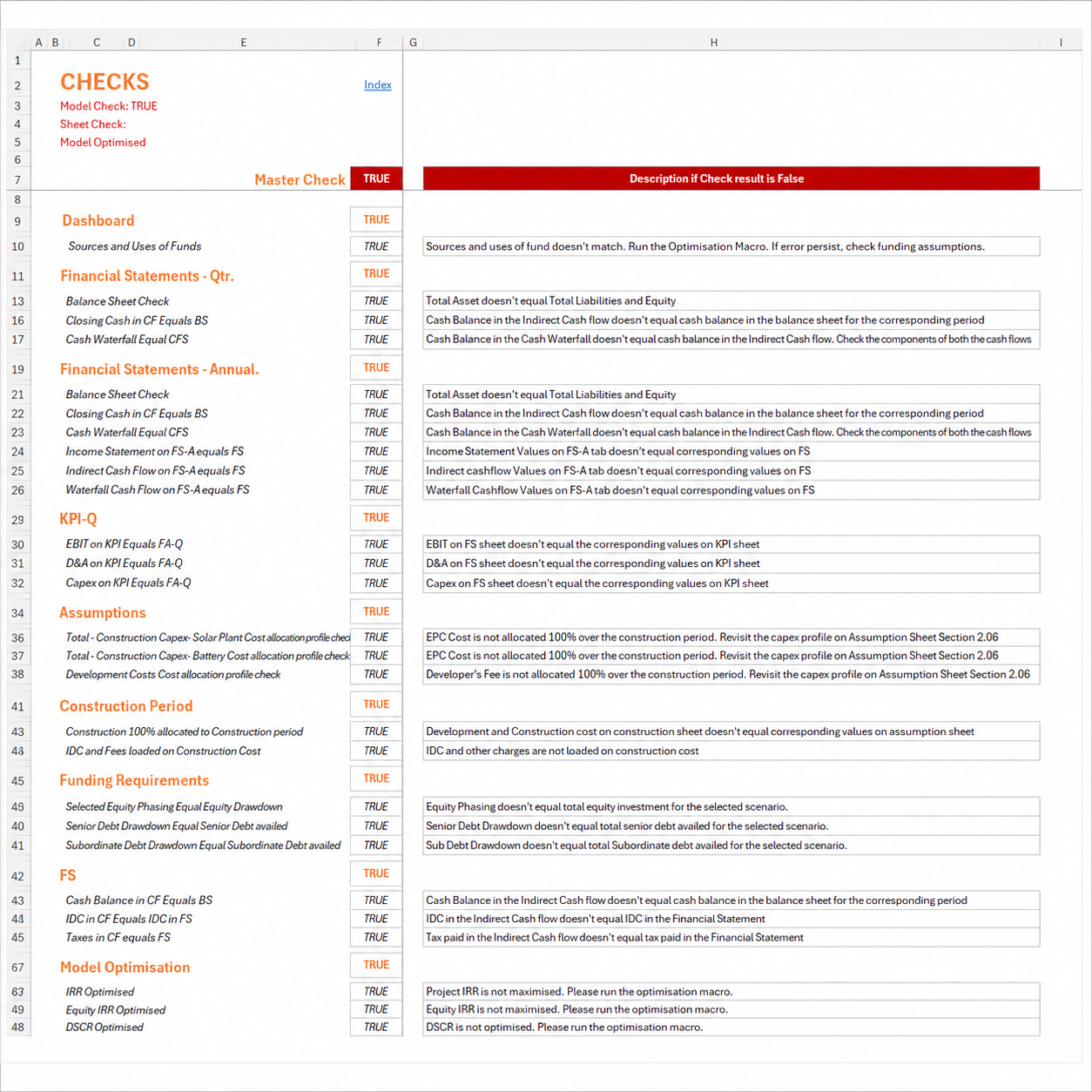
Thirteen sheets, colour-coded by function — inputs, calculations, outputs and information — with consistent cell styles distinguishing every input, calculation and total. A dedicated Checks sheet runs arithmetic and logical tests, and each sheet carries its own model check and sheet check in fixed cells, so an error announces itself immediately rather than hiding. A Read Me sheet documents the model map, cell styles, abbreviations and macro guidance. This is a file you can hand to a lender’s technical adviser.
Round-trip efficiency, cycles per day, availability, degradation and a funded replacement reserve — mechanics a solar template cannot express.
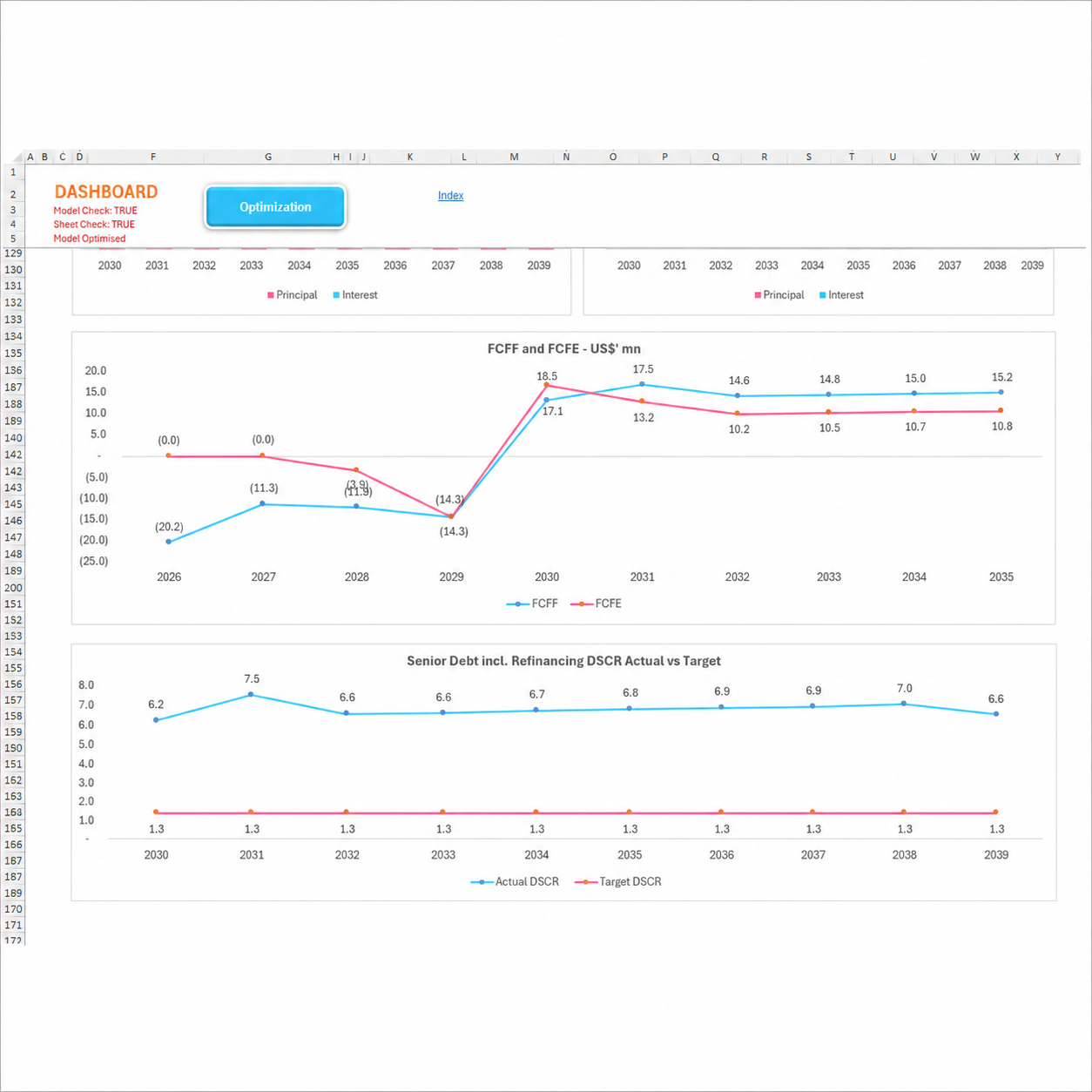
Senior and subordinate debt each carry their own DSCR, LLCR and PLCR, with refinancing and DSRA built in.
Billable energy is the lesser of demand and supply, with an unserved energy penalty and cap — so under-delivery costs money in the model, as it would in reality.
New to these metrics? Read an overview of the debt service coverage ratio. For a model built to your own specification, see our project finance advisory services, or browse the full range of PPP and project finance templates.
Battery dispatch and replacement reserve, unserved-energy penalties, senior and subordinate debt with refinancing, DSCR-sized debt and LCOE — thirteen linked sheets, ready in Excel.