
Business Valuation Consulting Firm: 2026 Guide for U.S. Businesses
How to choose the right valuation adviser, understand the principal methods and prepare for a reliable engagement

A business valuation consulting firm estimates the economic value of a company, ownership interest or intangible asset. The right adviser combines financial analysis, market evidence and professional judgment—and matches the valuation scope to the purpose of the assignment.
Selling a business, raising capital, bringing in a new shareholder or evaluating an acquisition often leads to the same question: what is the business worth? The answer is rarely available from the balance sheet alone. A credible valuation considers expected cash flow, risk, comparable companies or transactions, asset values, capital structure and the purpose for which the conclusion will be used.
This guide explains what a business valuation consulting firm does, how the principal valuation approaches work, what information advisers typically require and how U.S. businesses can select the right provider. It also identifies situations in which a U.S.-credentialed appraiser, tax adviser, attorney or other jurisdiction-specific specialist may be necessary.
The Definition
What Is a Business Valuation Consulting Firm?
A business valuation consulting firm is an advisory practice that estimates the value of a business, a business ownership interest, a security or an intangible asset. The analysis may support a transaction, fundraising process, shareholder decision, strategic review, financial reporting exercise or another defined business purpose.
A professional engagement goes beyond applying a single market multiple. The adviser reviews the company’s historical performance, normalises earnings where appropriate, assesses the forecast, studies the industry and market environment, evaluates risk and selects methodologies that fit the facts of the assignment.
An indicative valuation used for internal planning is different from a valuation prepared for tax, litigation, regulatory or lender reliance. The required credentials, standards, documentation and report format depend on the intended use and jurisdiction.
When It’s Needed
When Might a Business Need a Valuation?
Businesses commonly seek independent valuation advice for the following purposes:
- Business sale, merger or acquisition negotiations
- Capital raising and investor discussions
- Shareholder entry, exit, buyout or succession planning
- Strategic planning and evaluation of growth alternatives
- Management incentive plans and equity-related decisions
- Purchase price allocation or financial reporting support
- Tax, estate, gift, divorce or dispute matters
- Lender, SBA or other financing requirements
The final three categories can involve specific U.S. professional, legal, tax or lender requirements. Before appointing an adviser, confirm who may rely on the valuation, which standards apply and whether a locally credentialed professional must sign or review the report.
The Methodology
The Three Principal Valuation Approaches
Most business valuations draw on one or more of three recognised approaches. The appropriate method depends on the company, the available information and the valuation purpose.
Income Approach
The income approach estimates value from the future economic benefits expected from the business. The discounted cash flow (DCF) method is a common technique: projected free cash flows are discounted to present value using a rate that reflects the time value of money and the risks associated with the forecast.
DCF analysis is particularly useful when management can prepare a supportable forecast and when future performance may differ materially from recent historical results. Its reliability depends on the quality of the forecast, terminal-value assumptions and discount rate.
Market Approach
The market approach compares the subject business with similar publicly traded companies or completed transactions. Common techniques include the guideline public company method and the guideline transaction method. Relevant valuation multiples may be applied to revenue, EBITDA, EBIT or another operating measure.
The challenge is comparability. Differences in size, growth, profitability, customer concentration, geography, capital intensity and liquidity can materially affect value. A credible adviser explains why each comparable was selected and how differences were considered.
Asset Approach
The asset approach estimates value with reference to the fair value of assets less liabilities. It may be particularly relevant for holding companies, asset-intensive businesses, businesses with weak or uncertain earnings, or companies being evaluated on a liquidation basis.
Book value is not automatically fair value. Real estate, equipment, inventory, contingent liabilities and intangible assets may require adjustment, and specialist appraisals may be needed for certain asset classes.
Early-Stage Companies
How Startup Valuation Differs
Early-stage companies frequently lack a long operating history, stable earnings or positive cash flow. Their valuation therefore depends more heavily on scenarios, probability, market evidence and the economics of the funding round.
Depending on the stage and available data, advisers may consider:
- Venture capital method, working backwards from a potential exit value and required investor return
- Scenario-weighted DCF, reflecting different commercial and funding outcomes
- Comparable funding transactions and relevant revenue or user-based multiples
- Milestone-based methods such as the Scorecard or Berkus method as supplementary early-stage references
- Dilution, liquidation preferences, option pools and other terms affecting investor and founder economics
No single startup method should be treated as universally definitive. A fundraising valuation is also a negotiated commercial outcome; it may not be equivalent to a valuation prepared for tax, accounting or legal purposes.
The Process
A Typical Business Valuation Process
Define the purpose and standard of value. Establish the valuation date, subject interest, intended users, required deliverable and applicable professional standards.
Collect and review information. Analyse financial statements, management accounts, tax information, forecasts, debt, ownership records, operational data and relevant contracts.
Understand the business and industry. Discuss the business model, competitive position, customers, suppliers, management team, risks and growth plan.
Normalise financial performance. Consider owner compensation, related-party items, non-recurring costs, unusual income and other adjustments relevant to maintainable earnings.
Apply suitable valuation methods. Select and reconcile the income, market and asset approaches based on the facts and available evidence.
Perform sensitivity and scenario analysis. Test key assumptions such as growth, margins, discount rates and valuation multiples.
Document the conclusion. Present the methods, assumptions, limitations and conclusion in a format appropriate for the intended use.
Preparation
What Information Should the Business Prepare?
Good preparation improves both turnaround time and analytical quality. Advisers typically request:
- Three to five years of historical financial statements and recent management accounts
- Business plan, budgets and financial forecasts with supporting assumptions
- Revenue and margin analysis by product, service, geography or customer segment
- Customer and supplier concentration information
- Debt, cash, working-capital and capital-expenditure details
- Shareholding structure, shareholder agreements and details of options or preference shares
- Material contracts, leases, licences, intellectual property and contingent liabilities
- Information on non-recurring items and transactions involving owners or related parties
Fees
How Much Does a Business Valuation Cost?
There is no reliable universal fee for a business valuation. Cost depends on the intended use, complexity of the company, quality of the available data, number of entities or securities, required report depth, applicable standards, deadline and whether testimony or post-report support is required.
| Engagement Factor | Why It Affects the Fee |
|---|---|
| Purpose and reliance | A management estimate generally requires less documentation than a report intended for tax, court, lender or regulatory reliance. |
| Business complexity | Multiple entities, business lines, locations, securities or intangible assets increase analysis and review requirements. |
| Data readiness | Incomplete records, weak forecasts or extensive normalisation work can extend the engagement. |
| Deliverable | A calculation, presentation, summary report and comprehensive valuation report involve different levels of work. |
| Timing and support | Accelerated deadlines, negotiations, depositions or expert-witness support may require additional resources. |
Ask for a written, scope-based proposal defining the subject interest, valuation date, intended use, deliverable, assumptions, exclusions, timetable, fees and post-report support.
Selection Criteria
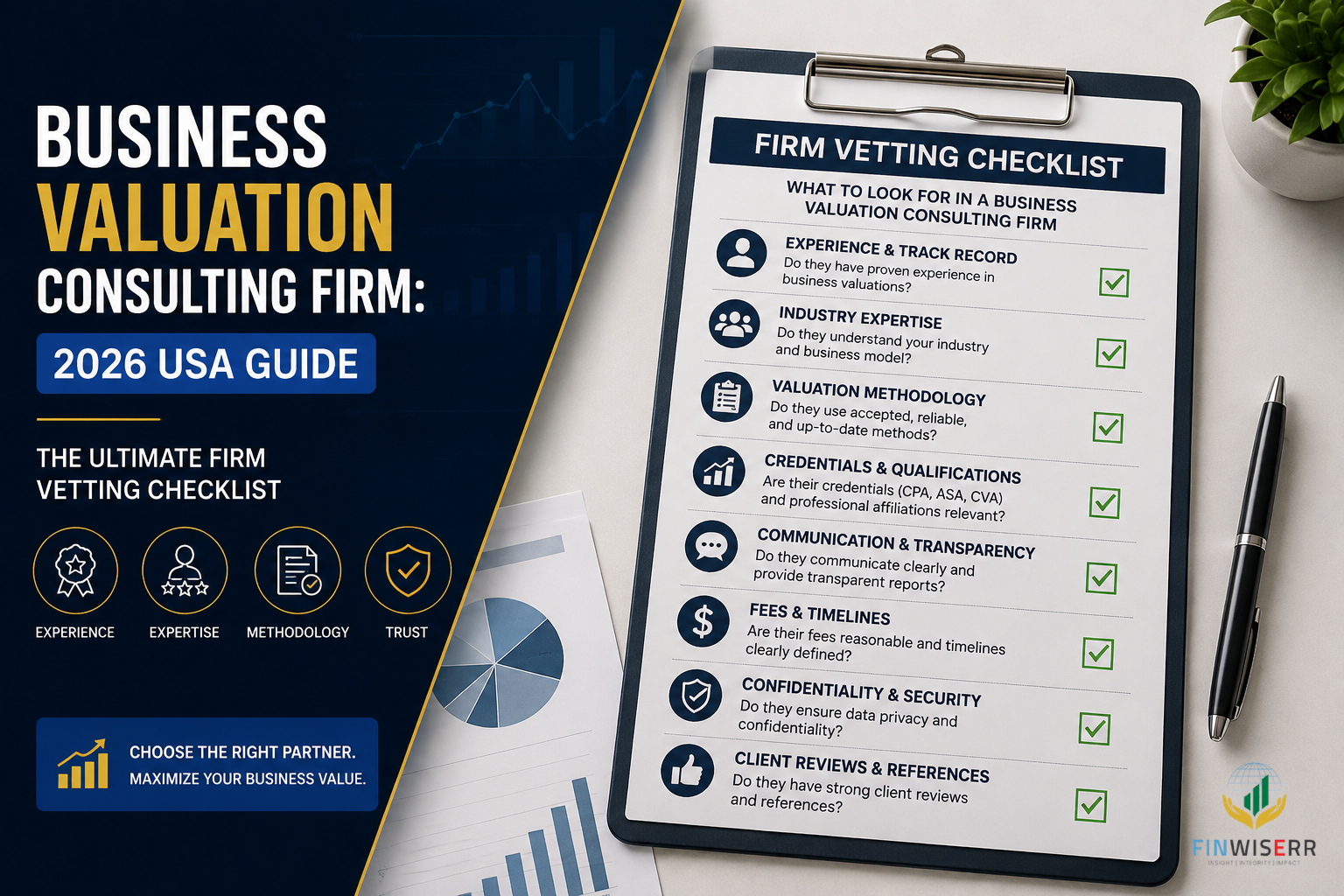
How to Choose the Right Business Valuation Consulting Firm
The most suitable adviser is not necessarily the largest firm or the lowest-priced provider. Use the following selection criteria:
- Relevant experience: Has the team valued businesses of a similar size, sector, stage and complexity?
- Purpose fit: Does the firm regularly undertake valuations for your intended use—transaction, fundraising, planning, reporting, tax or dispute?
- Methodology transparency: Can the adviser explain the likely approaches, information requirements and important assumptions?
- Professional credentials: If the report requires U.S. third-party reliance, are the necessary CPA/ABV, ASA, CVA or other qualifications available?
- Independence and conflicts: Has the firm identified relationships or incentives that could affect objectivity?
- Report quality: Can it provide a suitably redacted example or clearly describe the proposed deliverable?
- Commercial clarity: Are fees, timing, responsibilities, limitations and additional-support charges documented?
- Communication: Will senior team members remain accessible throughout the engagement?
Watch For
Red Flags to Avoid
- A conclusion offered before the adviser has reviewed the company’s financial and commercial information
- Dependence on a single generic multiple without explaining comparability or risk
- Guaranteed values or a willingness to target a predetermined outcome
- Unclear scope, undefined intended use or no written engagement terms
- Claims of tax, court, lender or regulatory acceptance without confirming applicable requirements
- No explanation of key assumptions, limitations or sensitivity to changing conditions
Regulatory Context
When a U.S.-Credentialed Specialist May Be Required
Valuations used for U.S. tax filings, estate and gift matters, litigation, certain financial reporting assignments, SBA-backed financing or equity compensation can involve specific rules and reliance requirements. The AICPA’s VS Section 100, for example, applies to AICPA members performing covered valuation services. IRS and SBA matters are governed by separate requirements and guidance.
Before proceeding, confirm the applicable standard with the relevant attorney, tax adviser, auditor, lender or regulator. An international valuation adviser may contribute financial modelling, market research and transaction analysis while an appropriately credentialed U.S. professional signs, reviews or relies on that work where required.
Our Approach
How Finwiserr Supports Business Valuation Decisions
Finwiserr supports businesses, founders, investors and project sponsors with financial advisory, valuation and financial modelling. Its work is designed to help decision-makers understand value drivers, test assumptions and evaluate transactions or strategic alternatives with greater clarity.
Depending on the engagement, support may include:
- Business and enterprise valuation for transactions and strategic decisions
- Financial modelling and scenario analysis
- M&A, fundraising and investor-decision support
- Project and investment valuation
- Review of business plans, forecasts and value drivers
- Cross-border analytical support coordinated with local professional advisers where necessary
Frequently Asked Questions
Common Questions
What does a business valuation consulting firm do?
It estimates the economic value of a business, ownership interest, security or intangible asset using financial analysis, market evidence and professional judgment. The scope and report format should match the purpose of the valuation.
Which business valuation method is the most accurate?
No method is universally the most accurate. DCF can be useful when reliable forecasts are available; market methods depend on relevant comparable evidence; and the asset approach can be appropriate for asset-intensive or liquidation situations. Advisers often consider more than one method.
How long does a business valuation take?
Timing depends on complexity, data availability, management access and the required deliverable. A clearly defined scope and well-prepared information package can materially shorten the process.
Is a broker’s estimate the same as an independent valuation?
Not necessarily. A broker’s estimate may be useful for an initial sale discussion, but it may have a different scope, methodology and level of documentation from an independent valuation prepared for defined third-party reliance.
Can one valuation be used for every purpose?
Usually not. A valuation prepared for internal planning may not satisfy tax, court, lender, accounting or regulatory requirements. The intended use and users should be established before the work begins.
Does Finwiserr provide valuation support for U.S. businesses?
Finwiserr provides valuation, financial modelling and transaction-related analytical support. Where an assignment requires a specific U.S. licence, credential, standard or local professional sign-off, the engagement scope should provide for the appropriate specialist involvement.
In Summary
Make the Valuation Fit the Decision
A useful valuation is not simply a number. It is a structured explanation of what drives value, which assumptions matter and how the conclusion should—and should not—be used. Start by defining the decision, intended users and required standard. Then select an adviser with the experience, methodology and credentials appropriate to that purpose.
Planning a transaction, fundraising process or strategic valuation? Speak with Finwiserr about a scope tailored to your business, intended use and decision requirements.