$120.00
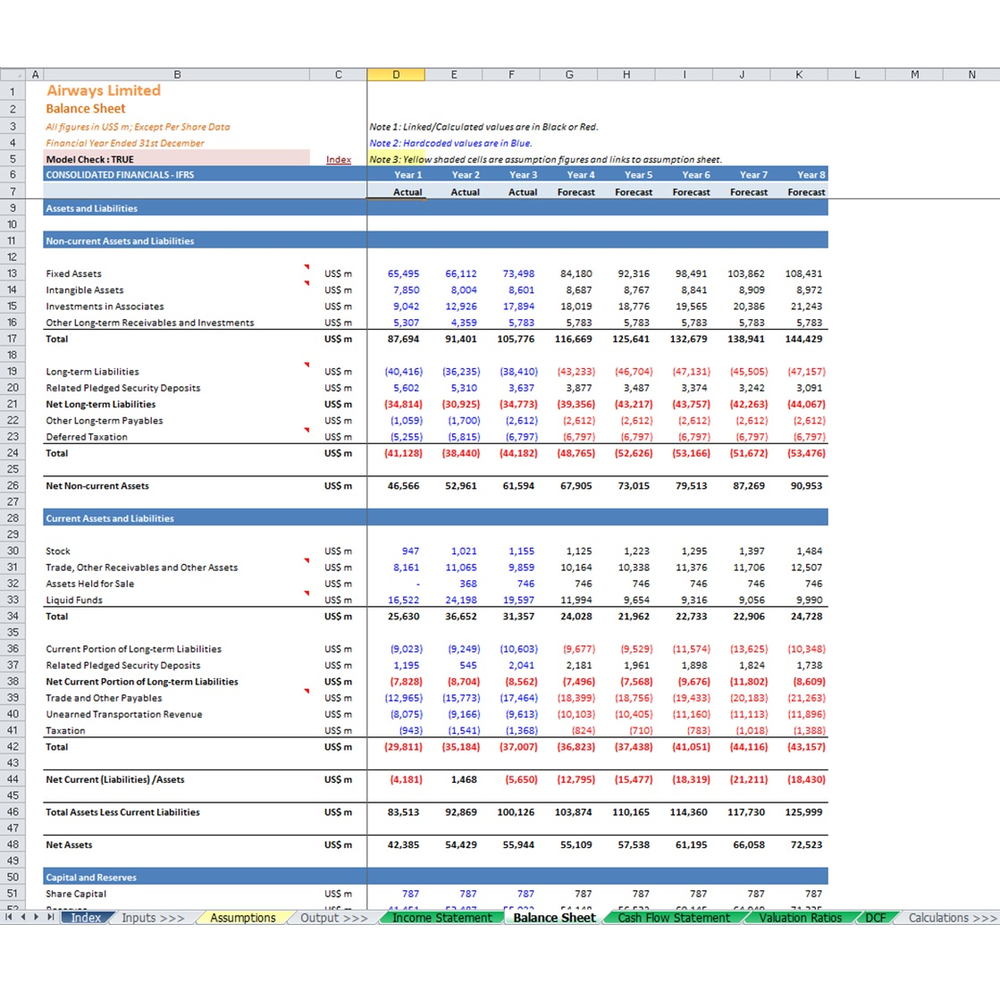
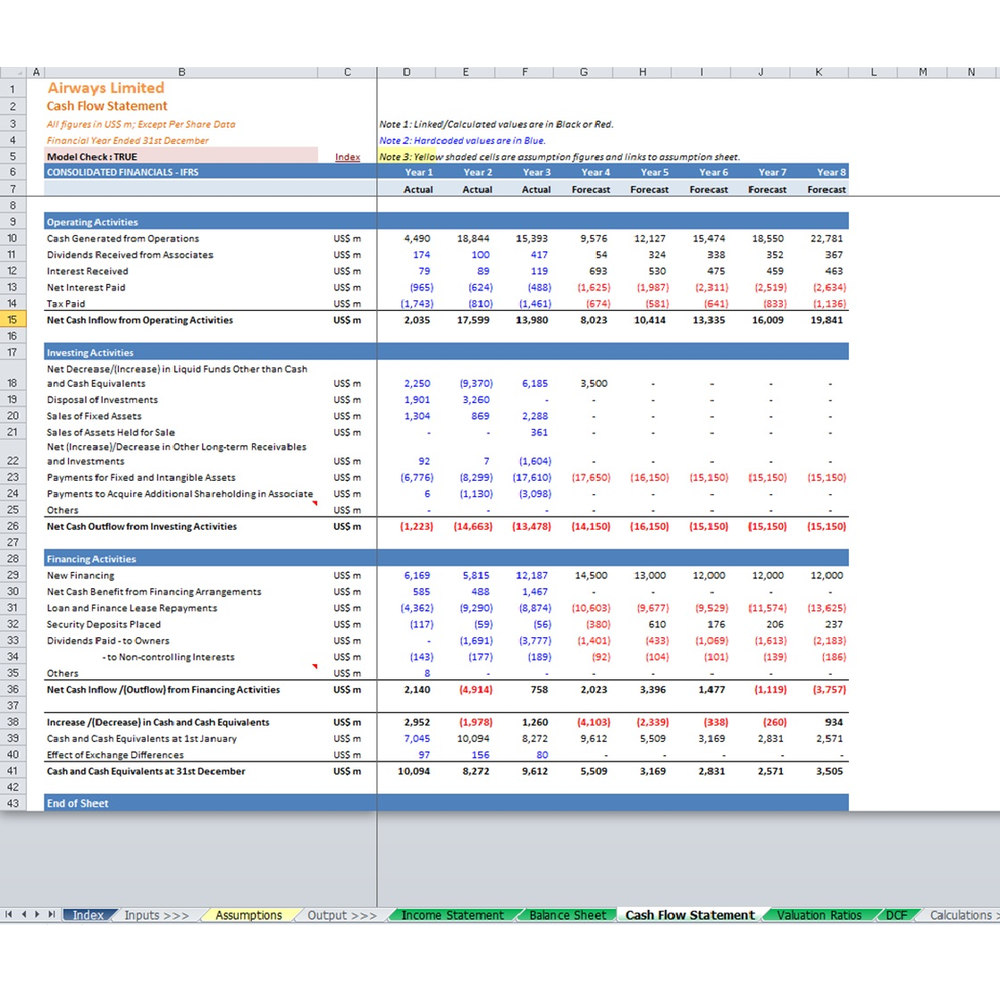
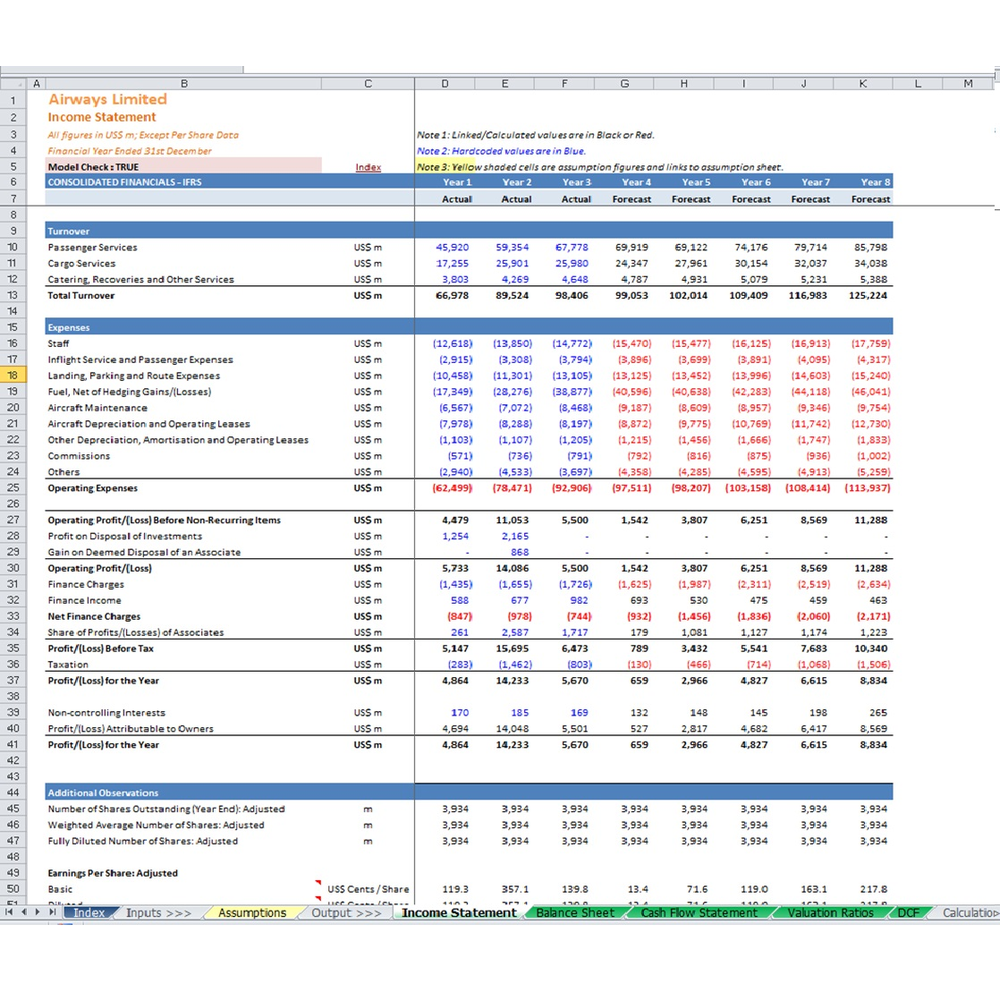
A detailed, user-friendly airline financial model with three integrated financial statements and full DCF-based valuation, built entirely in Excel.
Airlines do not forecast like ordinary businesses. Revenue is not a growth rate applied to last year’s figure — it is a function of yield, traffic, load factor and available capacity, and those four variables interact in ways that a simple percentage assumption cannot capture. Add a fleet that takes years to expand, fuel costs that can move thirty percent in a quarter, and a cost base that is largely fixed once the aircraft is in the air, and you have an industry where generic templates produce numbers nobody believes.
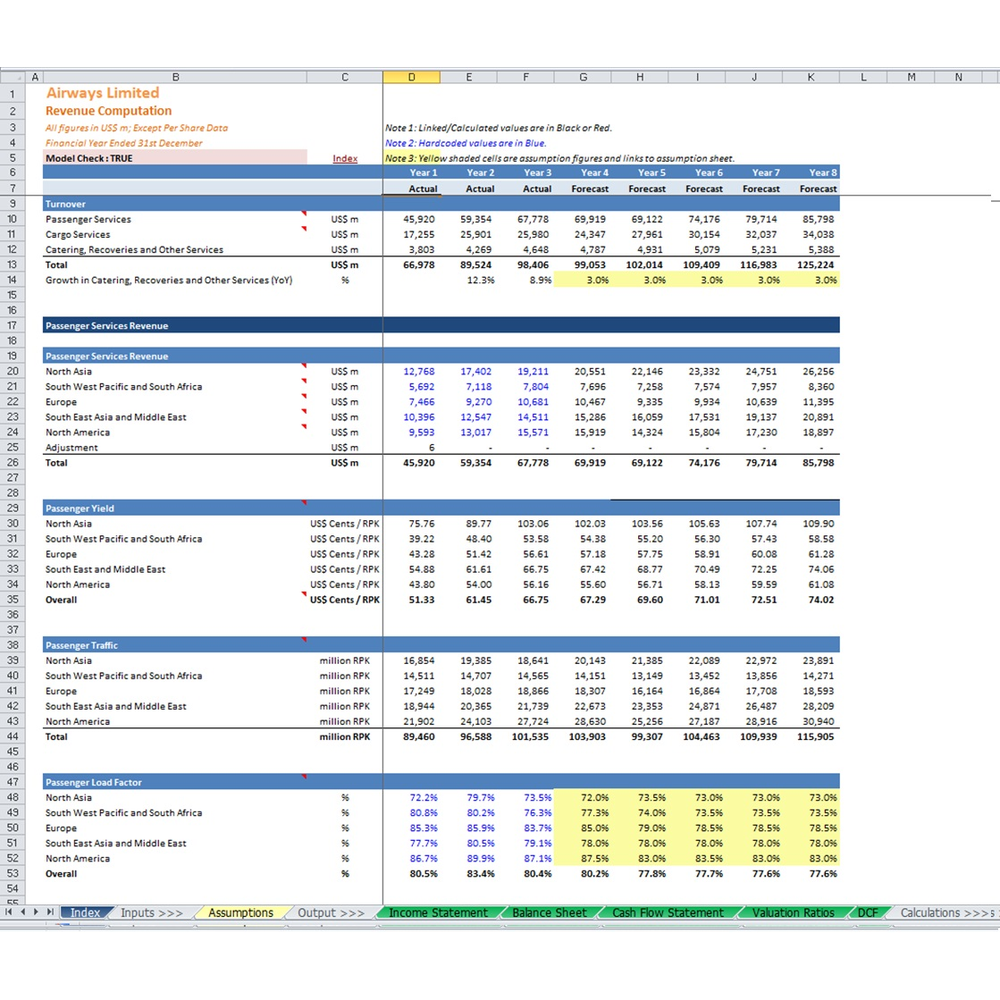
This model is built around the drivers that airline analysts actually work with, across both passenger and cargo operations. Revenue is constructed from the operating fundamentals upward, so when you flex load factor or adjust yield, the model responds the way the business would. That is the difference between a forecast you present and a forecast you defend.
The model covers 3 years of historical data plus a 5-year forecast period. Valuation is derived from the forecast using discounted cash flow methodology, with terminal value and discount rate assumptions fully under your control.
Passenger and cargo are two different businesses sharing an aircraft. They have different yield dynamics, different demand cycles and different sensitivities to economic conditions. Modelling them as one revenue line loses all of that.
Here they run independently. Passenger revenue is built from yield, traffic, load factor and capacity; cargo revenue from cargo yield, cargo traffic and capacity. You can stress one without distorting the other — useful when modelling a recovery scenario where freight rebounds ahead of leisure travel, or the reverse.
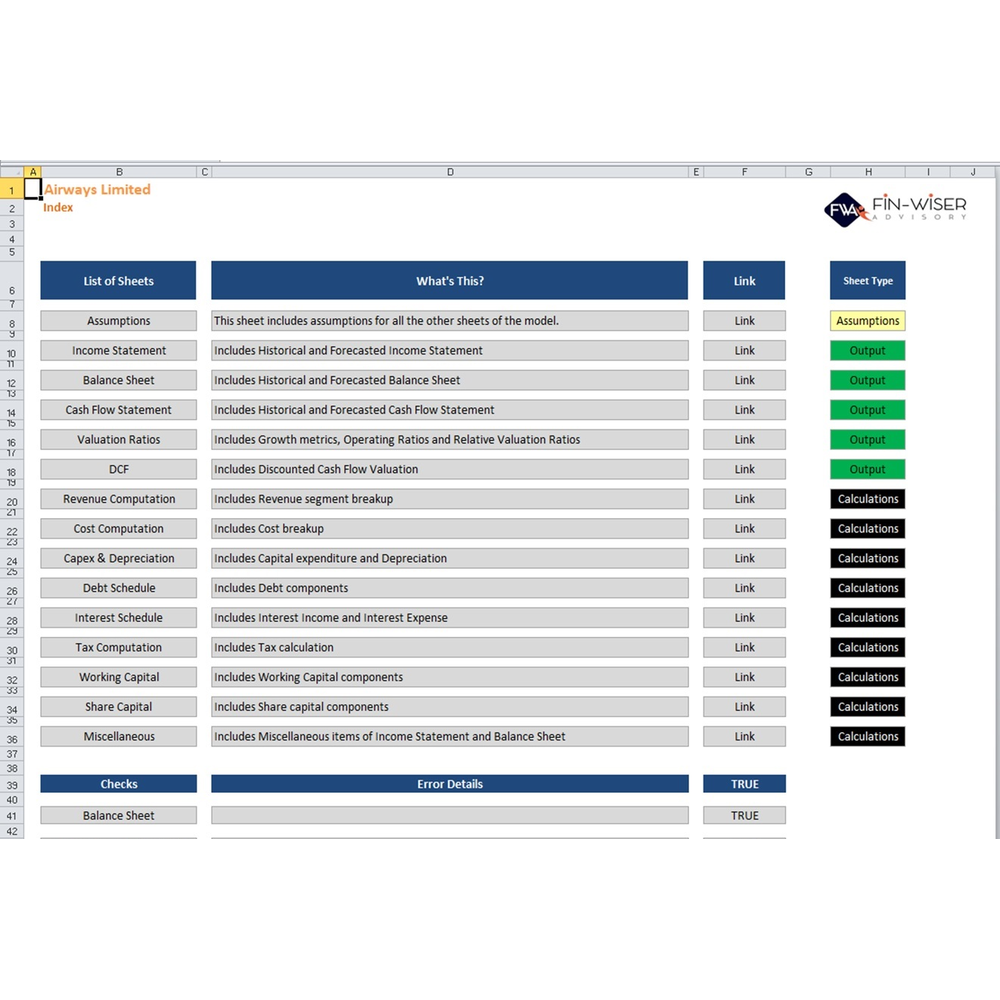
A single assumptions tab drives the entire model. Change an input and every statement, ratio and valuation output updates automatically. The inputs cover:
| Passenger Revenue | Passenger yield, passenger traffic, load factor and capacity |
| Cargo Revenue | Cargo yield, cargo traffic and capacity |
| Costs | Staff cost, fuel expense, landing, parking and route charges and more |
| Income Tax | Effective and statutory tax treatment |
| Working Capital | Receivables, payables and inventory |
| Capex & Depreciation | Tangible and intangible assets, with full amortisation schedules |
| Debt | Long-term and short-term borrowings |
| Share Capital | Issue of new shares and reserve accounts |
| Dividends | Interim and final dividend, including tax impact |
| Interest | Interest income and interest expense calculations |
Comprehensive calculations run off your inputs to generate a complete set of outputs:
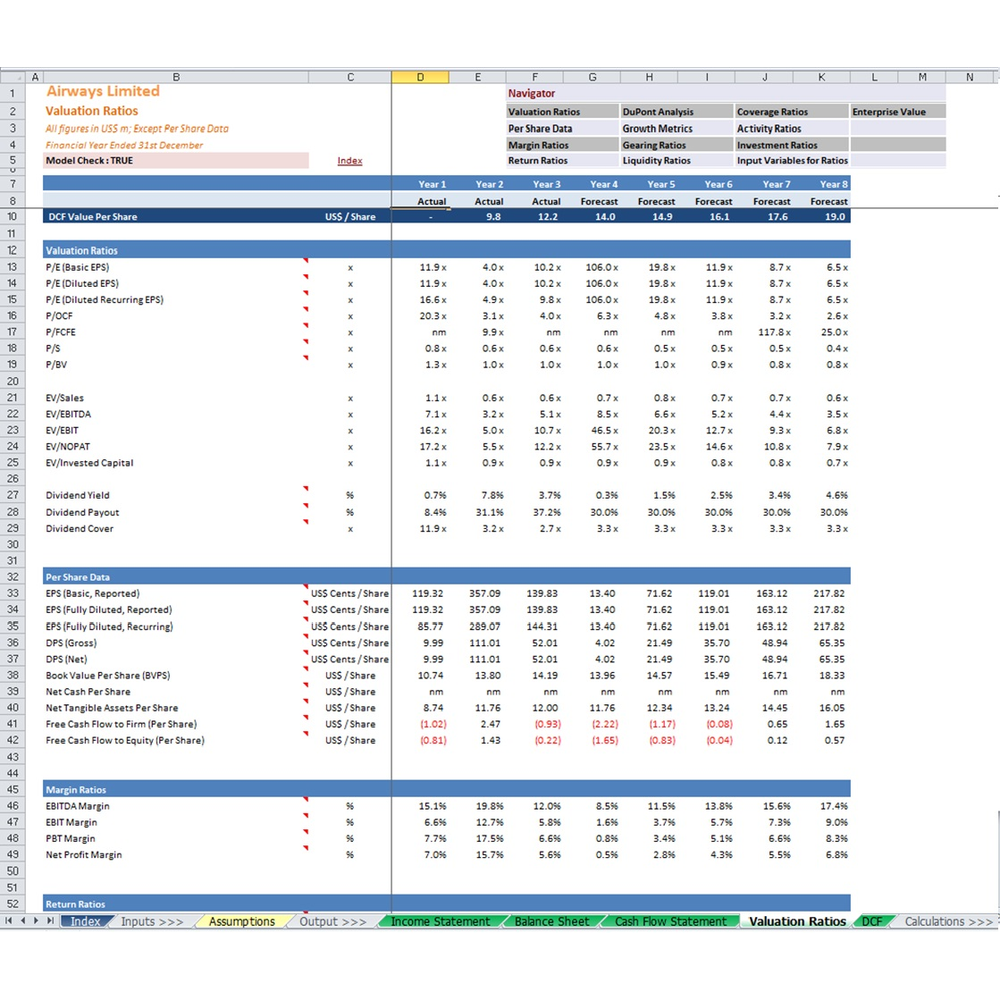
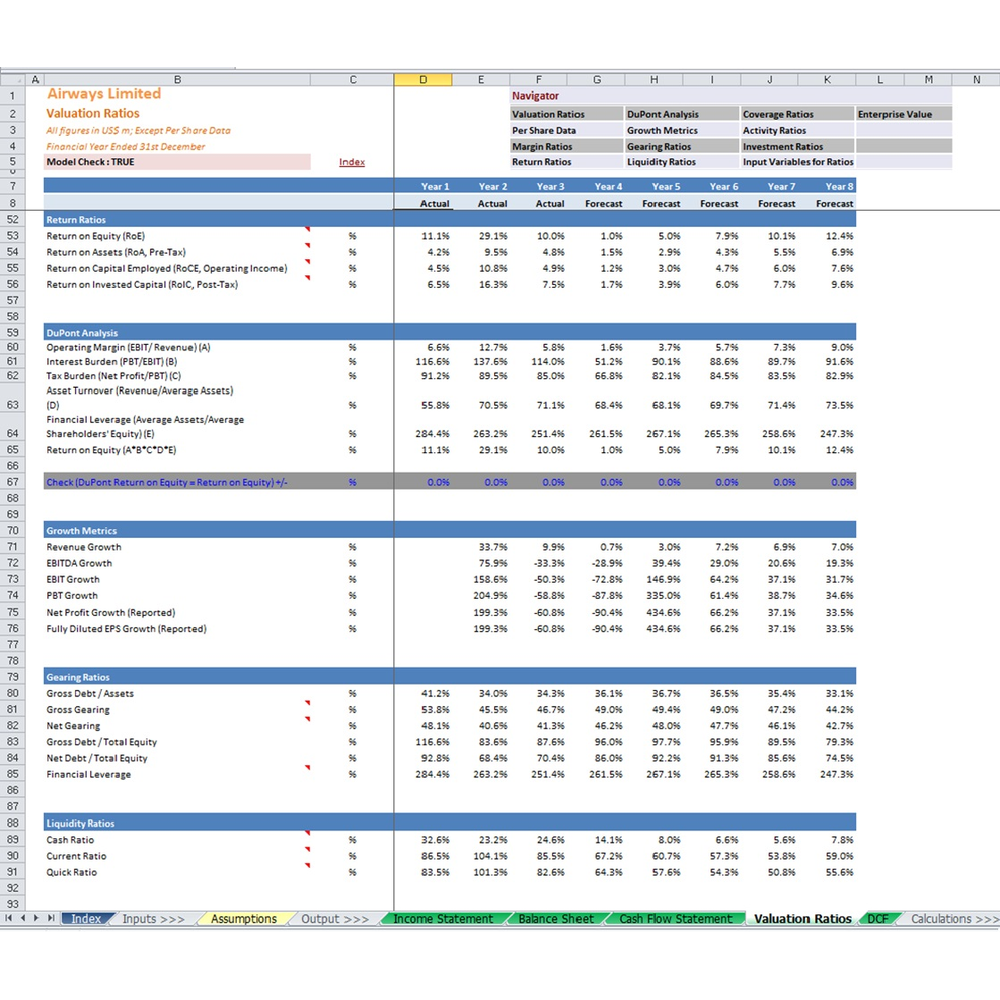
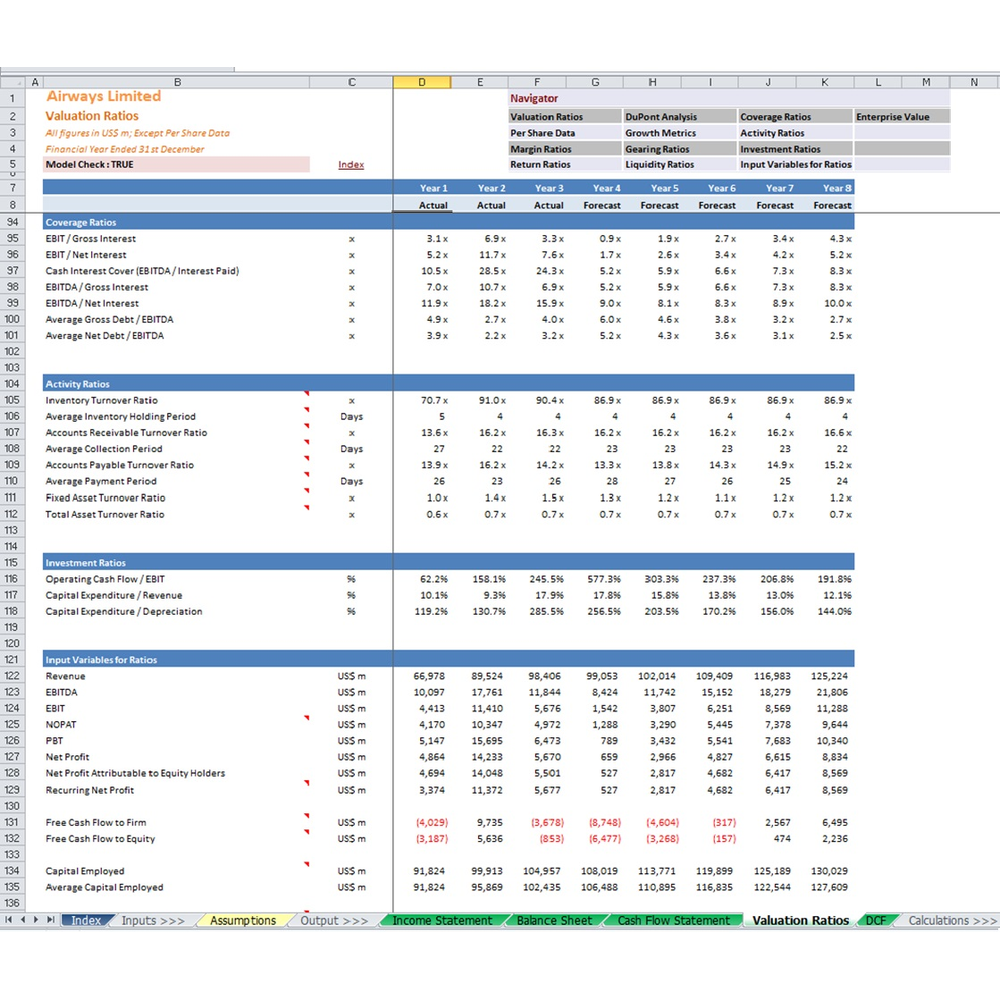
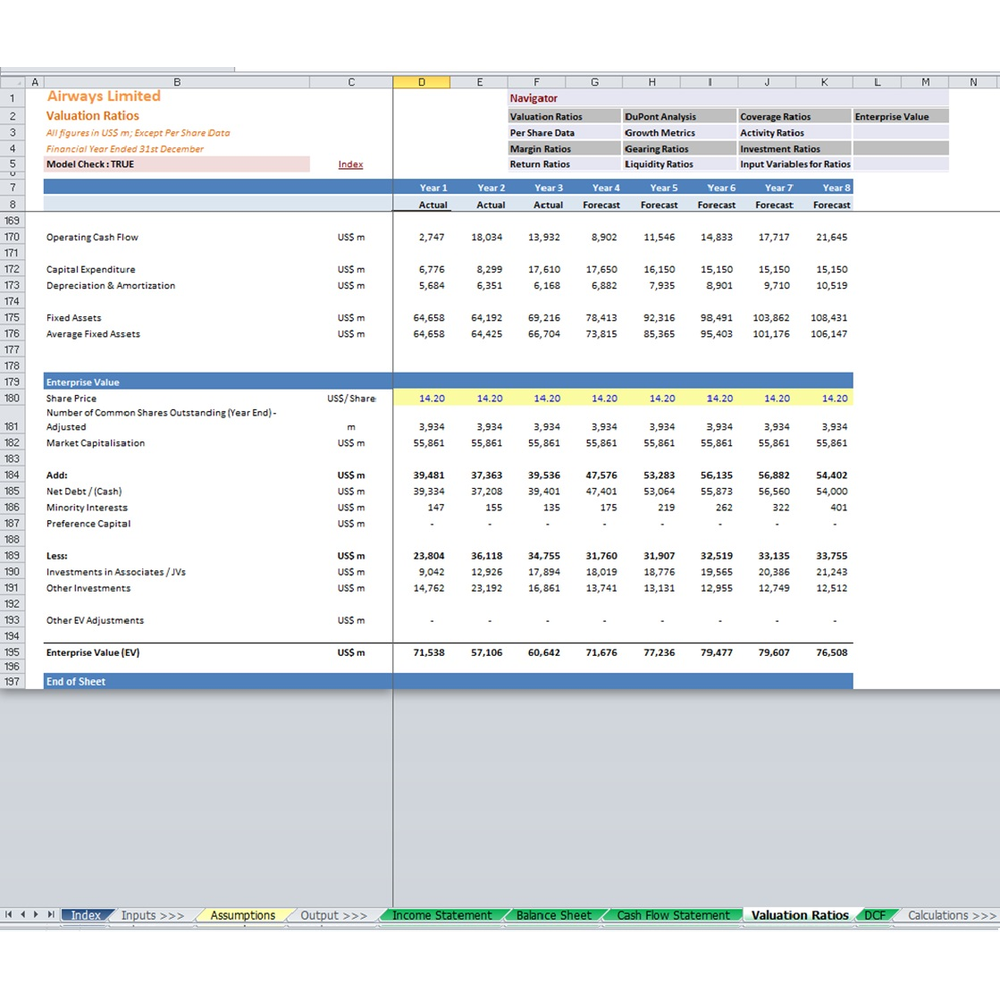
The analysis sheet goes considerably beyond a standard ratio summary, giving you the metrics an analyst would expect in a full valuation pack:
Price and EV-based valuation ratios, enterprise value, plus per-share data including EPS, DPS and FCFF per share.
Margin ratios, return ratios and a full DuPont decomposition of ROE into its operating, efficiency and leverage components.
Gearing ratios, liquidity ratios and coverage ratios — critical given the leverage and capital intensity of aviation.
Activity ratios covering asset and working capital efficiency, plus investment ratios for shareholder analysis.
Yield, traffic, load factor and capacity — the metrics airline analysts genuinely work with, not a generic revenue line dressed up.
Fuel is broken out as its own assumption, so you can stress the single most volatile input in the industry without touching anything else.
Every formula is visible and traceable. Audit the logic, adapt it to your own carrier, or use it to see how a proper DCF is constructed.
Need a model built to your own specification? See our financial advisory services, or browse the full range of DCF valuation templates.
Passenger and cargo revenue drivers, three years of history, a five-year forecast, DCF valuation and a complete ratio pack.