$120.00
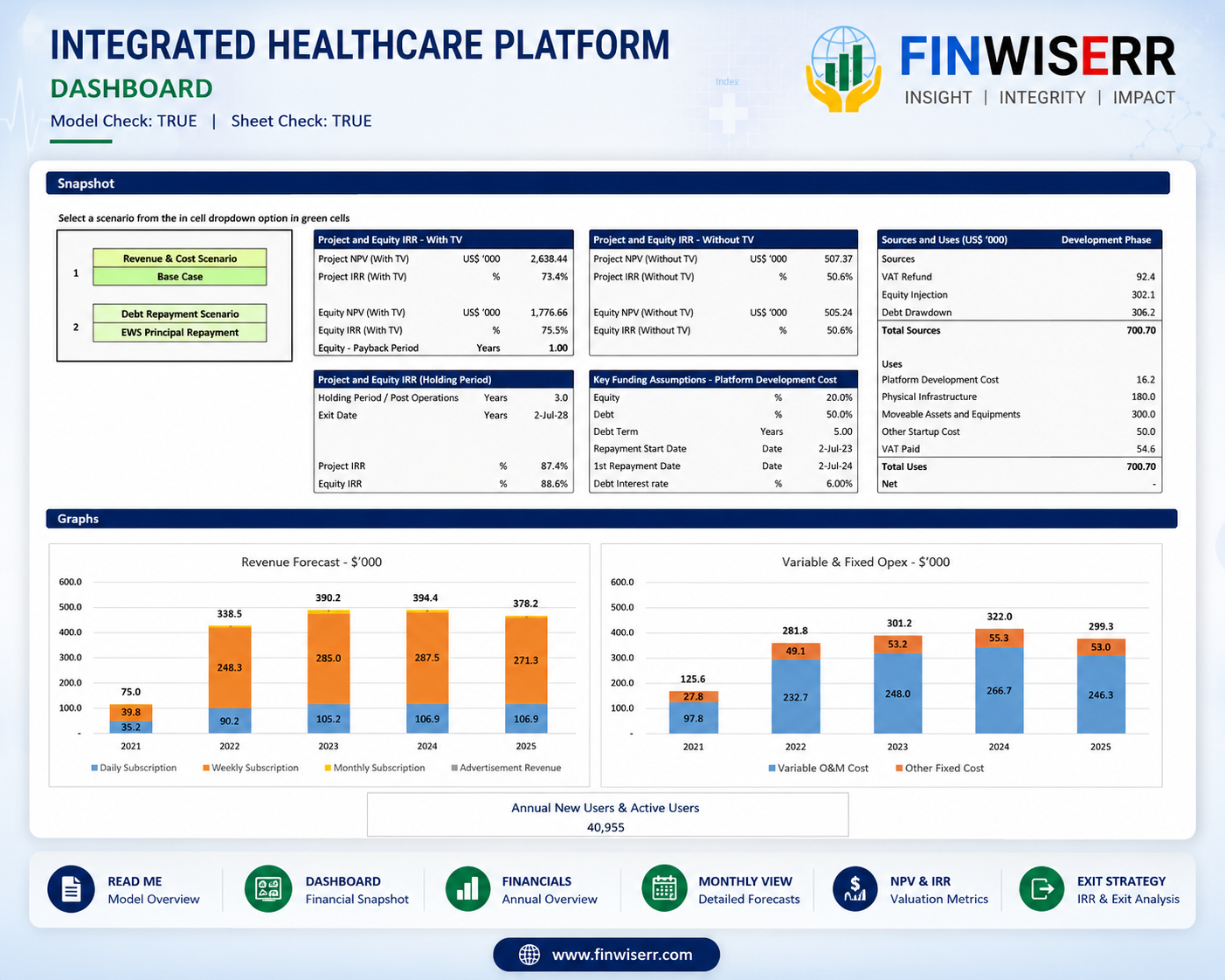
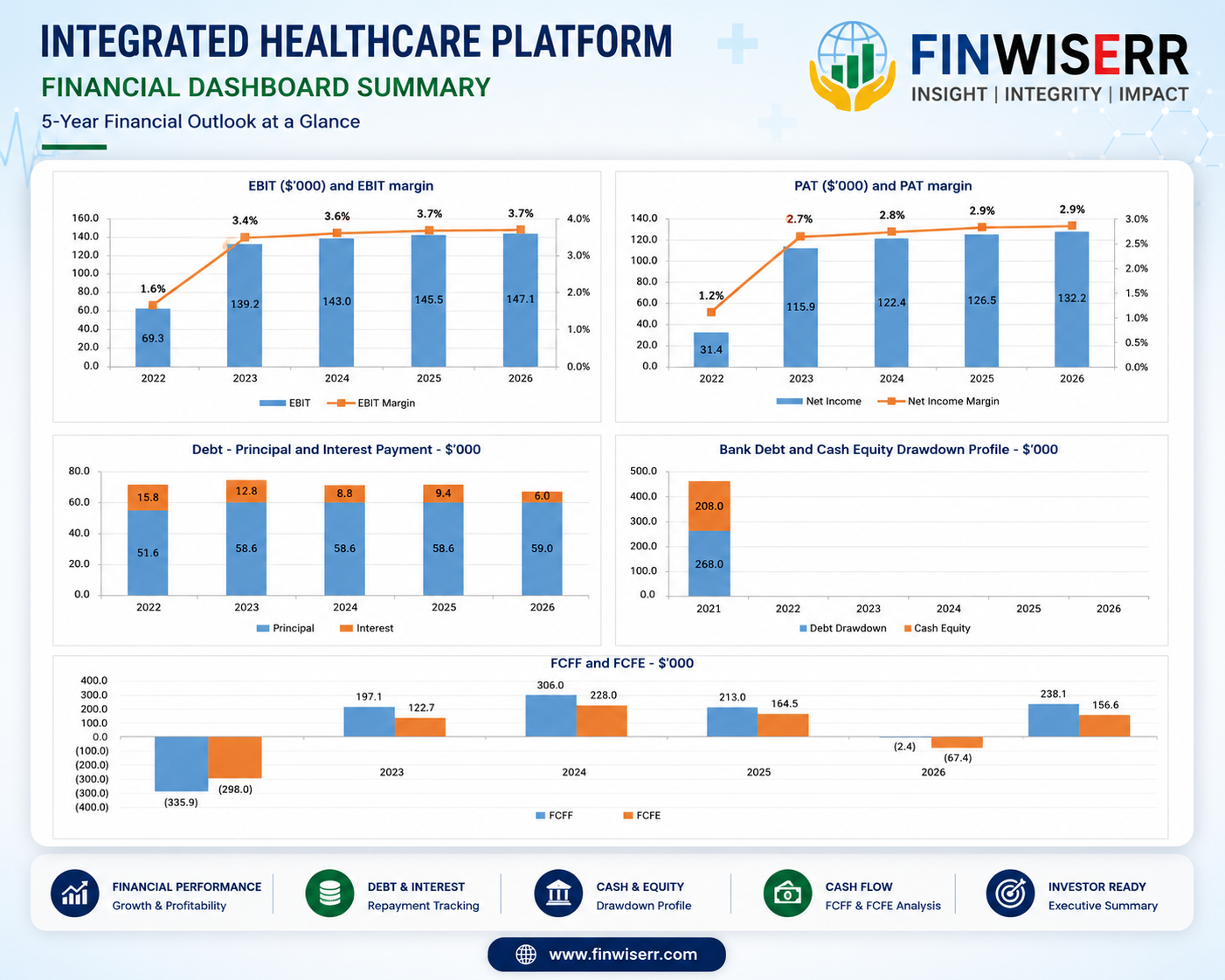
A detailed, investor-ready meal planning financial model for a subscription meal-plan business — with a four-tier subscription ladder, a user acquisition and retention funnel, an in-house kitchen operation and advertising revenue, plus platform-development and operation phases, break-even analysis and valuation, in one integrated Excel model.
A meal planning business sits at an unusual intersection: it has the recurring-revenue economics of a subscription app and the physical cost base of a kitchen. Users subscribe to a plan and pay on a repeating cycle; meanwhile food, kitchen staff and consumables are consumed producing the meals. Model only the subscription side and you understate the cost; model only the kitchen and you miss the retention dynamics that make or break the business. This model holds both.
Revenue is driven from a user funnel — registrations, retention and active-user rates — converted into subscribers across four plan tiers, with advertising layered on top. The kitchen operation is costed as a percentage of revenue across food, staff and consumables. Platform development is treated as the capitalised, amortised intangible it genuinely is, and the whole business flows through to a complete, investor-ready output set.
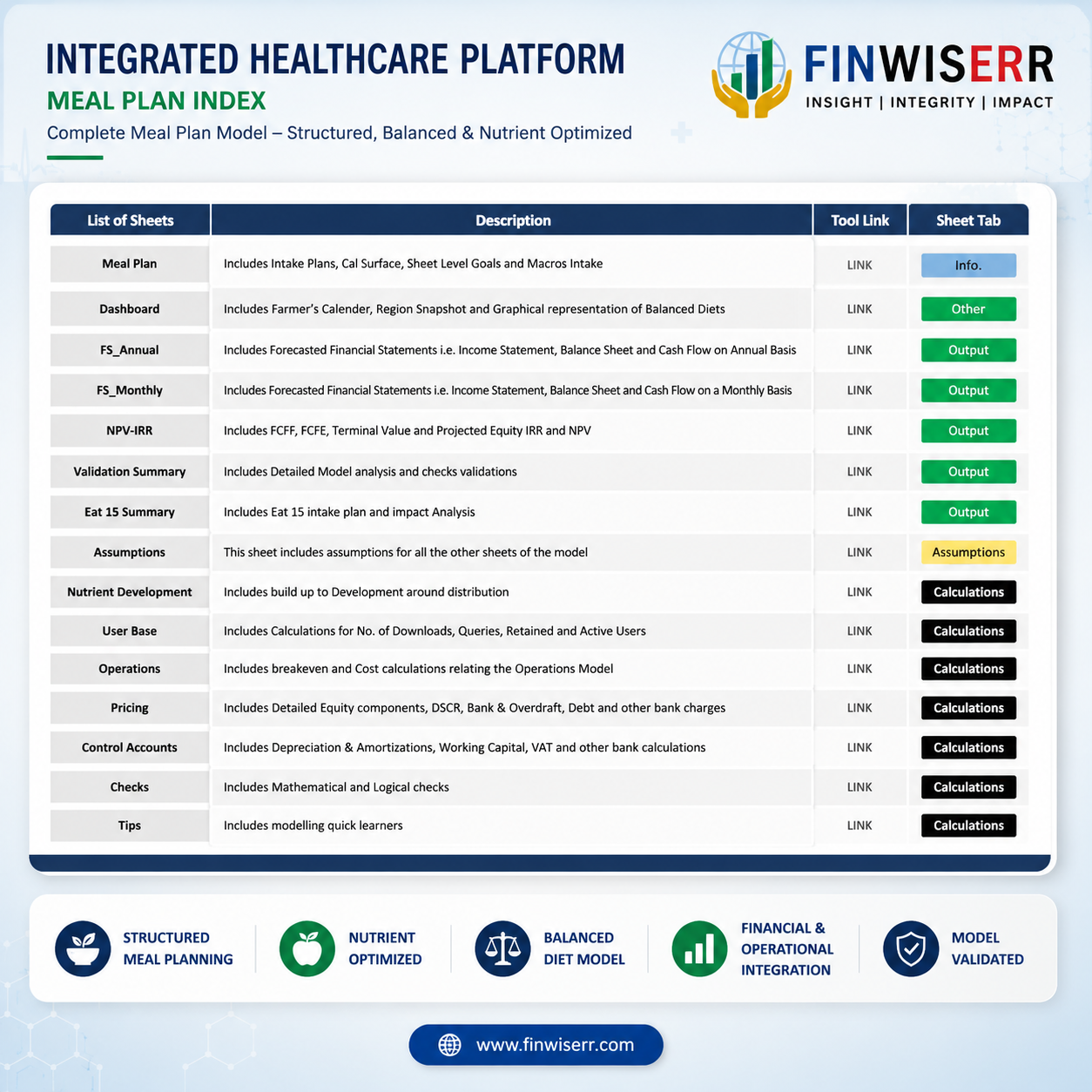
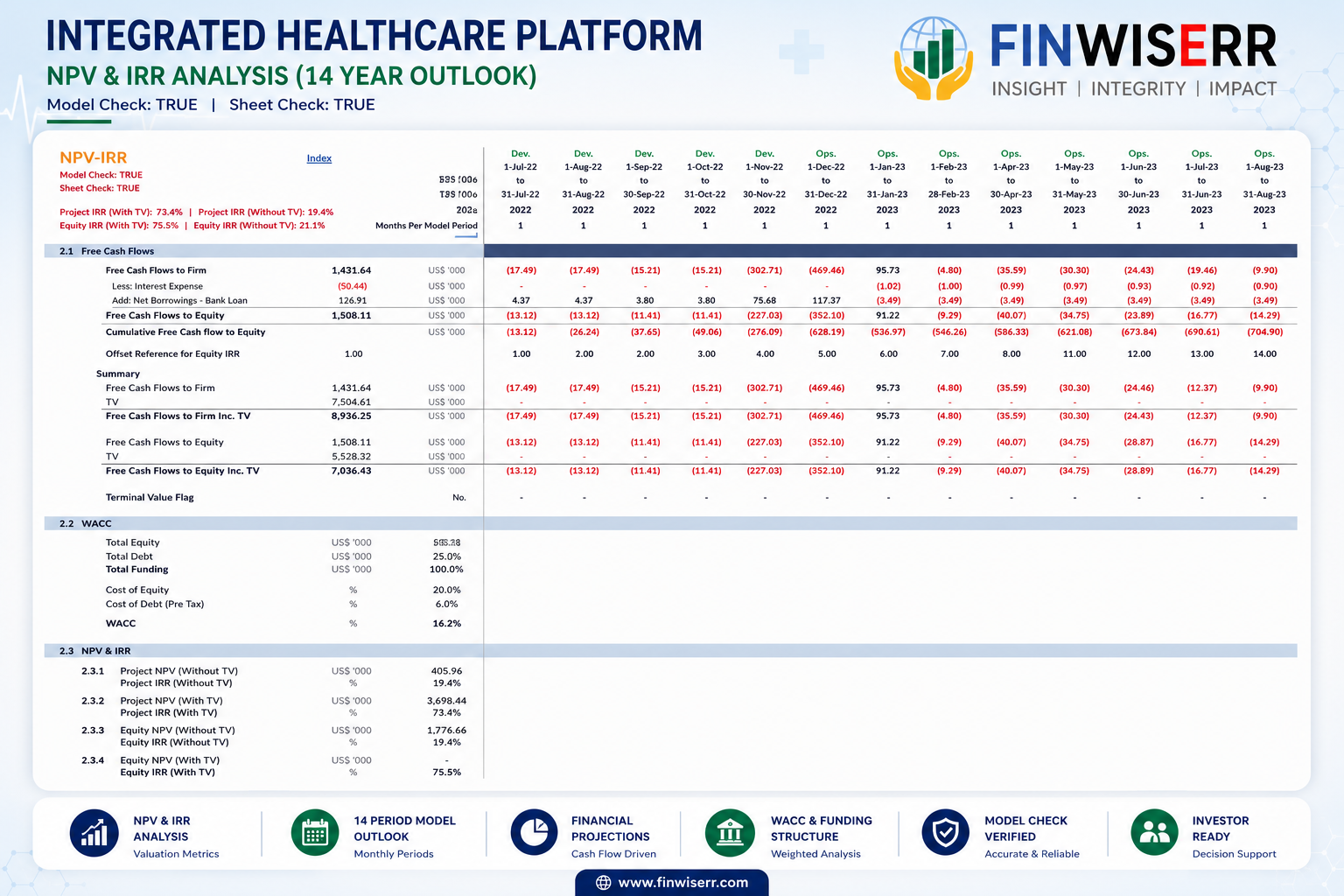
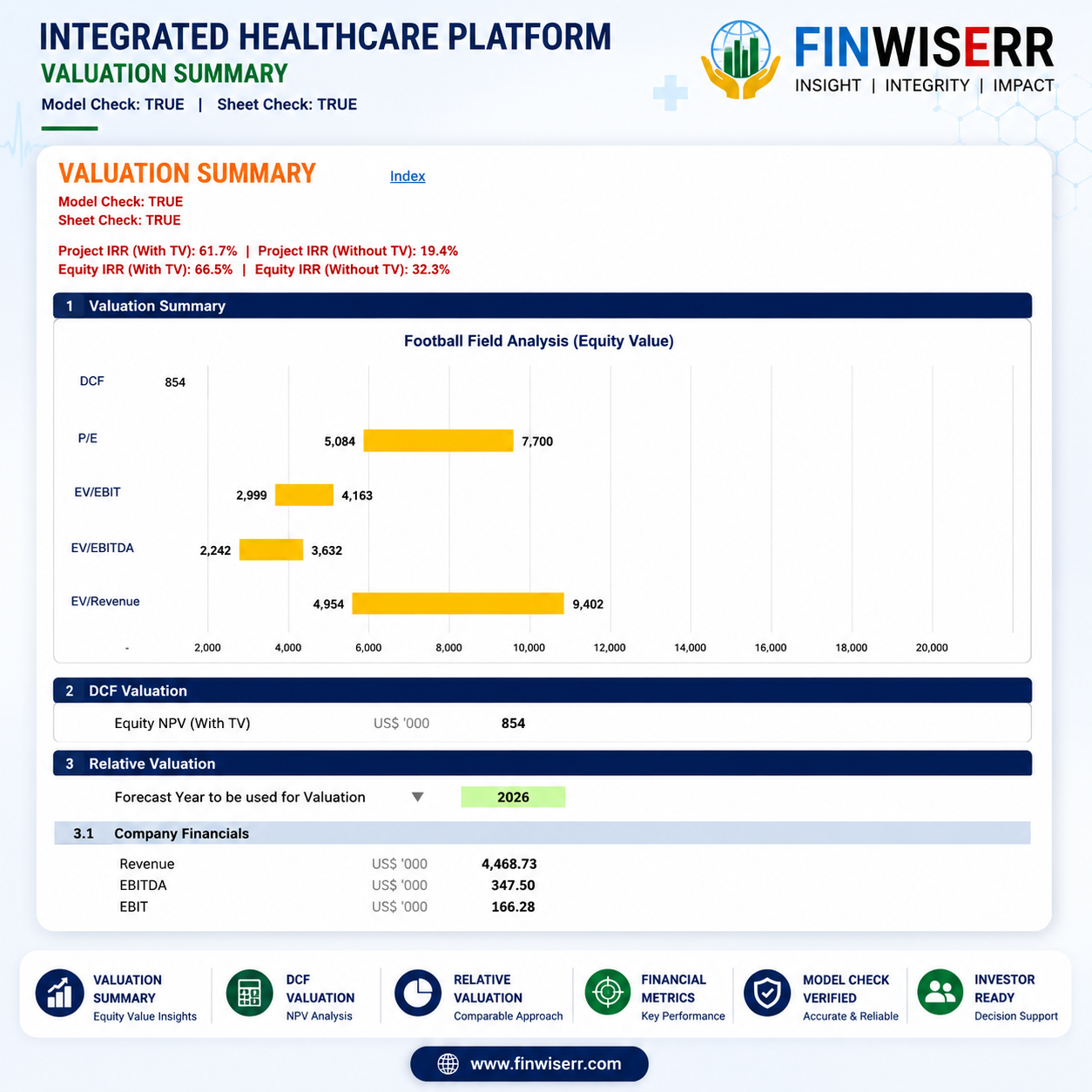
The output set is comprehensive: Project and Equity IRR and NPV (with and without terminal value), equity payback, break-even analysis, a DCF valuation and a fully linked dashboard.
The revenue engine is built on four plan tiers — daily, weekly, monthly and yearly — each with its own subscription charge and its own share of the active user base. That structure captures the reality of subscription pricing: a yearly plan trades a lower effective rate for committed, upfront revenue and better retention, while a daily plan captures casual users at a premium. Being able to model the mix, and shift it, is the heart of any subscription business.
Each plan can be activated or deactivated independently, so you can model a business that launches on monthly plans alone and adds annual commitments later, or one that runs all four from day one. The split of the active user base across tiers is yours to set and to flex across scenarios.
The model builds its user base from monthly registrations, a periodic retention rate that compounds, and an active-user percentage. For a subscription business, retention is not one metric among many — it is the metric. A plan that acquires users cheaply but loses them within two cycles will never turn a profit, and only a model that treats retention as an explicit, compounding input reveals that. Here it sits front and centre, with Base, Management and Upside cases so you can bracket the outcome honestly.
Every driver of the business is an explicit, editable input. The assumptions cover:
| User Base | Downloads and registrations per month (Base, Management, Upside), retention rate and active-user percentage |
| Subscription Plans | Daily, weekly, monthly and yearly plan charges, with the split of active users across the four tiers |
| Advertising | Sessions per month, minutes per session, ad impressions per minute and CPM |
| Kitchen Cost | Food and beverage, kitchen staff and consumables, each as a percentage of revenue |
| Fixed Costs | Management salary, technical and central-office staff, rental, office expenses, SPV cost, insurance and security |
| Platform Capex | UI/UX, native platform and app, backend, admin panel, DevOps, project management and contingency, amortised as an intangible |
| Other Capex | Kitchen equipment, other equipment and setup cost, with refresh capex at end of life |
| Financing | Debt-equity ratio, development and operations debt, term and repayment schedule |
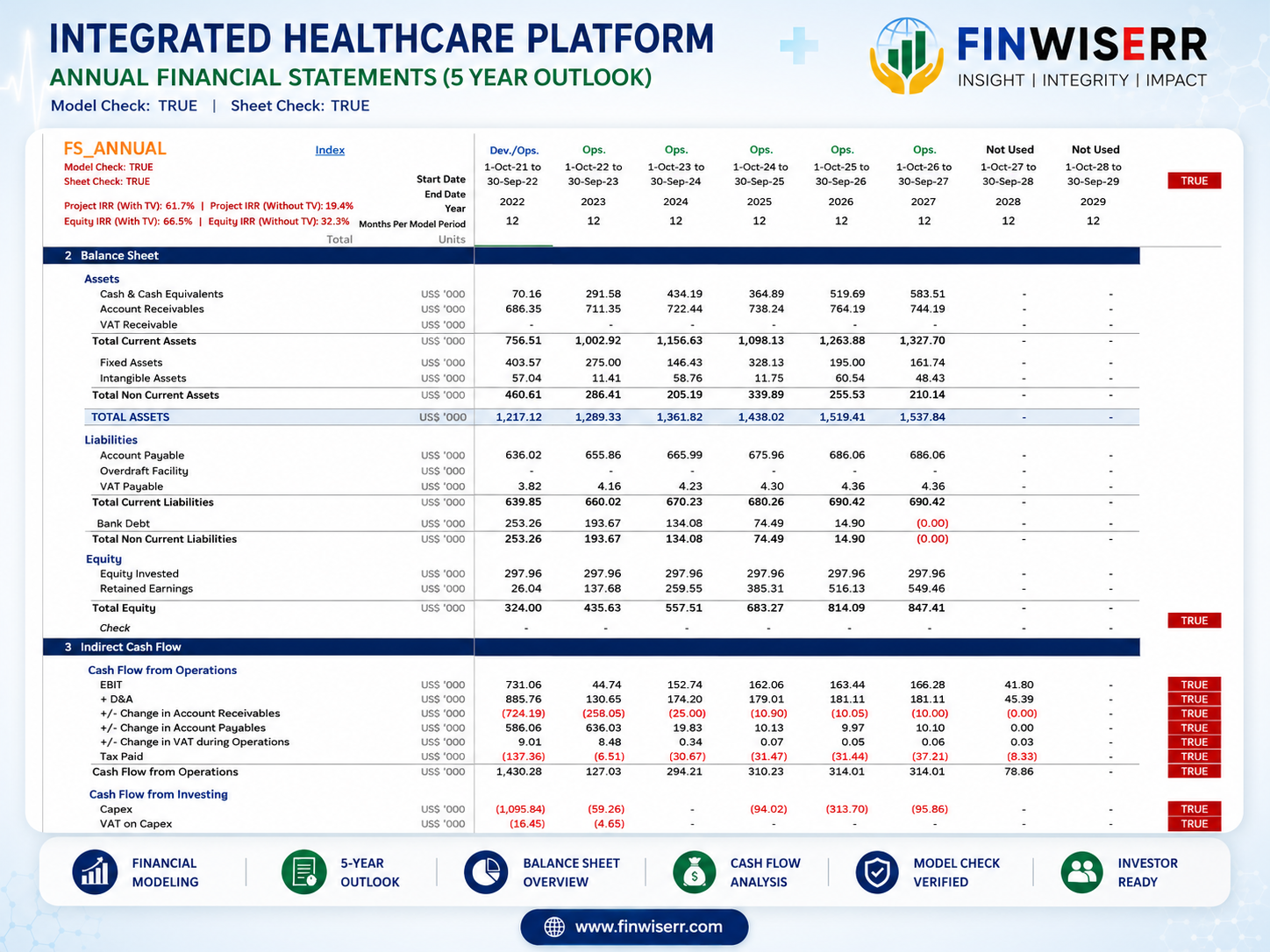
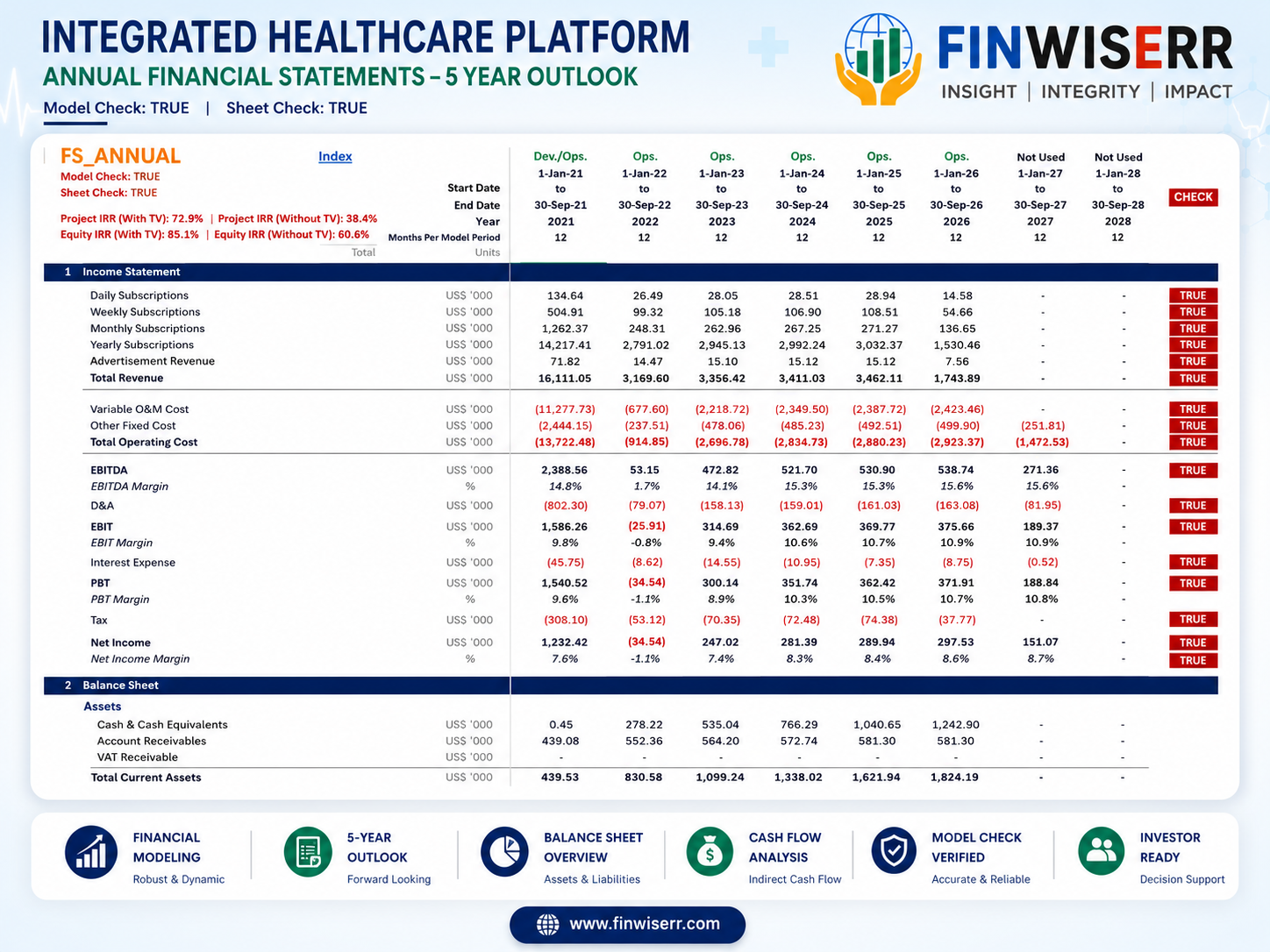
The model recognises that this business has two very different capital bases. The platform — UI/UX, native apps, backend, DevOps — is capitalised as an intangible and amortised over its useful life. The kitchen equipment is a tangible fixed asset, depreciated on its own schedule. Both carry refresh capex to fund replacement. Treating the two correctly, rather than lumping them together, is what makes the statements realistic and the valuation defensible.
A dedicated break-even analysis shows when subscription revenue overtakes the combined cost of the kitchen and the platform — the milestone every subscription investor probes. Alongside it, a full DCF valuation derives Project and Equity NPV and IRR both with and without terminal value, so you can see how much of the value rests on the long-run subscriber base versus the years in view.
The model forecasts across development and operation on a monthly basis, with financial statements on both monthly and annual views. Every revenue and cost assumption can be entered across Base, Management and Upside cases and switched at the click of a button — and because the model uses no macros, every change flows through instantly.
Daily, weekly, monthly and yearly plans, each priced and weighted separately, activate independently.
A compounding retention funnel with Base, Management and Upside cases — the metric a subscription business lives on.
Platform amortised as an intangible, kitchen equipment depreciated as a fixed asset — each treated correctly.
New to these metrics? Read an overview of internal rate of return. For a model built to your own specification, see our financial advisory services, or browse the full range of business plan Excel models.
A four-tier subscription ladder, a retention funnel, an in-house kitchen and a full valuation — five years of monthly projections, ready in Excel.