$99.00
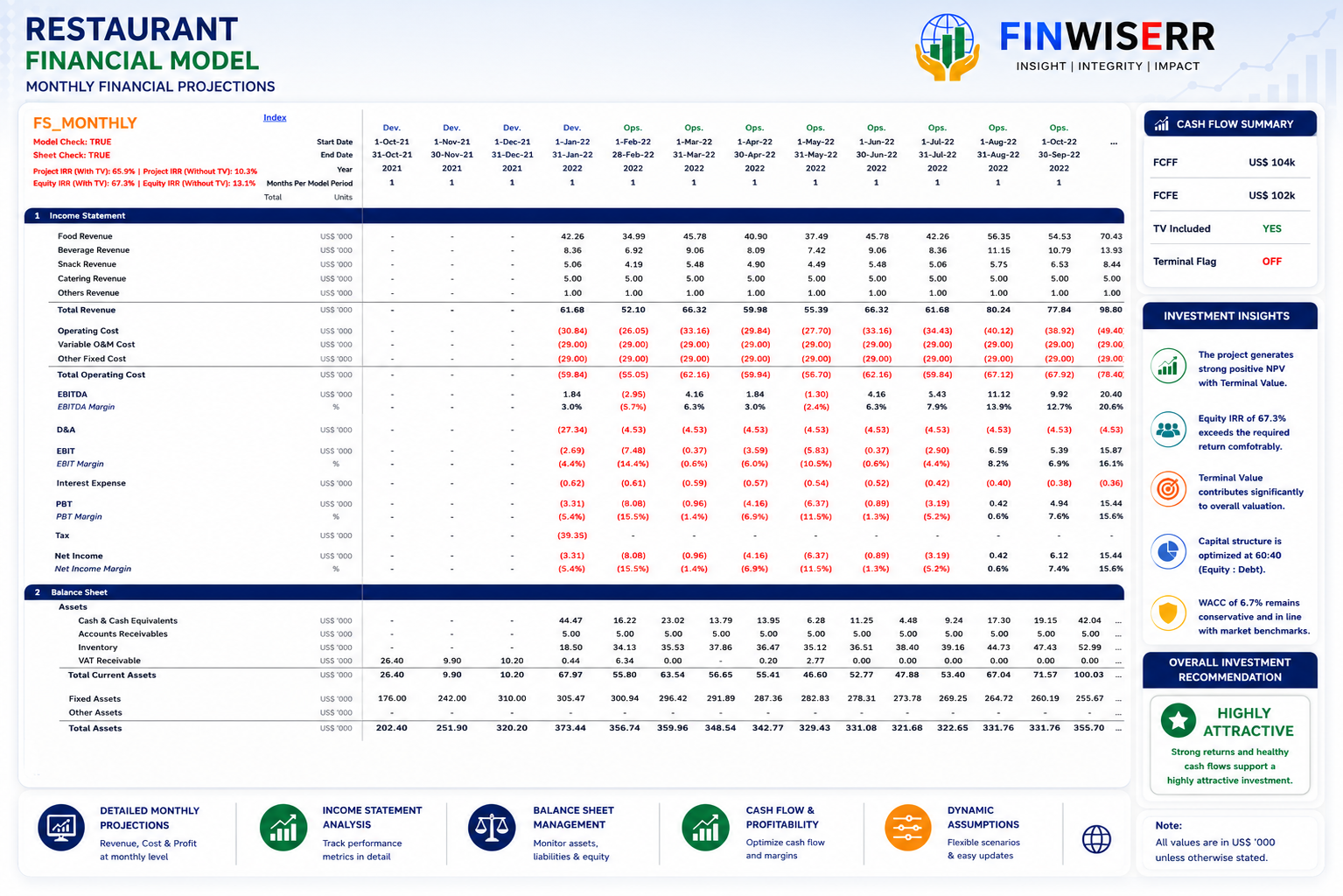
A detailed, investor-ready restaurant financial model for a dine-in restaurant — with footfall-driven revenue, multi-item customer baskets, catering income and a defined exit strategy, plus construction and operation phases, 5-year monthly projections and valuation, in one integrated Excel model.
A restaurant is a footfall business. Everything flows from how many people come through the door, how much they spend once they’re seated, and how reliably that repeats across quiet weekdays and busy weekends. Get those drivers right and the rest of the model follows; get them wrong — or bury them in a single revenue line — and no amount of cost detail will save the plan. This model puts footfall, basket and margin exactly where they belong: at the centre.
This restaurant financial model builds revenue from average daily footfall with a growth ramp, converts visitors to paying customers, and splits each customer’s spend across main course, beverage and starter — with different behaviour midweek versus weekend. Catering adds an event-driven line on top. The whole operation runs through construction and operation phases into a complete, investor-ready output set.
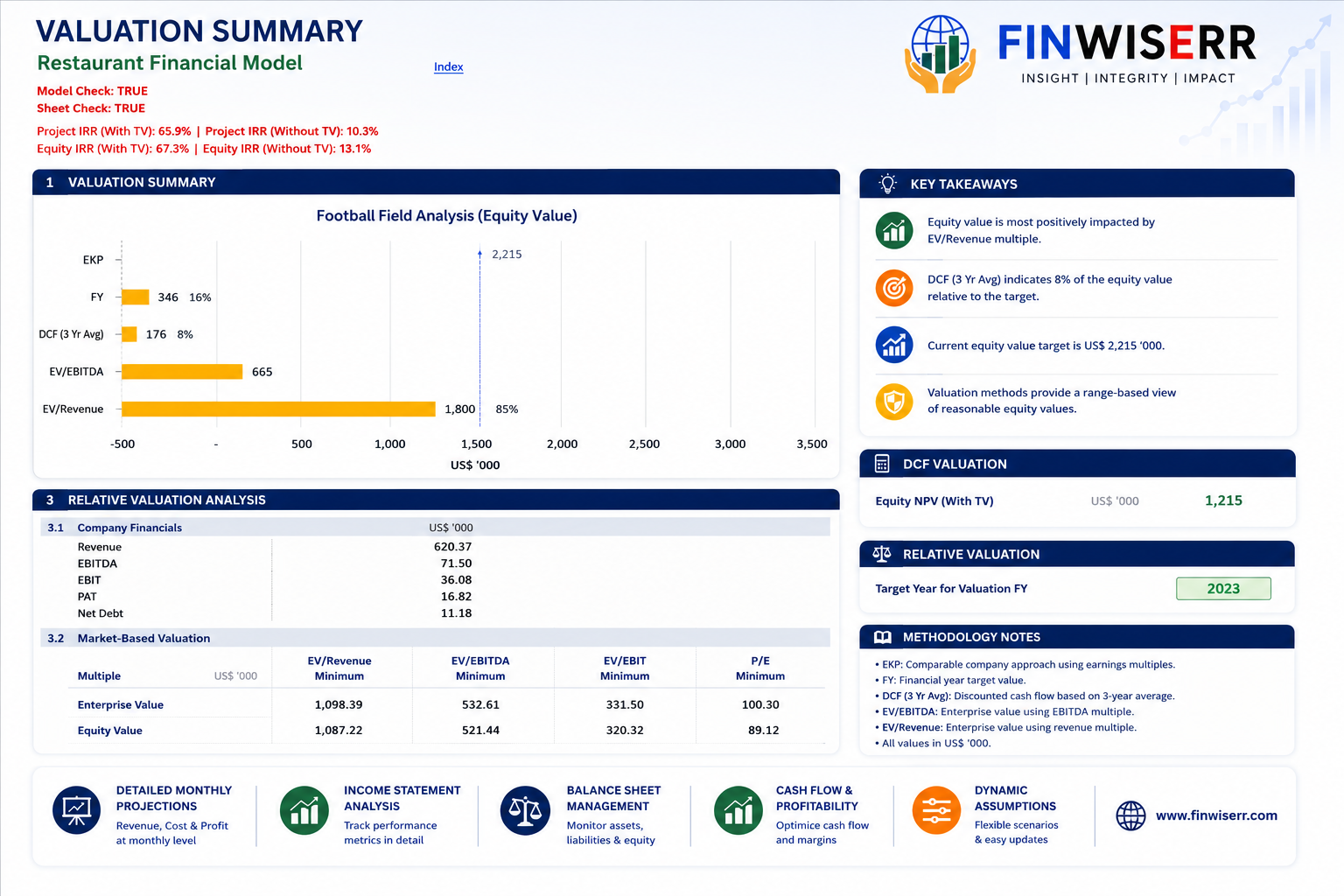
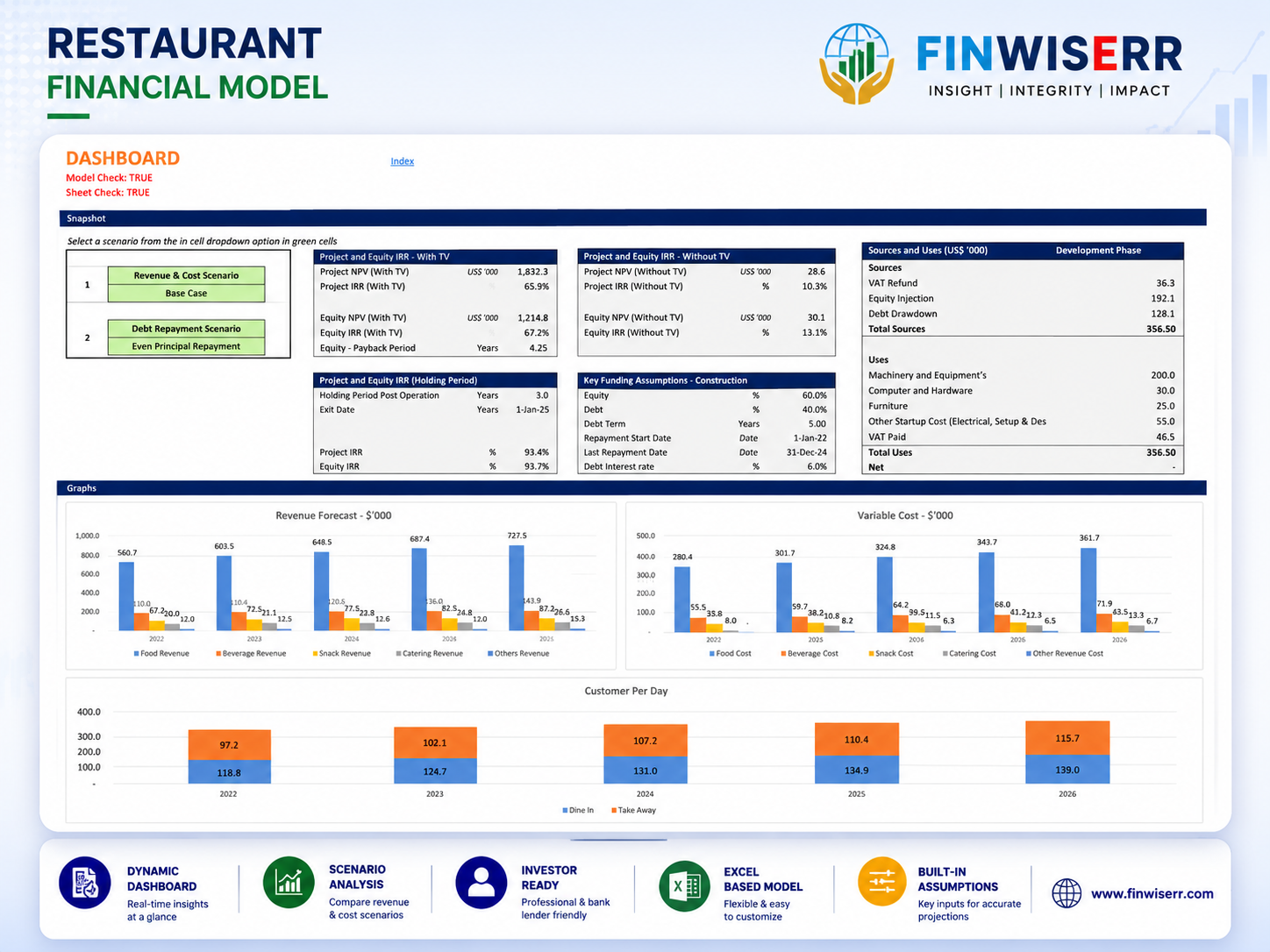
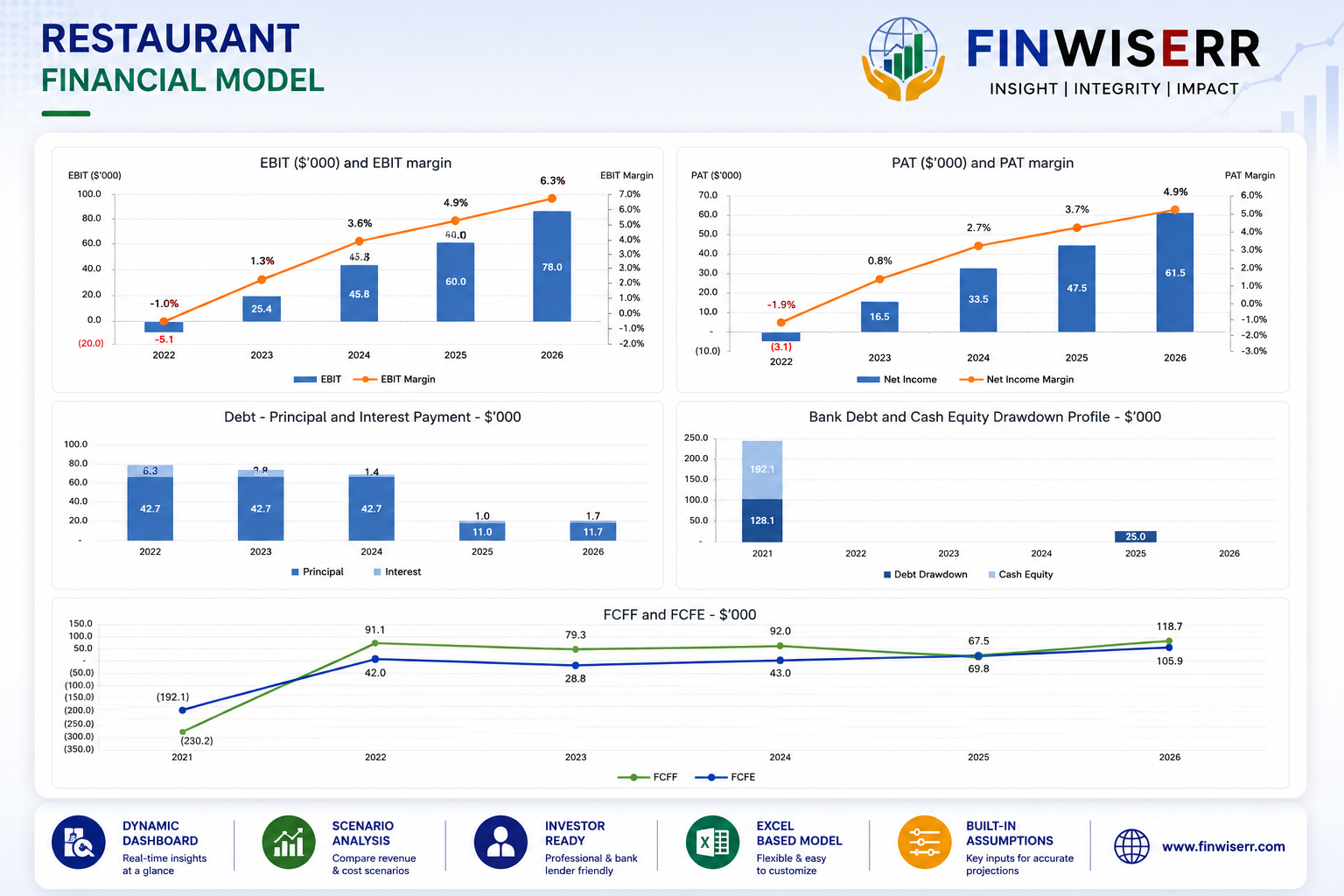
The output set is comprehensive: Project and Equity IRR and NPV (with and without terminal value), equity payback, a DCF valuation, an exit strategy and a fully linked dashboard.
Revenue starts with average daily footfall and an annual growth rate across the five operating years, converted to paying customers through a footfall-to-customer ratio. Each customer is a basket, not a single cover: main course quantity, the share adding a beverage, and starter revenue as a percentage of the rest — all modelled separately for midweek versus weekend and holiday trade, because a restaurant’s Saturday looks nothing like its Monday.
That midweek/weekend split is what makes the forecast honest. A venue that lives on weekend covers has a very different risk profile — and a very different staffing need — from one with steady weekday lunch trade, and only a model that separates them shows it.
Every driver of the business is an explicit, editable input. The assumptions cover:
| Footfall | Average daily footfall, annual growth rate over five years, and footfall-to-customer conversion |
| Basket & Pricing | Main course quantity per customer, beverage attach rate and starter share — split midweek versus weekend — with average prices |
| Catering & Other | Catering events per month and charges, plus other revenue per month |
| Variable Cost | Food, beverage, snack, catering and other-revenue cost, each as a percentage of revenue |
| Fixed Costs | Management salary, rent, staff cost, warehouse rent, SPV cost, insurance, security and licence |
| Capex | Machinery and equipment, computer and hardware, furniture and setup cost, with refresh capex at end of life |
| Financing & Exit | Debt-equity ratio, construction and operations debt, tax, holding period and exit assumptions |
The model derives a full DCF valuation — Project and Equity NPV and IRR, both with and without terminal value, so you can see how much of the value rests on the exit assumption versus the operating years themselves.
A dedicated exit strategy lets you set a holding period and model a sale of the restaurant, computing returns over the hold plus the value of cash flows beyond it. For a founder building a venue — or a group planning to prove a concept and sell it on — that exit view is exactly the analysis an investor expects to see.
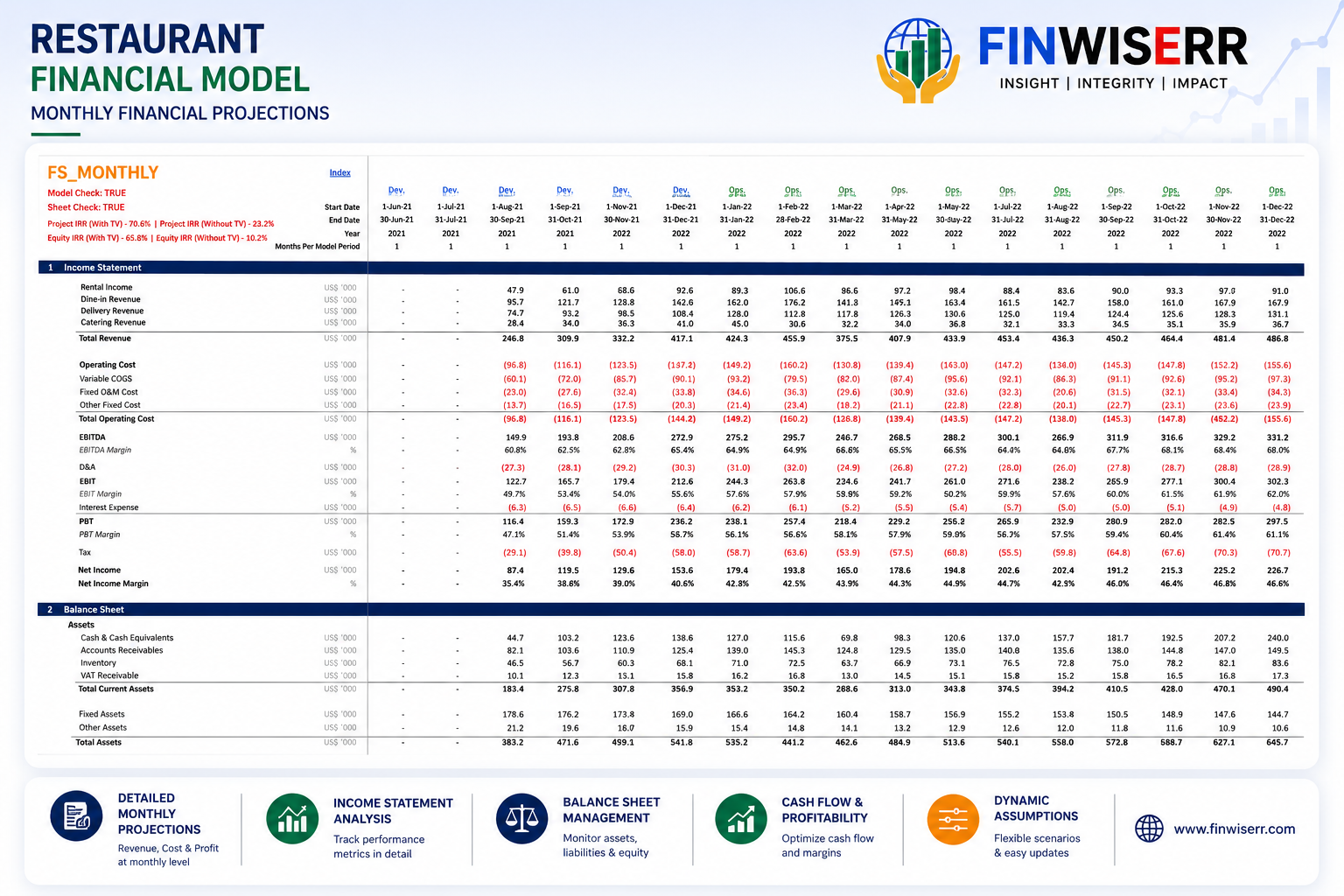
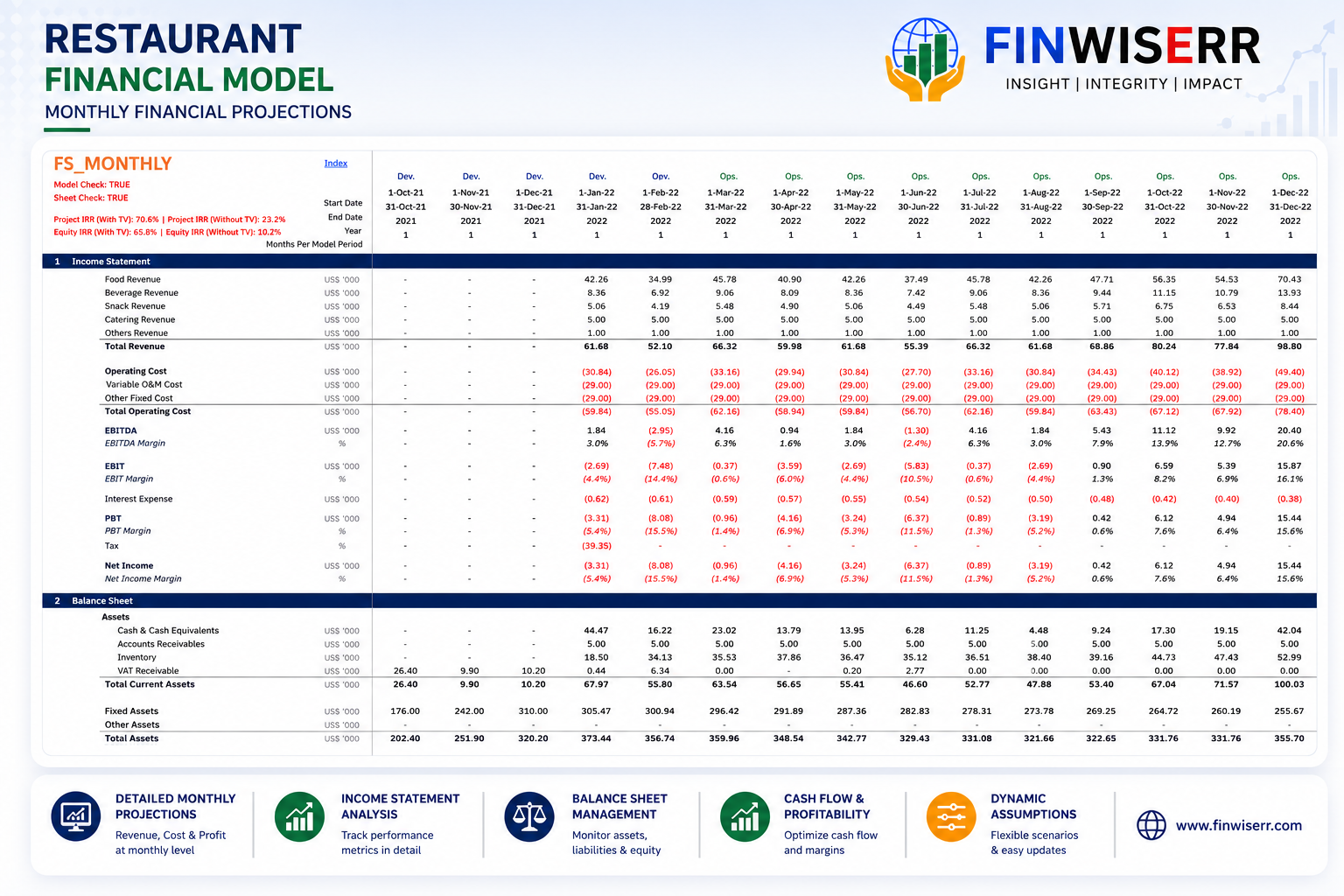
The model forecasts across construction and operation on a monthly basis, with financial statements on both monthly and annual views. Every revenue and cost assumption can be entered across three scenarios and switched at the click of a button, so a cautious footfall ramp sits beside an optimistic one — and because the model uses no macros, every change flows through instantly.
Built from daily footfall and conversion, with midweek and weekend baskets modelled separately.
Main, beverage and starter with catering on top, so average spend is built from the ground up.
A holding-period exit plus a full DCF valuation with and without terminal value.
New to these metrics? Read an overview of internal rate of return. For a model built to your own specification, see our financial advisory services, or browse the full range of business plan Excel models.
Footfall-driven revenue, multi-item baskets, catering, an exit strategy and valuation — five years of monthly projections, ready in Excel.