Most organisations don’t have an AI problem. They have an AI prioritisation problem.
AIPIF™ scores and ranks every AI opportunity on your list — so leadership knows exactly which use case to fund, pilot, or defer.
The Problem
The challenge is rarely a lack of ideas. Most organisations have the opposite problem — too many AI opportunities.
Artificial Intelligence has moved beyond experimentation and become a boardroom priority. One department wants an AI chatbot. Another wants predictive analytics. Operations teams want automation. Marketing wants personalisation. Finance wants forecasting. Leadership wants transformation.
The question is no longer whether AI can create value. The real question is:
“Which AI initiatives should be pursued first?”
That is precisely why we developed AIPIF™ — the AI Prioritisation & Investment Framework.
What It Is
What is AIPIF™?
AIPIF™ is Stage 2 of the AIDEX™ suite. It takes the output of AIRDIF™ — your AI readiness assessment — and transforms it into a structured prioritisation engine.
After completing AIRDIF™, organisations typically identify 15–20 possible AI opportunities. AIPIF™ scores and ranks each one across six strategic dimensions, so leadership knows exactly which use case to fund, pilot, or defer.
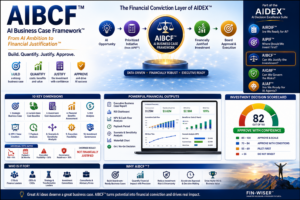
Deliberately positioned before financial justification. AIPIF™’s job is to identify which use cases deserve a full business case — not to build that case. Detailed financial modelling (ROI, NPV, payback, cost-benefit analysis) happens in AIBCF™, Stage 3 of AIDEX™.
The framework helps leaders answer:
- Which opportunities offer the highest strategic value?
- Which projects align best with priorities?
- Which initiatives are technically feasible?
- Which opportunities carry lower risk?
- Which use cases deserve a full business case?
Why Prioritisation Matters
Many AI programmes fail before they begin
Not because the technology is inadequate. Not because the business lacks ambition. But because organisations invest in the wrong projects. Gartner’s research on AI project prioritisation makes a similar point: without a structured funnel, teams stay stuck evaluating hundreds of ideas instead of shipping the handful that move the needle.
Common pitfalls include:
- Pursuing low-impact use cases
- Technically impressive, commercially weak ideas
- Underestimating implementation complexity
- Ignoring data limitations
- Overlooking organisational readiness
- Rushing to financial modelling too early
AIPIF™ helps avoid these pitfalls by introducing structure, discipline, and objective decision-making before budget is committed.
The Framework
The six core dimensions of AIPIF™
AIPIF™ evaluates each AI opportunity across six weighted dimensions. Each is scored on a 1–5 scale across eight evidence-based questions, producing a weighted Priority Score that drives the investment ranking.
Strategic Value
Does this initiative support top strategic priorities and create defensible advantage? The highest-weighted dimension, because strategic misalignment is the most common cause of AI investment failure.
Implementation Ease
Technical complexity, integration requirements, resource availability, 90-day pilot feasibility, change management burden, and clarity of the implementation roadmap.
Data Readiness Fit
Anchored to your actual AIRDIF™ Data Readiness score, so prioritisation reflects real readiness — not aspirational data quality.
Time to Value
Whether the first measurable outcome lands within 6 months, suitability for iterative deployment, speed from pilot to production, and independence from other initiatives.
Risk Profile
Regulatory exposure, reputational impact of an AI error, human override mechanisms, bias considerations, and organisational preparedness for incidents.
Scalability Potential
Can this use case expand to other business units or geographies, generate reusable AI capability, and compound in value as more data becomes available?
A note on Financial Return: it’s intentionally excluded as a scored dimension. AIPIF™ is a prioritisation framework, not a financial justification tool — detailed ROI, NPV, and payback modelling happens downstream in AIBCF™. Taking every opportunity straight to financial modelling is expensive; AIPIF™ ensures only the right ones get there.
The Methodology
From opportunities to priorities in five steps
Complete AIRDIF™
Import your AI readiness scores into the AIPIF™ model — they directly inform the Data Readiness Fit dimension and provide context across all six scoring sheets.
Register use cases
List all AI opportunities identified during AIRDIF™ (typically 15–20). Assign each to a business function and a dedicated scoring tab (UC-01 through UC-10).
Score each use case
Answer 48 evidence-based questions per use case (8 questions × 6 dimensions) on a 1–5 scale, with notes and supporting evidence.
Review the Priority Ranking Dashboard
The DASHBOARD tab auto-calculates weighted Priority Scores and assigns each use case to one of five investment tiers.
Proceed to AIBCF™
Tier 1 and Tier 2 use cases are handed off to AIBCF™ (Stage 3) for full financial justification, ROI modelling, and board-level business case development.
The Outcome
The five investment tiers
Each use case is automatically classified based on its weighted Priority Score:
Immediate Investment. Proceed to AIBCF™ business case and board approval.
Priority Pilot. Commission a 90-day pilot and develop the AIBCF™ model in parallel.
Conditional. Address identified gaps, then re-score before proceeding.
Deferred. Revisit in 6–12 months. Do not commission financial modelling yet.
Rejected. Do not invest. Redirect resources to foundational capability building.
Key Outputs
What AIPIF™ produces
- AI Opportunity Priority Ranking Dashboard
- Weighted Investment Priority Scores per use case
- 5-Tier Investment Classification for all use cases
- Dimension-level diagnostic scores highlighting gaps
- AIRDIF™-linked Data Readiness context per use case
- Clear AIBCF™ hand-off list (Tier 1 & 2 use cases)
Who It’s For
Built for anyone evaluating multiple AI opportunities
Why AIPIF™ Matters
Successful AI transformation does not begin with financial modelling. It begins with prioritisation.
AI investment decisions are becoming increasingly important and increasingly expensive. Organisations cannot afford to pursue every opportunity, nor can they afford to ignore the ones that create meaningful value — and they cannot afford to take every idea straight to a financial model, wasting consultant time and leadership attention on use cases that should have been filtered out at the strategy stage.
AIPIF™ provides the discipline to prioritise intelligently, allocate resources to the right use cases, and ensure only the strongest opportunities reach AIBCF™ for financial justification.
Part of the AIDEX™ Suite
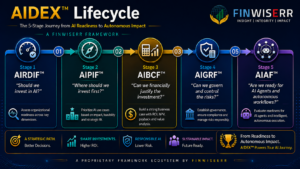
AIPIF™ is Stage 2 of AIDEX™
Together, these frameworks help organisations move from AI readiness to autonomous impact.
AIPIF™ · Identify. Score. Rank. Prioritise.
Stage 2 of the AIDEX™ lifecycle — turning a long list of AI ideas into a short list worth funding.
Get Started
Turn 20 AI ideas into a ranked shortlist
Get the AIPIF™ scoring model and Priority Ranking Dashboard, and know exactly which AI opportunities deserve a business case.