$120.00
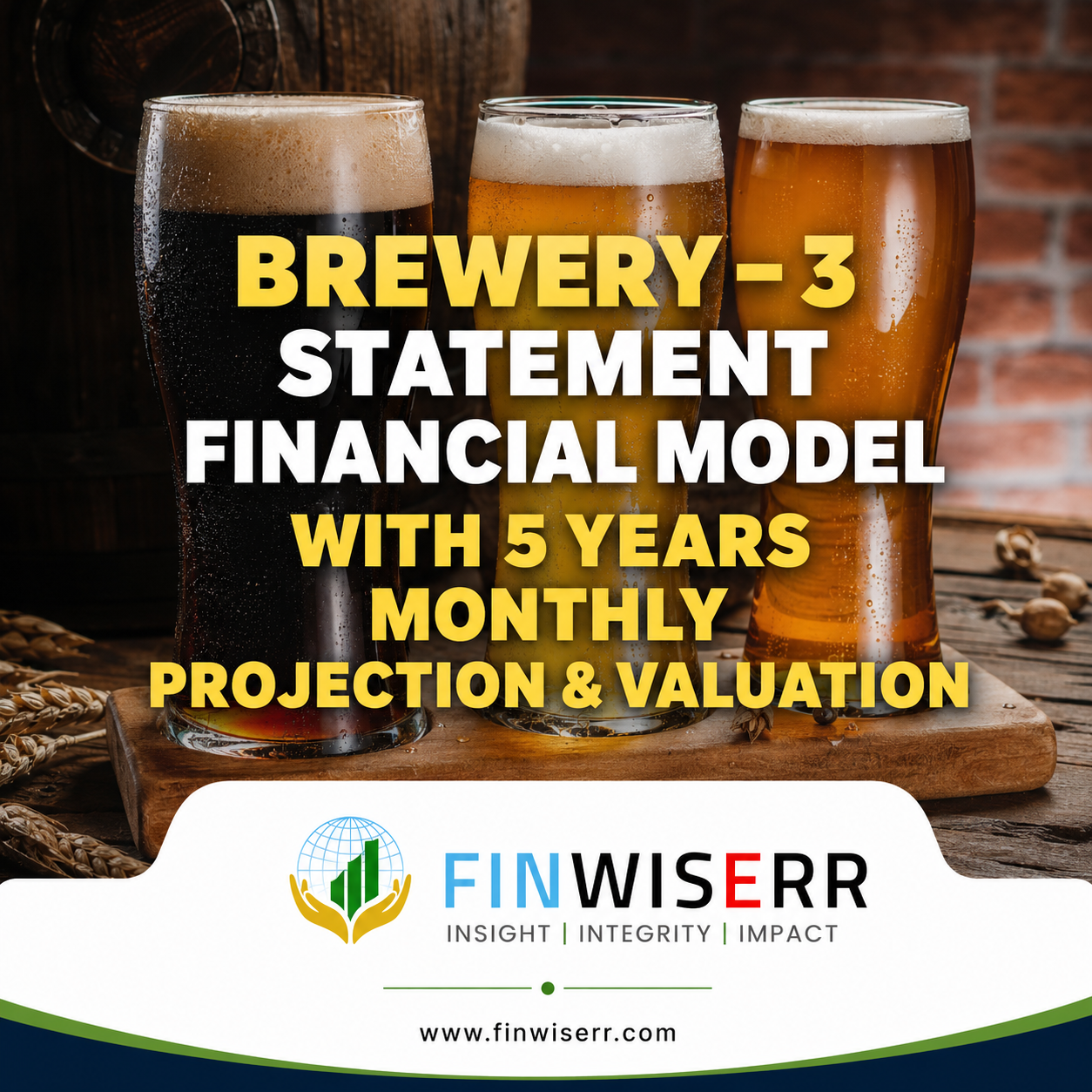
A detailed, investor-ready brewery financial model for a craft brewery and taproom — with barrel-based production capacity, wholesale and retail sales channels, and taproom food and membership revenue, plus construction and operation phases, an exit strategy and both DCF and comparable-company valuation, in one integrated Excel model.
A brewery is a manufacturing business, a wholesale business and a hospitality business rolled into one — and the three earn in completely different ways. Beer is brewed by the barrel and sold by the keg, case and pint. Some goes to wholesale accounts at one margin; the rest is poured in your own taproom at another. And the taproom itself adds food and membership income that has nothing to do with how much you brew. Model all of that as a single revenue line and you learn nothing useful about where the business actually makes money.
This brewery financial model is built to hold every part of it. Production runs off barrel capacity with full unit conversion, sales split between wholesale and retail, and the taproom’s food and membership revenue sit as their own streams. The whole operation flows through construction and operation phases into a complete, investor-ready output set.
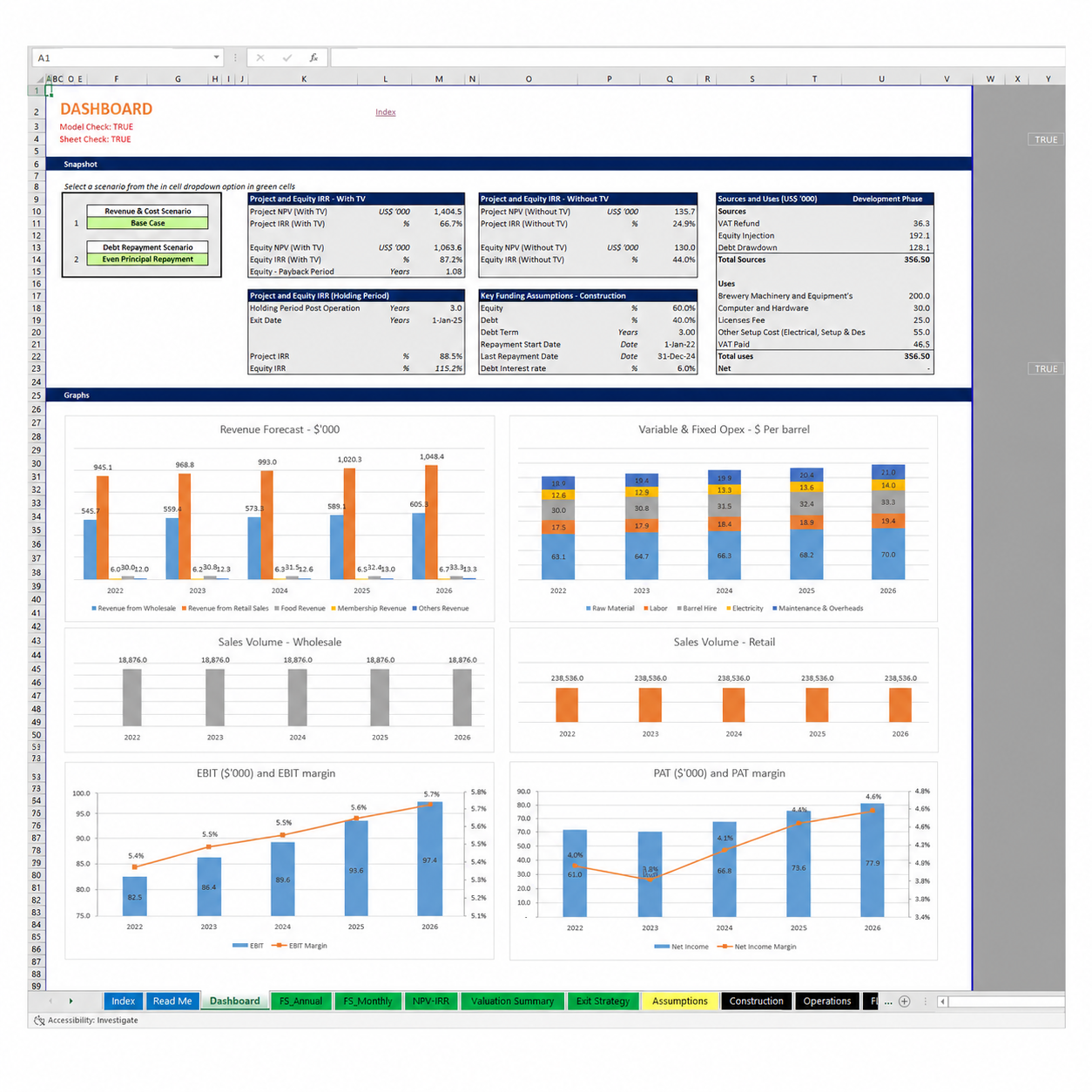
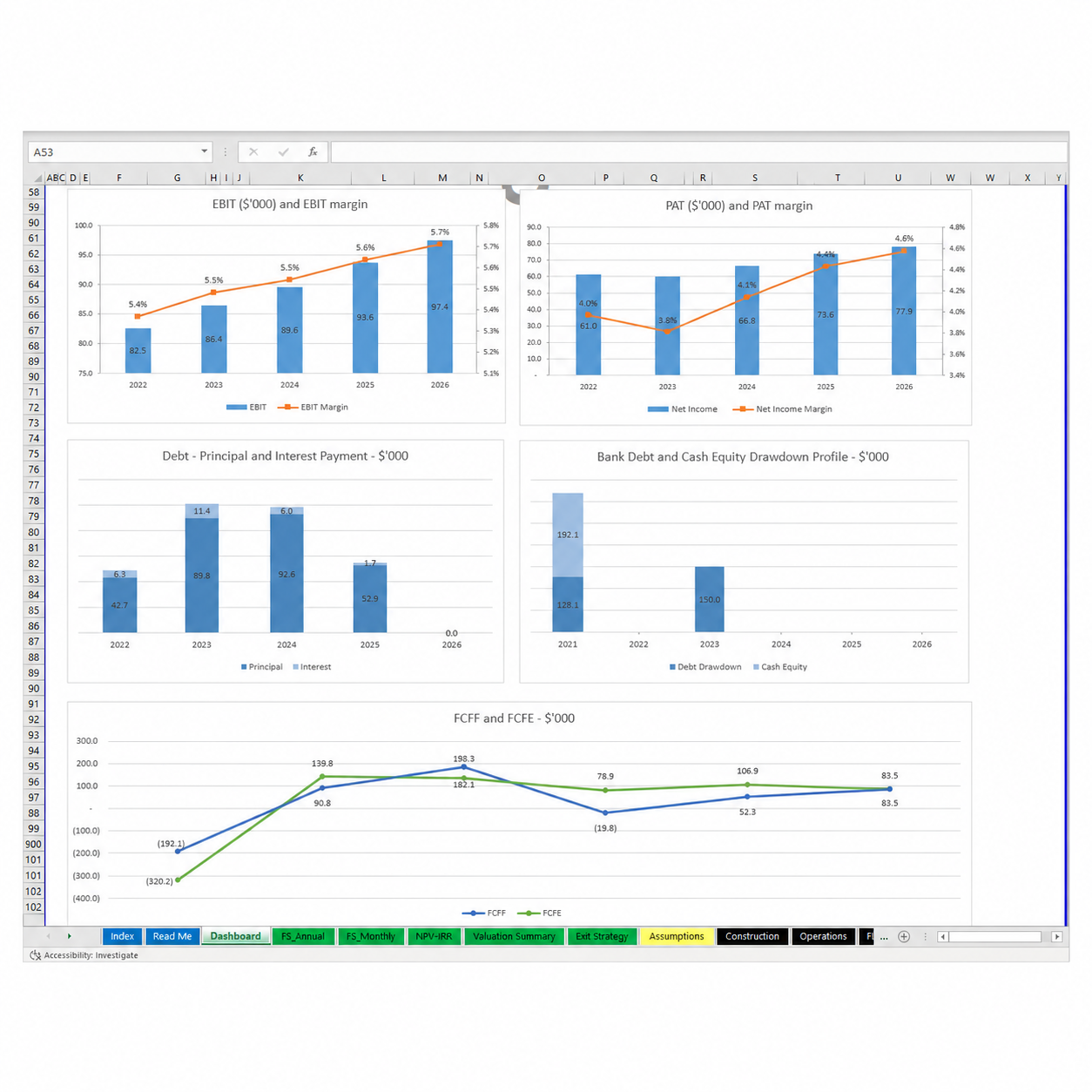
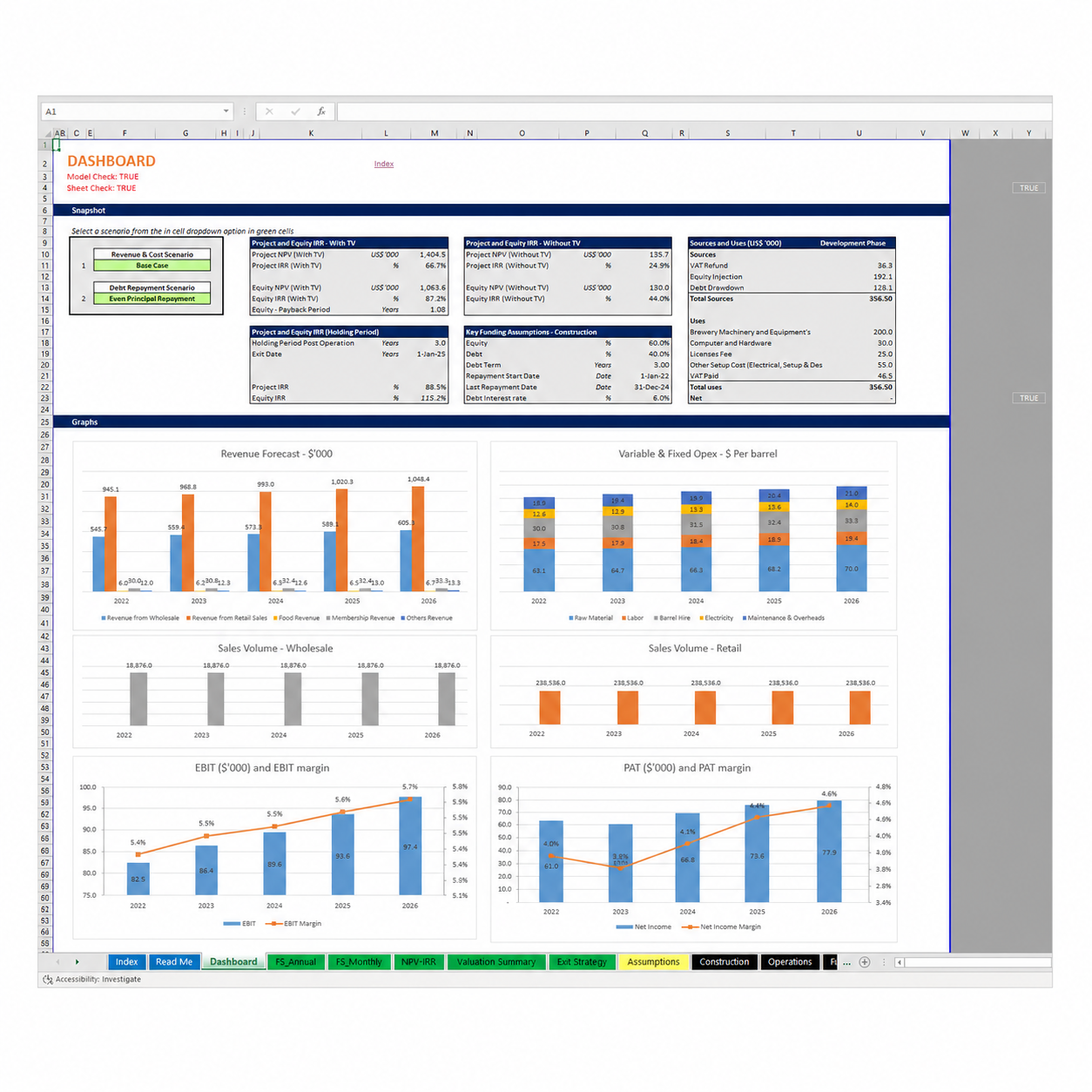
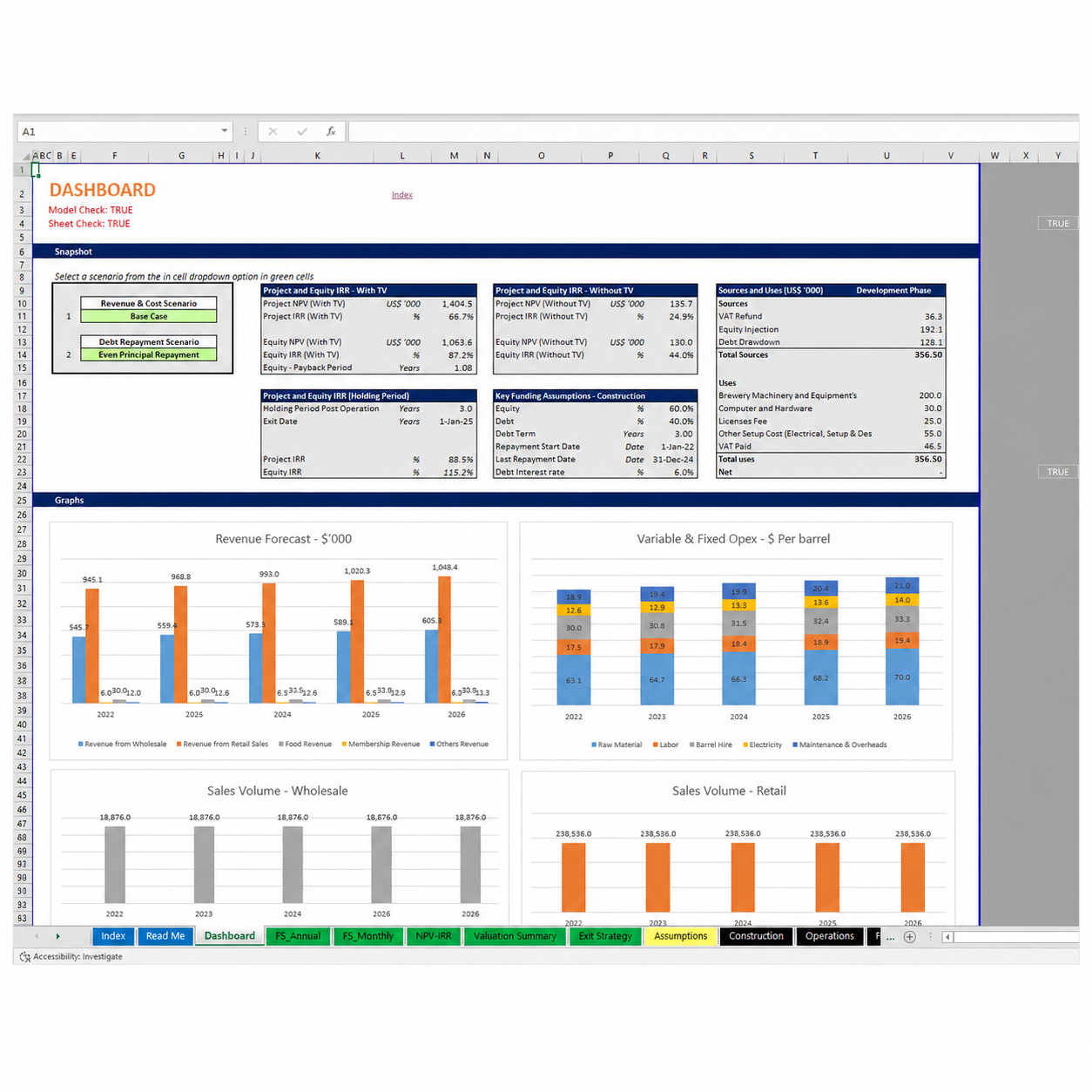
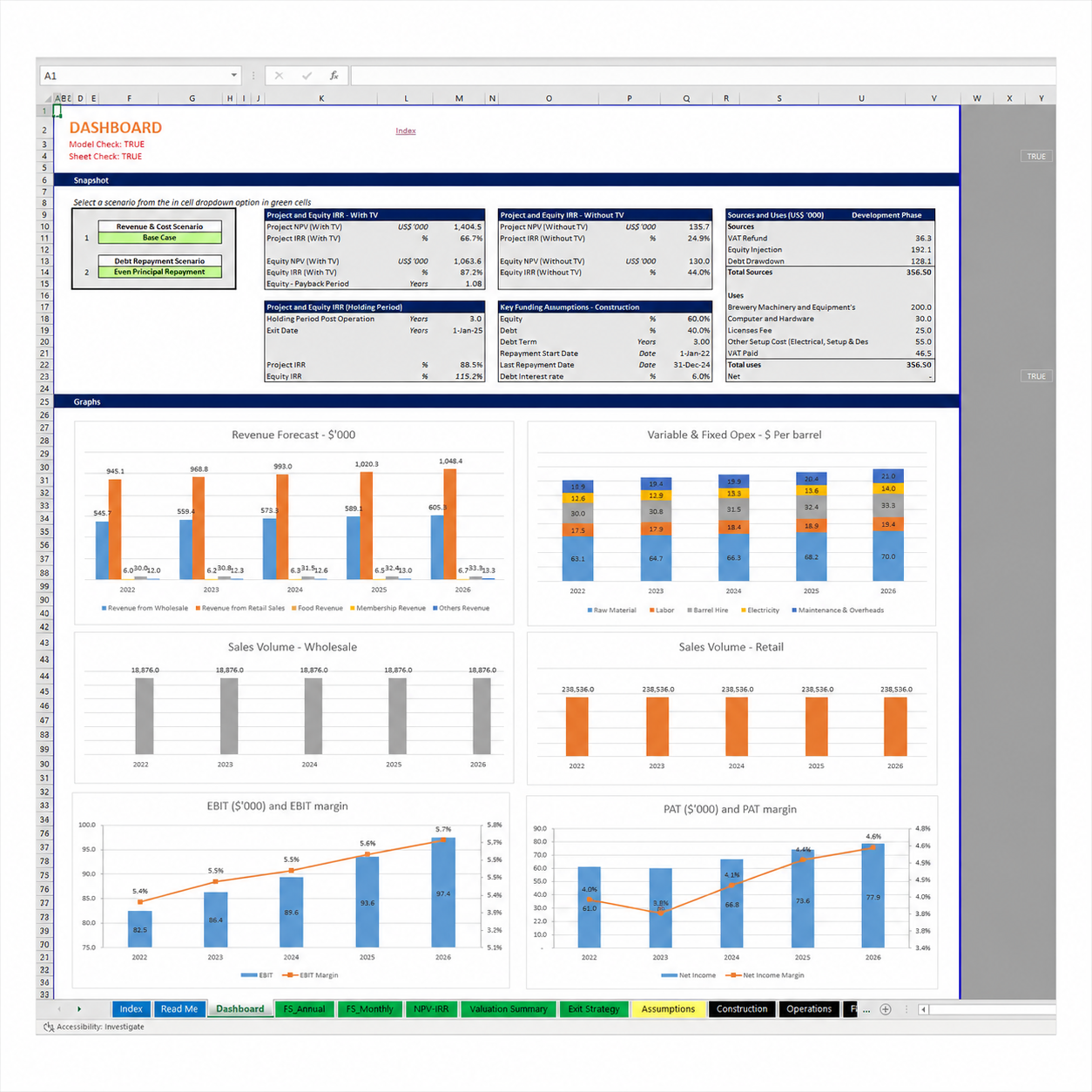
The output set is comprehensive: Project and Equity IRR and NPV (with and without terminal value), equity payback, a DCF valuation, a comparable-company valuation, an exit strategy and a fully linked dashboard.
Production is built from brewing capacity in barrels, with a full set of conversion factors — kegs, cases, pints, gallons and litres per barrel — so you enter capacity once and the model tracks it through every unit the beer is actually sold in. Capacity utilisation drives how much of that potential you realise, ramping as the brewery finds its market.
Sales then split between wholesale — sold by the barrel and case to accounts — and retail, poured by the pint in your taproom. Because the two carry very different prices and margins, modelling them apart is what shows you whether your next barrel is better sold to a distributor or over your own bar.
Beyond beer, the model captures the two revenue streams that turn a brewery into a destination. Food revenue is driven by guests per month and average spend per head, with food cost as a percentage of that revenue. Membership revenue builds from members added each month against a membership fee — the recurring, high-margin income that a loyal taproom crowd provides. For many modern craft breweries, these two lines are the difference between surviving on wholesale margins and thriving.
Every driver of the business is an explicit, editable input. The assumptions cover:
| Capacity & Conversion | Brewing capacity in barrels, with conversion to kegs, cases, pints, gallons and litres |
| Sales & Channel Split | Capacity utilisation and the split between wholesale and retail sales |
| Beer Revenue | Wholesale sales price per barrel/case and retail price per pint, each indexed |
| Taproom Revenue | Guests per month and average food bill; members added per month and membership fee; other revenue |
| Variable O&M | Per-barrel raw material, labour, barrel hire, electricity and maintenance; food cost as a percentage of food revenue |
| Fixed Costs | Management salary, office and warehouse rent, SPV cost, insurance, security and licence |
| Capex | Brewery machinery — mashing tuns and kettles, distribution tanks, lauter tuns and fermenters — with refresh capex at end of life |
| Financing & Exit | Debt-equity ratio, construction and operations debt, tax holiday, holding period and EV/Revenue comparables |
The model values the brewery two ways. A DCF valuation captures intrinsic value from the forecast cash flows, with and without terminal value. Alongside it, a relative valuation benchmarks the business against listed peers on an EV/Revenue multiple — so you can present a defensible range rather than a single figure.
A dedicated exit strategy lets you set a holding period and model a sale, computing returns over the hold plus the value of cash flows beyond it. For a founder building a brewery with an eventual trade sale in mind, that exit view is exactly the analysis an investor will want to see.
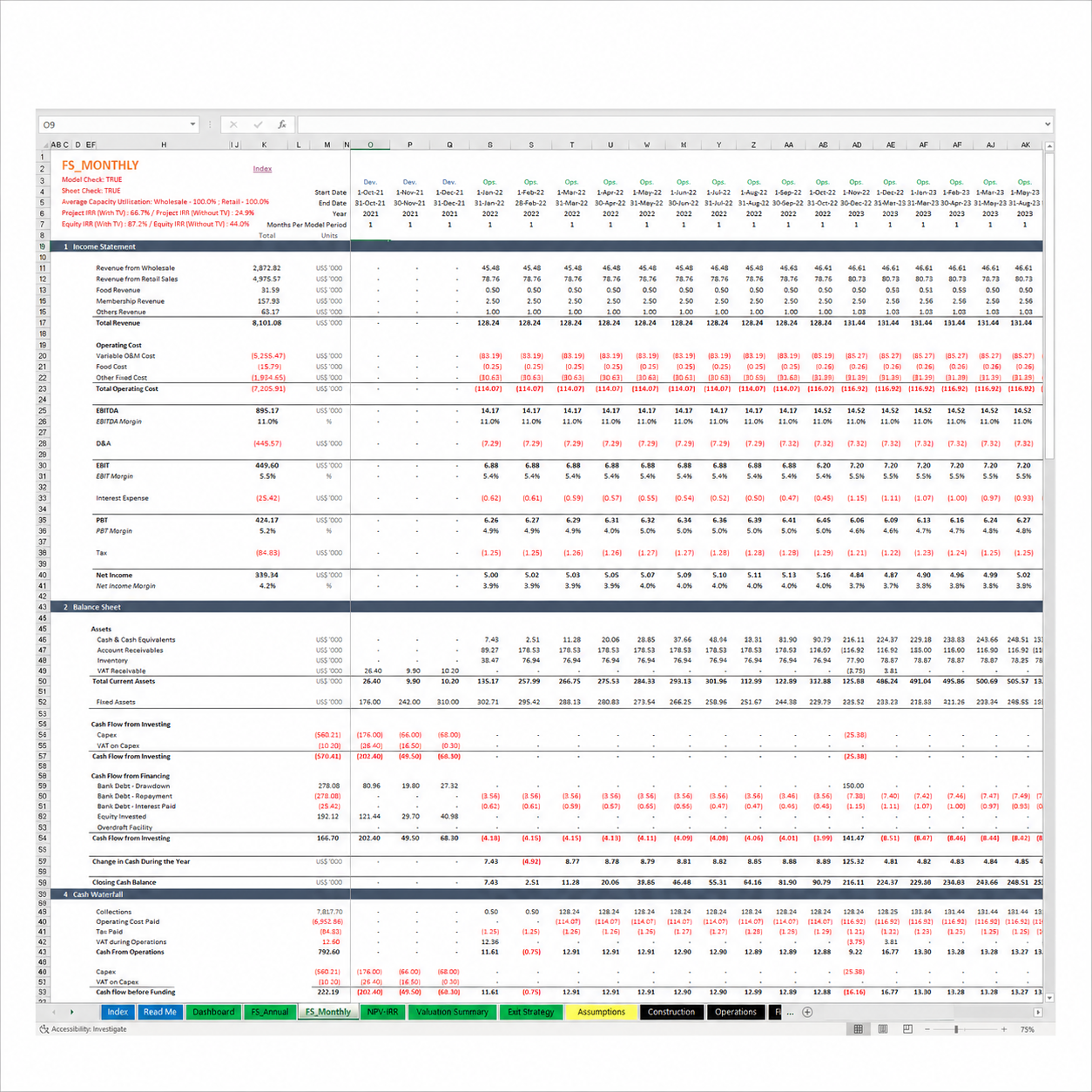
The model forecasts across construction and operation on a monthly basis, with financial statements on both monthly and annual views. Every revenue and cost assumption can be entered across three scenarios and switched at the click of a button, so a cautious utilisation ramp sits beside an ambitious one — and because the model uses no macros, every change flows through instantly.
Enter capacity in barrels; the model tracks kegs, cases and pints, so wholesale and retail are both modelled correctly.
Food and membership income modelled separately from beer — the streams that make a modern brewery work.
A holding-period exit plus DCF and comparable valuation, for founders building toward a sale.
New to these metrics? Read an overview of internal rate of return. For a model built to your own specification, see our financial advisory services, or browse the full range of business plan Excel models.
Barrel-based production, wholesale and retail, taproom food and membership, an exit strategy and dual valuation — five years of monthly projections, ready in Excel.